As Korea’s medical device market grows, foreign companies profit most from such expansion, said Professor Sun Kyong of Kyung Hee University during a forum at the National Assembly Monday.


Although the Korean medical device market grows rapidly, foreign companies, not domestic firms, take substantive profits, an expert pointed out Monday.


Sun Kyung, a special professor at Kyung Hee University, said so during a forum to discuss the innovative growth of medical equipment at the National Assembly. “The domestic medical device market and the domestic businesses should grow together,” Sun said.


Explaining major policies pushed by the Ministry of Food and Drug Safety to develop the Korean medical device industry, Sun noted that the government pushes to make the bio-industry a second growth engine following semiconductors.


“The incumbent government puts particular emphasis on medical devices. For the industry to become the next growth engine, it should earn money,” the professor said. “However, only the domestic market grows without the corresponding growth of domestic makers, indicating it has a structure where foreign companies reap profits.”


Noting that the government has a very optimistic scenario about the healthcare industry, including medical devices, Professor Sun pointed out there could be a pessimistic future, too, expressing concerns about the health divide caused by different income and educational levels, regions, and social classes.


“Worldwide, cooperation between medical professionals and engineers is regarded very important in the medical equipment sector,” he said. “However, foreign companies take the lead in most cases. From now on, I hope to see more examples of Korean companies making global hit products and the whole world using them.”


Ra Gun-ho, director of Naver Healthcare Research Institute, said if the government eases regulations a little, Korean companies will lead the global medical equipment industry at the same forum.


Industry executives share the concern.


“The biggest domain of the medical equipment industry is healthcare service. So, for instance, the global sensation of ChatGPT also has a great possibility of application to healthcare,” said Ra Gun-ho, director of Naver Healthcare Research Institute. “We have the experience of grafting our meeting minute preparation program, ‘Clover Note,’ to a nursing record transfer program. As a result of using the program at Sun Chun Hyang University Hospital, it showed a 98 percent precision rate.”


Ra explained that as recently as in early 2021, it took 15,000 hours to make a nursing record transfer program. However, thanks to the sophistication of machine learning technology, they could turn the program into voice data in 300 hours.


“Even more interestingly, the nursing program was made by oncology department wards, but it saved the efforts of other departments, such as neurological or cardiothoracic departments, to make separate nursing programs,” he added.


Pointing out that in domestic healthcare, current artificial intelligence technology can solve medical practices where Korean and English are mixed, he said the technology is improving so well that local governments are using it in dementia relief centers.


However, Ra expressed concerns about protecting domestic companies in the service sector, including the medical device industry, in the future.


“Few countries worldwide have their search engines,” Ra said. “If the government opens the way a little wider in terms of regulation, the Korean medical device and artificial intelligence industries will lead the world.”
OLATHE, Kansas — It’s a typical Thursday evening in the Hoffman house.
The family hangs out in the living room for a small dance party. Then one of the kids reads a book to 18-month-old Miles.
Neil and Abby Hoffman make sure Miles, who has chronic lung disease and cerebral palsy, joins in with his three siblings while sitting in his positioning chair.
“He has some vision problems,” Neil Hoffman said. “He eats through a G tube (a gastrostomy tube used to deliver food and medication directly to the stomach), has a tracheostomy tube in his throat. (He’s) ventilator dependent. So he’s basically on life support. But he’s doing really well. He’s fighting through it all.”
The coat closet in the front hallway is filled with Miles’ medical supplies. He sleeps in the dining room.
“It’s just too hard to take him up and down the stairs,” Abby Hoffman said.
What their son really needs now is a standing frame to learn how to stand and build leg muscle. With that, Miles might walk one day.
But insurance won’t pay. Miles is covered by overlapping plans — his parents’ Blue Cross Blue Shield of Kansas City policy and a second one managed by Aetna from the Kansas Medicare program, KanCare.
Blue Cross says it doesn’t cover standing frames. That passes the buck to Aetna.
Aetna might pay the $5-6,000 cost for a standing frame. But only after Blue Cross puts its denial in writing. Blue Cross won’t. And that leaves Miles in limbo.
“It’d be nice if they just talk to each other and say, ‘Hey, we’re not going to cover this, so will you?’”
Families across Kansas find themselves in similar bureaucratic dead zones, unable to get critical medical devices. The denials can spoil chances to develop at home, at school and into productive adults. And in some cases, like Miles, that first step.
Doctors, therapists and advocacy groups say the denials of prescriptions for medical equipment come too often and appear to violate at least the spirit of federal law.
The Kansas Department of Health and Environment did not respond to questions about chronic delays and denials for physician-prescribed devices by KanCare insurance companies.
Instead, in an emailed statement, KDHE said it is working to get lawmakers to address low Medicaid reimbursement rates.
“The Medicaid program needs the Legislature’s approval to increase rates to the levels our providers are asking for,” the agency said.
Wait Times
Carlos Moreno
/
KCUR 89.3
The Hoffmans’ entryway coat closet has been repurposed to hold Mile’s medical supplies.
Carrie Grosdidier, an early childhood intervention occupational therapist who works with the Hoffmans, said the absence of that standing frame could have profound consequences for Miles.
“That’s impacting his ability to move forward with his outcomes, his goals, and his independence,” she said.
Cases like his can prove complicated and mean navigating through red tape. The barriers cost families life-changing equipment. Elizabeth Edwards, an attorney with the health care rights group National Health Law Program, said bureaucracy too often gets in the way of care.
“People should not be waiting … an extremely long time to get these medically necessary devices,” she said.
The federal Early and Periodic Screening, Diagnostic and Treatment law, or EPSDT, mandates children on Medicaid receive access to comprehensive equipment and services they need.
“One of the things that comes up often is whether or not the state sets the definition of medical necessity, or whether or not managed care plans have more wiggle room to define what medical necessity means,” Edwards said. “That can really inhibit whether or not something is covered by a plan.”
The insurers
Carlos Moreno
/
KCUR 89.3
Dan and Kacy Seitz get their daughter, Hudsyn, ready for the day.
Kacy and Dan Seitz have learned to navigate the system over the years while taking care of their 12-year-old daughter, Hudsyn. She suffered a brain injury at birth. The Shawnee, Kansas, family has had to get a wheelchair, a bathing chair and a stairlift.
“We’ve been on this road for about 12 years, that process is more familiar to us,” Kacy Seitz said. “For new families, that’s pretty intimidating.”
Each month, Dan Seitz talks with insurers about what the family needs for Hudson. But insurance does not cover everything each month. Sometimes it depends on how much their claims add up to in a given month and whether KanCare, the state’s Medicaid program, will cover something or the family needs to pay for things on its own.
“These are not devices that are optional for our daughter,” Kacy Seitz said. “We have to have them.”
Knowing the lengthy wait times and potential denials that can routinely come with durable medical equipment means trying to prepare well in advance.
“You almost have to think about it a year ahead of time in order to follow the existing process and get equipment on time,” Kacy Seitz said.
And sometimes they just make something themselves. They’ve placed a La-Z-Boy recliner on a wooden platform with wheels and fashioned a paper towel holder to station one of her pumps by her bed.
“Kacy’s first thought is how do we get something paid for,” Dan Seitz said. “My first thought is, ‘How can I just make it, because I already know it’s probably not gonna get paid for.’”
National Health Law Program senior policy analyst David Machledt said few people appeal their denials. It’s even more difficult for those that do not have extra support systems to help.
“(It) exacerbates some of the health disparities and access that we are seeing for people with disabilities, for people from different cultural backgrounds,” he said.
A Strained System
Carlos Moreno
/
KCUR 89.3
The Hoffmans’ formal dining room has been converted to a bedroom for Miles.
Federal law promises children on Medicaid the equipment they need to thrive. Critics say routine delays and denials of medical equipment suggest KanCare does not live up to the law’s intent.
Disability Rights Center of Kansas executive director Rocky Nichols said the issue got worse when Kansas privatized Medicaid 10 years ago and handed over management to insurance companies.
“There’s been a lot more problems,” he said. “It’s a lot more difficult for people with disabilities or parents of kids with disabilities, to frankly get what they need under Medicaid.”
Kansas has three managed care organizations, known as MCOs, that operate KanCare.
Aetna, UnitedHealth and the Centene subsidiary Sunflower all received contracts with the state starting in 2019. Those contracts were automatically renewed last year for two years and won’t expire until the end of 2024.
“The managed care company gets paid upfront,” Nichols said. “So it creates a real problem.”
He said that cuts into incentives to insurers to cover more expenses.
Sheila Simmons operates a sort of stop-gap library of medical equipment in Parsons, Kansas. It checks out items including wheelchairs, crutches and beds.
Samantha Horton
/
KCUR 89.3
Some standing frames sit in the lobby area at the Assistive Technology for Kansas facility in Parsons. The location includes a variety of medical equipment able to borrowed as needed.
“The process is almost designed to be disheartening in some ways, if you ask a parent,” she said.
State negotiations
Advocates for those families want to make Medicaid work with fewer delays and denials.
Simmons, for instance, said more training for insurance companies on federal rules like EPSDT could help children access care they need.
“Kansas Medicaid needs to reassert that EPSDT is how they’re supposed to be operating,” she said. “And reminding (insurers) that if you’re able to document the child’s need — medically, physically — that equipment should be purchased.”
Alliance Rehab owner Scott Lopez finds himself regularly lobbying to get KanCare payments for equipment that doctors have prescribed.
“I’ve been trying to get a kid a bath chair since July,” Lopez said. “And we still don’t have that with them.”
That bath chair was finally delivered six months later. He said he has seen some progress.
“We’ve had some wins, we’ve had some kids get equipment that I didn’t think they’d get, it took a long time, we’re getting better at it, the state’s getting better at it,” he said. “But we just got to keep working to make it better.”
Carlos Moreno
/
KCUR 89.3
Dan and Kacy Seitz with their 12-year-old daughter, Hudsyn.
But the reimbursement through KanCare is still too little. If that doesn’t change, Lopez said, he is going to have to stop accepting Medicaid patients from Kansas.
With the current contracts to run KanCare ending next year, Nichols with the Disability Rights Center of Kansas, said the state can force insurance companies to deny less and pay for medical equipment more quickly.
“We don’t have the right incentives in the contract that the state controls to ensure that things are provided promptly,” said Nichols. “And the state needs to fix that.”
Other states, including Iowa, publish quarterly performance reports showing the rate of denials for each of the MCOs and what is being appealed the most by each insurer.
Frustrations
Dana Peterson is mom to a 20-year-old son, Charlie, with a chromosome abnormality. A few years back, she had to work to get a toilet adapter and wheelchair for him. They were custom-made, but the wrong sizes. So the family faces another long wait for the custom-made gear to be manufactured.
“It’s like starting all over again,” Peterson said. “If I have to pay out of pocket, I’m going to, because he needs something that works for him and that fits him.”
A temporary standing frame sits in the corner of Miles Hoffman’s room. His therapist, Grosdidier, has been able to loan it to the family until Miles gets his own personalized one. Neil Hoffman is grateful to have one, but he fears there will come a day when they lose it.
“I’m already pretty frustrated about it,” he said. “But I’d be pretty furious if we didn’t have one already.”
Samantha Horton reports on health for the Kansas News Service. You can follow her on Twitter @SamHorton5.
The Kansas News Service is a collaboration of KCUR, Kansas Public Radio, KMUW, and High Plains Public Radio focused on health, the social determinants of health and their connection to public policy.
Kansas News Service stories and photos may be republished by news media at no cost with proper attribution and a link to ksnewsservice.org.
Food and drug administration has formerly launched assistance on health-related product cybersecurity, but it in no way genuinely had teeth – until finally now.
Late final calendar year, President Joe Biden signed a $1.7 trillion omnibus appropriations bill into law, which included authorization for Fda to affirm that medical gadgets fulfill distinct cybersecurity expectations in advance of hitting the marketplace. The law also calls for health-related gadget suppliers to manage adequate article-industry surveillance from a cybersecurity standpoint, and addresses both gadget components design and style as properly as system software package, according to a report released by PwC. The laws goes into impact tomorrow.
MD+DI sat down with Tiffany Gallagher, overall health industries hazard and regulatory chief at PwC and a single of the authors of the report, who helped us breakdown the implications of the new professional medical gadget cybersecurity needs.
What is the latest point out of medical device cybersecurity?
According to scientific studies cited in a September 2022 report on health-related product cybersecurity revealed by the FBI, 53{08cd930984ace14b54ef017cfb82c397b10f0f7d5e03e6413ad93bb8e636217f} of linked clinical unit and other world wide web of items (IoT) equipment in hospitals had recognised essential vulnerabilities, and about a 3rd of health care IoT gadgets have an recognized important hazard potentially impacting technological operation and features of professional medical products.
Clinical products that are prone to cyberattacks include things like (but are not minimal to) insulin pumps, implantable cardiac defibrillators, cell cardiac telemetry, pacemakers, and implantable pain pumps. Hackers can probably direct these gadgets to give inaccurate readings, administer drug overdoses, or otherwise endanger affected individual well being.
Citing study from 2021, the FBI pointed out an ordinary of 6.2 vulnerabilities per clinical gadget, and remembers had been issued for crucial gadgets these kinds of as pacemakers and insulin pumps with acknowledged safety problems, even though additional than 40{08cd930984ace14b54ef017cfb82c397b10f0f7d5e03e6413ad93bb8e636217f} of professional medical devices at the conclude-of-lifetime stage provide very little to no safety patches or updates.
“The latest condition, as it relates exclusively to clinical system product safety, is quite immature,” Gallagher advised MD+DI. “This is a extremely essential piece of legislation that we definitely hope will move the needle, exclusively as it relates to med gadgets because you’re chatting instantly [about] patients’ safety.”
The Health care Gadget Innovation Consortium (MDIC) published a medical unit cybersecurity benchmarking report in Oct 2022, which came to the exact same summary.
“The cyber risk landscape is regularly evolving, with every innovation opening new danger vectors. This is as accurate for the professional medical technologies sector as it is for any other, with the included issue of client basic safety,” the authors of the MDIC report wrote. “Our final results reveal that while cybersecurity maturity differs significantly concerning [medical device manufacturers], the field as a entire has a lower degree of cybersecurity maturity, specifically relating to structure manage.”
Initial arrives existence-cycle administration
“Ahead of you even get there, you will need to know in which your products are and wherever they exist in the market place, and that concept of having products lifetime-cycle administration is also not incredibly mature,” Gallagher mentioned. “… How do you observe, how do you identify challenges inside those assets that you have, when and how do you decommission.”
Figuring individuals points out will be essential for producers to concentrate on as they put into practice the medical gadget cybersecurity necessities underneath the new laws.
Although the legislation will utilize to new health care equipment heading via Fda overview, Gallagher reported there is a need to have for businesses to get a step back and have an understanding of their present-day publicity to cyberattacks, because healthcare providers are starting to achieve out to companies to ask queries about cybersecurity as it relates to existing merchandise.
What really should health care unit producers be doing now to get up to speed?
Gallagher and her co-authors notice many steps in their report for medical device organizations to get up to pace on cybersecurity:
Create a vulnerability administration system. As aspect of the new legislation, manufacturers will have to have to regularly update the program in their products and remediate any safety vulnerabilities. “So, now’s the time to build a approach to check and deal with any challenges (which includes obtain, configuration and components vulnerabilities) and set up a procedure to proactively disclose any protection concerns to the Food and drug administration,” they wrote. “Product existence-cycle management is a critical activity to tell the vulnerability management program.”
Track your products and software provide chain. “You will want to comprehend all your products and solutions inside and out, together with what they do, their chance profiles, how they’re presently becoming secured, where by they’re found and far more,” the authors take note. “Going ahead, you will have to have to know wherever any new devices reside if you are going to patch and safeguard them. You will also have to have to update the computer software invoice of products for all connected products and solutions in your portfolio, which include the 3rd-get together computer software embedded in your products. Product or service lifetime-cycle administration should inform your methods for discontinued goods and technologies no lengthier supported.”
Assess gadgets currently in-industry. “Manufacturers cannot simply just achieve approval without review centered on an current considerably-like merchandise to bypass the specifications as they could earlier,” Gallagher and her colleagues wrote. They incorporate that even with FDA’s existing non-binding direction, the company has taken enforcement action underneath write-up-sector surveillance, and recalls have taken spot the final couple of yrs.
Recognize your small business approach. “Given the additional cybersecurity compliance, you may possibly now want to overview your item portfolio, concentrate on core goods or make a decision to period out old ones or allocate extra analysis and growth bucks to cyber than you had in advance of,” the authors wrote. “Getting a deal with on technique, and how these rules could possibly effect your company, need to be a top rated precedence.”
They also really encourage clinical unit makers to think about their distribution system. “Over the several years, brands have marketed units — often as a result of profits intermediaries this kind of as distributors — but have not necessarily stored track of all those assets,” they take note. “That can make it a lot more difficult for manufacturers to watch and patch software package or even to prepare phaseouts of old merchandise, both vital techniques to guard units from assaults. This will have to improve underneath the law.”
Integrate compliance by structure. “Begin developing security features instantly into new solution designs. Not only is that fantastic exercise — it’s a great deal more difficult to add safety into a products following it’s currently built — but new device purposes have to be submitted to the Fda that outline your cyber strategies,” the PwC authors wrote.
Reassess how you take care of IT danger. “Consider harmonizing your IT possibility management capabilities/procedures to address both equally GxP and cyber, as nicely as probably other (e.g., privateness, Sarbanes-Oxley Act) hazards and controls,” they pointed out.
“The very first step is genuinely like generating absolutely sure you have a mechanism in area to track all your gadgets and heading back to that item life-cycle management,” Gallagher said. “And that becomes seriously essential and a tiny little bit sophisticated due to the fact it is really not just the unit alone but if these products have software program on them that’s linked, getting the bill of elements of what that software program is turns into an crucial aspect of that broader products everyday living-cycle administration.”
But it unquestionably will not likely be effortless.
“This is likely to be challenging for the sector, mainly because cybersecurity is really hard, accomplishing it on their gadgets is challenging,” Gallagher reported. “I mean, there is certainly not enough cyber talent … cyber’s just tricky in general and … tracking units is likely to be tough, you can not have down time..”
You’ve got read of design and style for manufacturability, now believe ‘design for cybersecurity’
Medical system R&D teams are now properly-versed (or really should be) in the principle of design and style for manufacturability, now they just need to get utilized to incorporating cybersecurity characteristics into new products types. As Gallagher and her co-authors observed in their report, it is a lot harder to incorporate cybersecurity into a product after it is really presently created.
“Cybersecurity by layout, or compliance by style, will be a important part there simply because you are going to have to demonstrate that to the Fda,” Gallagher stated.
You can find a broad spectrum of challenges makers will need to imagine about … constructing it all up front just can make great perception,” she stated. “And thinking about it in an integrated way, like, ‘what are all the challenges I’m trying to mitigate?”
Important milestones to be conscious of
March 29: Amendments to the Foods, Drug, and Beauty Act take outcome. Apps submitted ahead of this day are not subject matter to the new professional medical system cybersecurity requirements.
June 27: Based on submitted options, Fda is expected to report on how firms are bettering their professional medical device cybersecurity in just 180 days of enactment.
December 29: The Govt Accountability Business office has to offer a report identifying cybersecurity troubles in the sector inside of 1 yr of enactment.
Dec. 29, 2024: Food and drug administration has to present current medical product cybersecurity direction for brands in two yrs of enactment.
“Fda will glimpse at almost everything which is been going on in the market, inquiries that are continuously coming in as perfectly as what they’re looking at around apps … and be equipped to give that opinions back again to the crew or back again to the group,” Gallagher stated.
The Food stuff and Drug Administration will now involve medical units fulfill specific cybersecurity suggestions just after many years of problems that a escalating range of net-related items used by hospitals and health care providers could be hit by hacks and ransomware assaults.
Beneath Food and drug administration advice issued this 7 days, all new healthcare product applicants will have to now submit a system on how to “monitor, identify, and address” cybersecurity concerns, as perfectly as make a system that supplies “reasonable assurance” that the unit in question is safeguarded. Applicants will also need to make protection updates and patches out there on a normal agenda and in critical situations, and offer the Fda with “a computer software invoice of resources,” which include any open-supply or other computer software their devices use.
The new security needs came into result as part of the sweeping $1.7 trillion federal omnibus spending bill signed by President Joe Biden in December. As aspect of the new law, the Food and drug administration must also update its professional medical system cybersecurity steering at the very least each individual two several years.
A 2022 report launched by the FBI cited study obtaining 53{08cd930984ace14b54ef017cfb82c397b10f0f7d5e03e6413ad93bb8e636217f} of electronic health-related gadgets and other world-wide-web-related products and solutions in hospitals had known essential vulnerabilities. The report listed a range of clinical gadgets that are inclined to cyber assaults, which includes insulin pumps, intracardiac defibrillators, mobile cardiac telemetry and pacemakers.
“Malign actors who compromise these products can direct them to give inaccurate readings, administer drug overdoses, or in any other case endanger individual health,” in accordance to the FBI report.
In 2021, a group of researchers investigating application used in professional medical products and equipment utilized in other industries observed more than a dozen vulnerabilities that, if exploited by a hacker, could bring about important devices such as patient displays to crash.
The Fda has confronted criticisms above the yrs for not performing ample.
A 2018 report from the US Division of Health and Human Services’ Business office of the Inspector Typical reported the Fda was not sufficiently protecting equipment from having hacked.
“FDA experienced options and procedures for addressing certain healthcare system complications in the postmarket stage, but its plans and processes were deficient for addressing clinical system cybersecurity compromises,” the report mentioned.
Surgeons who accept holidays and other freebies from health care system businesses could confront penalties like fines, stricter oversight, and even jail time, in accordance to authorities familiar with the federal Anti-Kickback Statute.
Historically, enforcement actions have largely targeted on the man or woman or business supplying the perks — and not automatically the medical professionals accepting it, Steven W. Ortquist, founder and principal of Arete Compliance Remedies, LLC, in Phoenix, explained to Medscape Medical Information.
But that’s switching.
“In latest many years, we are observing a craze toward keeping doctors and other folks on the receiving conclusion of the inducement accountable as well,” mentioned Ortquist, who is a previous board member and president of the Health Treatment Compliance Affiliation. He pointed out that authorities ordinarily pursue the inducing enterprise initially in advance of moving on to individual clinicians or techniques.
The Division of Justice (DOJ) followed a identical sample in a recently announced kickback settlement that ensnared an intraocular lens distributor, an ophthalmology machines supplier, two CEOs, and a surgeon. Precision Lens must fork out extra than $43 million for presenting substantial-conclude holidays and other high-priced benefits to surgeons who applied its cataract merchandise.
The verdict marks the finish of a 6-week civil jury trial, where by proof emerged that Paul Ehlen, owner of Precision Lens and its dad or mum organization, Cameron-Ehlen Team, taken care of a top secret “slush fund” for spending kickbacks to ophthalmic surgeons. The inducement plan netted the Minnesota-based enterprise millions in sales and led to the submission of 64,575 untrue Medicare statements from 2006-2015, a violation of the Anti-Kickback Statute and the False Statements Act.
According to courtroom files, physicians received luxurious vacation and enjoyment offers, including skiing, fishing, and golfing excursions at exclusive places, often traveling through non-public jet to show up at Broadway musicals and major sporting situations. Ehlen and corporation representatives also bought repeated flyer miles to medical professionals at a steep lower price, permitting them to get personal and small business visits beneath truthful market benefit.
Federal authorities to begin with introduced an investigation into the enterprise practices of Precision Lens in 2017 right after getting a whistleblower grievance from Kipp Fesenmaier, a former government at Sightpath Medical, an ophthalmology provider and “corporate companion” of Precision Lens. Fesenmaier alleged that equally firms had been included in an inducement plan.
Sightpath Clinical and its CEO, James Tiffany, agreed to a $12 million settlement to resolve the kickback allegations.
The DOJ subsequently investigated Jitendra Swarup, MD, an ophthalmologist and cataract surgeon who allegedly been given “unlawful remuneration from Sightpath, Precision, and Ehlen” and filed bogus coverage statements. In addition to accepting high priced hunting and fishing journeys from the clinical device companies, Swarup was paid out far more than $100,000 for each yr for consulting providers he did not thoroughly render.
Swarup agreed to a just about $3 million settlement and participation in a 3-yr company integrity arrangement with the Business of Inspector Standard. In trade for compliance with these contracts, the OIG permits physicians to go on participating in Medicare, Medicaid, and other federal healthcare applications.
In a statement from lawyers, Precision Lens and Ehlen pledged to attraction the verdict and “defend…our wholly correct actions” whilst remaining concentrated on their commitment to health care clinicians and brands.
“Endless” Opportunities for Inducement
Sadly, alternatives for inducement are “limitless,” gurus say. Extravagant visits, dinners, and presents can cause a violation, but so can just about just about anything of value.
Just past yr, Biotronik arrived at a $12.95 million settlement amid allegations that company associates wined and dined medical professionals to induce their use of its pacemakers and defibrillators. To date, no physicians have been charged.
But following a history-breaking amount of whistleblower judgments last fiscal 12 months totaling extra than $2 billion, physicians must take note, Radha Bhatnagar, Esq, director of compliance at The CM Group, told Medscape.
“When brands provide doctors kickbacks with the additional factor of fraudulent Medicare or Medicaid reimbursements, that is typically when companies and people today deal with civil and legal liability,” claimed Bhatnagar, a little something the DOJ alluded to when saying a settlement involving 15 Texas medical professionals previous 12 months.
In yet another circumstance, Kingsley R. Chin, an orthopedic surgeon and designer of a spinal implant, was indicted in 2021 for paying out hundreds of thousands of bucks in sham consulting expenses to medical professionals who utilized his products and solutions. At least six surgeons who approved cash from Chin were being later on named in a civil situation and purchased to fork out $3.3 million in penalties.
Jason Montone, DO, an orthopedic surgeon who recognized the illicit payments, agreed to a plea deal with a diminished prison sentence, one yr of supervised release, and a good of $379,000.
Even though Chin’s sentencing hasn’t been announced, violating kickback legal guidelines can end result in a sentence of up to 10 a long time.
Steph Weber is a Midwest-primarily based freelance journalist specializing in health care and legislation.
This article’s primary focus is on Inspire Medical Systems, Inc. (NYSE:INSP)
Investment Portfolio Discipline Summary
“Blockdesk’s Standard Performance Comparison fund invests in equities whenever Market-Maker hedging activity forecasts that 80{08cd930984ace14b54ef017cfb82c397b10f0f7d5e03e6413ad93bb8e636217f} or more of the near-coming price range is expected to be to the upside and 10{08cd930984ace14b54ef017cfb82c397b10f0f7d5e03e6413ad93bb8e636217f} or less may be to the downside. This is a guide to the balance of expectations, since coming price change directions tend to be led by prior extremes, issue by issue.
Holding periods are limited to achieving forecast price range maximums by, if not before, 3 months. Active reinvestment in more promising investment alternatives at that time is called for in any forecast holding at a loss.”
Description of Primary Investment Candidate
“Inspire Medical Systems, Inc., a medical technology company, focuses on the development and commercialization of minimally invasive solutions for patients with obstructive sleep apnea (OSA) in the United States and internationally. The company offers Inspire system, a neurostimulation technology that provides a safe and effective treatment for moderate to severe OSA. It also develops a novel, a closed-loop solution that continuously monitors a patient’s breathing and delivers mild hypoglossal nerve stimulation to maintain an open airway. The company was incorporated in 2007 and is headquartered in Golden Valley, Minnesota.”
Source: Yahoo Finance
Yahoo Finance
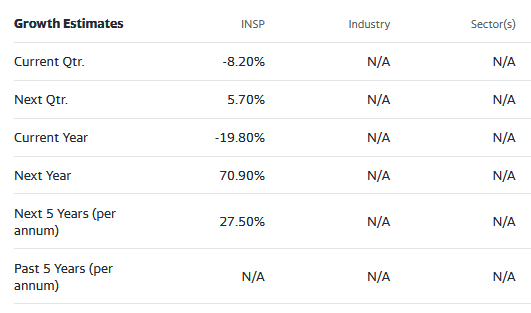
These growth estimates have been made by and are collected from Wall Street analysts to suggest what conventional methodology currently produces. The typical variations across forecast horizons of different time periods illustrate the difficulty of making value comparisons when the forecast horizon is not clearly defined.
Risk and Reward Balances Among INSP Competitors
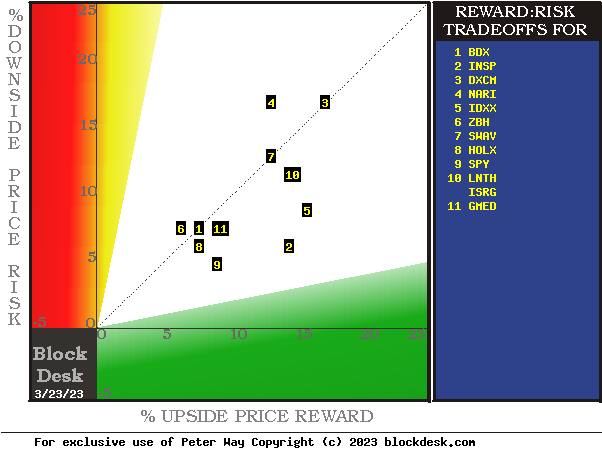
Here are several healthcare equipment industry services like INSP. Following the same analysis as with INSP, historic sampling of their prior Risk-Reward balances like those of today were taken, and are mapped out in Figure 1.
Figure 1
blockdesk.com
(used with permission)
Expected rewards for these securities are the average gains from current closing market price seen worth protecting short positions. Their measure is on the horizontal green scale.
The risk dimension is of actual price drawdowns at their most extreme point while being held in previous pursuit of upside rewards similar to the ones currently being seen. They are measured on the red vertical scale.
Both scales are of percent change from zero to 25{08cd930984ace14b54ef017cfb82c397b10f0f7d5e03e6413ad93bb8e636217f}. Any stock or ETF whose present risk exposure exceeds its reward prospect will be above the dotted diagonal line. Capital-gain attractive to-buy issues are in the directions down and to the right.
Our principal interest is in INSP at location [2], at the lower-right edge of the symbols cluster. A “market index” norm of reward~risk tradeoffs is offered by SPY at [9]. Most appealing (to own) by this Figure 1 view is INSP.
Comparing features of Alternative Investment Stocks
The Figure 1 map provides a good visual comparison of the two most important aspects of every equity investment in the short term. There are other aspects of comparison which this map sometimes does not communicate well, particularly when general market perspectives like those of SPY are involved. Where questions of “how likely’ are present other comparative tables, like Figure 2, may be useful.
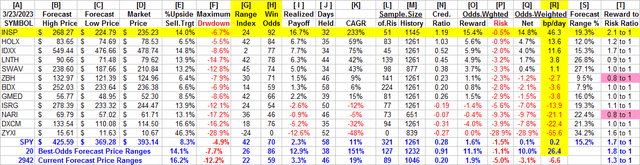
Yellow highlighting of the table’s cells emphasize factors important to securities valuations and the security INSP, most promising of near capital gain as ranked in column [R]. Pink highlighted cells suggest positions unfavorable for “long” holdings.
Figure 2
blockdesk.com
(used with permission)
Why do all this math?
Figure 2’s purpose is to attempt universally comparable answers, stock by stock, of a) How BIG the prospective price gain payoff may be, b) how LIKELY the payoff will be a profitable experience, c) how SOON it may happen, and d) what price drawdown RISK may be encountered during its holding period.
Readers familiar with our analysis methods after quick examination of Figure 2 may wish to skip to the next section viewing Price range forecast trends for INSP
Column headers for Figure 2 define investment-choice preference elements for each row stock whose symbol appears at the left in column [A]. The elements are derived or calculated separately for each stock, based on the specifics of its situation and current-day MM price-range forecasts. Data in red numerals are negative, usually undesirable to “long” holding positions.
Table cells with yellow fills are of data for the stocks of principal interest and of all issues at the ranking column, [R].
The price-range forecast limits of columns [B] and [C] get defined by MM hedging actions to protect firm capital required to be put at risk of price changes from volume trade orders placed by big-$ “institutional” clients.
[E] measures potential upside risks for MM short positions created to fill such orders, and reward potentials for the buy-side positions so created. Prior forecasts like the present provide a history of relevant price draw-down risks for buyers. The most severe ones actually encountered are in [F], during holding periods in effort to reach [E] gains. Those are where buyers are emotionally most likely to accept losses.
The Range Index [G] tells where today’s price lies relative to the MM community’s forecast of upper and lower limits of coming prices. Its numeric is the percentage proportion to the downside of the full low to high forecast seen below the current market price.
The use of prior market actions subsequent to RIs like today make it necessary that those priors be representative of experiences in the just-past 5 year period of 1261 market days. Any RI sample of less than 20 market days could have occurred in one month of 21 market days. Out of the 5 years of 60 months such performance might well be not representative of the whole period.
[H] tells what proportion of the [L] sample of prior like-balance forecasts have earned gains by either having price reach its [B] target or be above its [D] entry cost at the end of a 3-month max-patience holding period limit. [ I ] gives the net gains-losses of those [L] experiences.
What makes INSP most attractive in the group at this point in time is its basic strength of reward to risk ratio of 2.1 to 1 in [T].
Further Reward~Risk tradeoffs involve using the [H] odds for gains with the (100 minus H) loss odds as weights for N-conditioned [E] and for [F], for a combined-return score [Q]. The typical position holding period [J] on [Q] provides a figure of merit [fom] ranking measure [R] useful in portfolio position preferencing. Figure 2 is row-ranked on [R] among alternative candidate securities, with ISPN in top rank.
Along with the candidate-specific stocks these selection considerations are provided for the averages of some 3000+ stocks for which MM price-range forecasts are available today, and 20 of the best-ranked (by fom) of those forecasts, as well as the forecast for S&P 500 Index ETF (SPY) as an equity-market proxy.
Current-market index SPY is not competitive as an investment alternative with its Range Index of 42 indicating the other more than half of its forecast range is to the upside, yet only 7/10ths of previous SPY forecasts at this range index produced profitable outcomes, with enough losers to put its average in near breakeven result in column [ I ].
As shown in column [N] of figure 2, those levels in comparison to their row forecasts [E] vary significantly between stocks. What matters is the net profit between investment gains and losses actually achieved following the forecasts, shown in column [I]. The Win Odds of [H] tells what proportion of the Sample RIs of each stock were profitable. Odds below 80{08cd930984ace14b54ef017cfb82c397b10f0f7d5e03e6413ad93bb8e636217f} often have proven to lack reliability.
Price range forecast trends for ISPN
Figure 3
blockdesk.com
(used with permission)
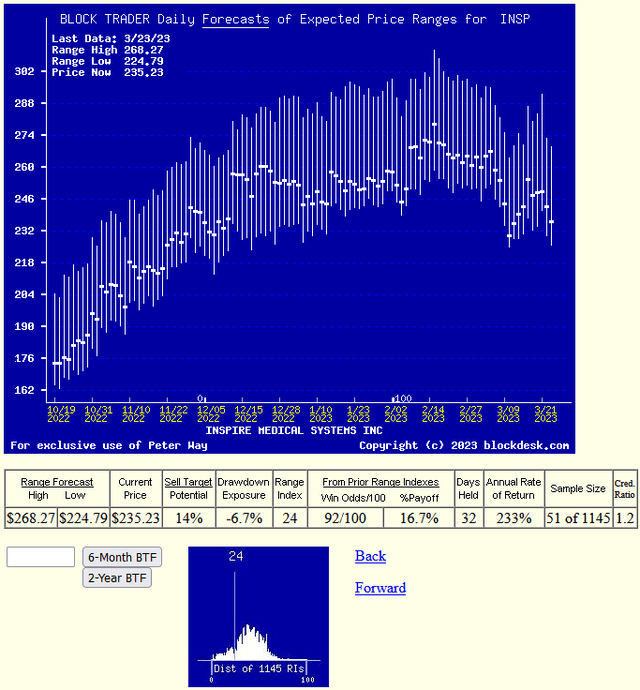
No, this is not a “technical analysis chart” showing only historical data. It is a Behavioral Analysis picture of the Market-Making community’s actions in hedging investments of the subject. Those actions define expected price change limits shown as vertical bars with a heavy dot at the closing price on the date of the forecast.
It is an actual picture of experienced market professionals expected future prices, not a simple hope of a recurrence of the past. These expectations are backed up by significant bets of investment capital made to protect market-makers or to earn a proprietary profit from risk-taking.
The special value of such pictures is their ability to immediately communicate the balance of expectation attitudes between optimism and pessimism. We quantify that balance by calculating what proportion of the price-range uncertainty lies to the downside, between the current market price and the lower expected limit, labeled the Range Index [RI].
In this structure a RI at zero indicates no further price decline is likely, but not guaranteed. The odds of 3 months passing without either reaching or exceeding the upper forecast limit or being at that time below the expected lower price (today’s) are quite slight.
The probability function of price changes for INSP are pictured by the (thumbnail) lower Figure 3 frequency distribution of the past 5 years of RI values with the today value indicated.
Conclusion
The multi-path valuations explored by the analysis covered in Figure 2 of prior Realized Payoffs [I], months and a half holding periods [J], Win Odds [H], and Odds-Weighted basis-points per day (1{08cd930984ace14b54ef017cfb82c397b10f0f7d5e03e6413ad93bb8e636217f} of 1{08cd930984ace14b54ef017cfb82c397b10f0f7d5e03e6413ad93bb8e636217f}) [R] is rich testimony to the near-future value prospect advantage of a current investment in Inspire Medical Systems, Inc. over and above the other compared alternative investment candidates.