
Health Insurance for Expats

Health Insurance for Expats

Do I Need Health Insurance for Expats?

If you want help covering the costs of your medical expenses while living abroad then, yes, you’ll need international health insurance for expats. It may also be required by the government of your destination country. For example, Portugal requires expats to carry valid health insurance that covers necessary medical expenses such as urgent care and repatriation.

While it’s not always required, expat health coverage is usually a good idea. It helps to ensure that you can get quality medical attention in a variety of scenarios at an affordable price. For example, in the unfortunate case that you’re involved in a serious car accident and need emergency care, it will often help to cover the costs of your hospital stay, any required surgeries, rehabilitation, and repatriation (if necessary). 

Further, if you were to develop a serious illness like cancer, health insurance can help to cover the costs of chemotherapy or radiation therapy, specialist visits, lab tests, and other care you would need. 


What Is Health Insurance for Expats?

Health insurance for expats refers to the health insurance plans that help cover the costs of medical services abroad (and in the U.S., for some plans). It’s comparable to the coverage you would have from a health insurance provider in the U.S.—you can access emergency assistance, private hospitals, doctors, nurses, and prescription medications in foreign countries, and your insurance will help to cover the costs, in many cases. 

Note that expatriate health insurance is different from travel insurance. Travel insurance is designed for people taking shorter-term trips versus living abroad long-term. 

How Does Health Insurance for Expats Work? 

Here’s a look at the cornerstones of expat health insurance from policy limits and coverage areas to pricing. 

Maximum Limits

Each plan will have a maximum annual plan benefit which is the most the plan will pay out during the annual policy period. Additionally, the plans often have dollar limits on specific benefits (e.g. rehabilitation treatment, nursing at home, and accidental death). These limits may be on a “per event” or “per year” basis. 

Some insurance providers do offer unlimited coverage, although it’s more of an exception than the rule.  

Beyond the policy dollar limits, the benefits included in expat health insurance policies will vary. For example, a higher-tier plan may cover preventative care while a lower-tier one doesn’t. Further, some insurers may cover vision care while others don’t. The availability of add-on plans like outpatient, maternity, and dental coverage can also vary depending on the provider, policy, and applicant. 

Coverage Areas

Insurers may offer various coverage area options. For example, Allianz Care offers worldwide coverage plus worldwide coverage excluding the U.S. and coverage for Africa only. The coverage area you choose will impact your pricing. 

Costs

Once you find the expat health insurance policy with the right benefits and coverage for your situation, a quote can help you understand the costs. When reviewing quotes, look for the annual and monthly premium prices, deductible options, annual plan limit, and coinsurance or copays that will apply. You can often choose a deductible amount which will lower your premium.

Medical Providers

When it comes to medical providers and facilities, expat health insurers typically have established networks. When you use providers from your insurer’s network, it often comes with perks like seamless billing. That said, most companies will let you choose any medical provider you want as long as they’re licensed and operate in a covered country.

Billing

The way your insurer covers your bills can vary. In some cases, you’ll be required to pay the medical provider upfront and submit the bill to your insurer to get reimbursed. In other cases, you may need to notify your insurer about a medical service before your appointment so they can coordinate with the medical provider and settle the bill directly. 

You may need to give your insurer a specific amount of notice to get a bill covered upfront—such as five days notice before seeking care. 

The specifics of expat health insurance plans can vary greatly from one provider to the next. While the common terms and conditions have been covered here, be sure to read the fine print from the companies you consider. 

What Does Health Insurance for Expats Cover?

The coverage provided through health insurance for expats varies from one provider to the next. However, all the plans we reviewed included inpatient services—care that requires you to be admitted and spend at least one night at a hospital or other type of medical facility. Beyond that, insurers vary in their offerings of benefits like outpatient care, preventative care, vision, dental, maternity care, life insurance, and more. Some offer multiple plans with varying levels of benefits, while others offer base plans with add-on coverage packages. 


Health Insurance for Expats Cost

Costs for expatriate health insurance (without U.S. coverage) are most influenced by your age and level of coverage. To give an idea of how costs vary, we collected quotes for both 35- and 65-year-old U.S. residents living in Mexico. 

35-Year-Old Expat

Monthly premiums ranged from $179 per month up to $476 per month for a 35-year old U.S. resident living in Mexico, based on our research. But cost can swing widely depending on the features you choose. 

For example, the Allianz basic plan (Care Core) costs $179 per month for a 35-year-old and has an annual maximum benefit of $2,500,000. On the other hand, an Elite Xplorer Essential plan from GeoBlue costs up to $476 per month, but has an unlimited annual maximum benefit and covers emergency outpatient care (the Care Core plan from Allianz does not). Both plans have a $0 deductible. 

You may also choose to increase your benefits by adding coverage. Allianz priced add-on coverages as follows:

  • Maternity coverage: From $66 per month
  • Outpatient coverage: From $106 per month
  • Dental plans: From $76 per month
  • Repatriation plans: From $11 per month

65-Year-Old Expat

If you’re a 65-year-old U.S. resident moving to Mexico, Allianz Care’s plans start at $583 per month with a $0 deductible and 2.5 million annual maximum benefit. An Elite Explorer Essential plan from GeoBlue costs up to $2,312 per month. It also has a $0 deductible, but provides an unlimited annual benefit and covers emergency outpatient care. Prices are precipitously more expensive the older you are because insurance companies expect you to more frequently use your plan. 

Allianz priced add-on coverages for a 65-year-old as follows:

  • Maternity coverage: Not available
  • Outpatient coverage: From $308 per month
  • Dental plans: From $76 per month
  • Repatriation plans: From $11 per month


Popular Health Insurance Companies for Expats

Now, let’s take a look at some of the most popular health insurance companies for expats. 

Insurance Companies Insurance Marketplaces
Azimuth Meridian International Citizens Marketplace
William Russell   
Trawick International   
Safety Wing   
NOW Health International   
Seven Corners Liason Majestic   
AXA Global Healthcare   
Bupa Global   
A Plus International   
AIA Group   
Now Health International   
Expacare Global Healthcare   
Integra Global   

Frequently Asked Questions

  • The cost of expat health insurance can vary greatly depending on your age, coverage area, benefits, deductible amount, and maximum limits. In our research, the monthly premium costs for plans with a $0 deductible ranged from $197 to $904.

  • Yes, you can get U.S. health insurance if you live abroad. Many expat insurance providers offer coverage in the U.S. as well as in foreign countries. However, when plans include coverage in the U.S., they are more expensive.

  • Expats are not required to carry U.S. health insurance. While it was previously mandatory for Americans who spent at least 36 days in the U.S. during a given calendar year, that requirement ended in 2018.

  • Expat health insurance can help to cover the costs of medical services in foreign countries. It often covers inpatient care including hospital stays, physician visits, surgeries, lab tests, physical therapy, transplants, and more. Additionally, some insurers offer coverage for outpatient care, preventative care, dental, vision, and more.

GAMING HEALTH EDUCATION | News Services

GAMING HEALTH EDUCATION | News Services

Eu-produced recreation employs tech to train nursing, health-related pupils

Occasionally gaming does not indicate enjoying a game.

In June of 2022, Josh Peery, a sport designer and educational technology consultant for East Carolina University’s University of Nursing, was asked to converse at the Critical Enjoy convention in Orlando. A conference about online games is not the initial location you’d hope to obtain a nursing university staff, but Peery wasn’t there to discuss about nursing students playing very first-individual shooter games or the newest zany Mario Brothers experience.

“I maintain getting invited to communicate at conferences for the reason that in the health treatment sector, we are just one of the few faculties that are developing major video games in home and utilizing them at the similar time,” Peery claimed.

Severe games, Peery said, are these that do not have entertainment as the principal aim, but rather instruction, education or consciousness. The U.S. Department of Defense was an early adopter of serious games to simulate battlefield situations with out the charge of physically reenacting battlefield conditions. The government carries on to be a popular developer and consumer of really serious online games, with a massive presence in North Carolina.

“Before I was at European I was heading to check out to come again from California to perform at a big activity developer in Raleigh. They showed me a sport they ended up establishing, and I questioned who it was for and they ended up like, ‘We cannot say,’” Peery explained.

Peery is not a sport developer by training, at least not the coding aspect of activity enhancement, but his graduate training in English and film gave him entre into the gaming earth since he understood how to establish a story and deal with elaborate assignments.

“When this position presented itself, they necessary a person who could talk to the school and fully grasp investigation and things of that nature,” Peery reported. “So that’s in which my diploma came into position.”

The changeover to the development of the Digital Clinic — the Higher education of Nursing’s house-grown serious match — was an easy healthy for Peery. His educational exploration focuses on the gamification of non-gaming spaces, like on-line searching and user knowledge. Significant games are finest suited for the space among a human being owning no expertise about a subject and being at a point of mastery of that matter — a wide continuum of practical experience — and various for each individual learner.

The students’ needs in this in-concerning phase are repetition and novelty — experiential designs that in the authentic entire world are time and price prohibitive. The requirement for dwelling and respiration simulated people, and school to oversee the mastering practical experience in the genuine environment, is amazingly pricey.

In the Virtual Clinic gaming house a nursing or healthcare university student can repeat a simulated business office pay a visit to as quite a few periods as is important. Need to question a individual, for the seventh time, how they are experience and when their fever begun? No issue, just restart the activity. Not buying up on the refined cues that would direct to the analysis of a serious health-related situation? Strike the replay button.

The significant activity framework permits health sciences college students the option to use their most useful healing device — their minds — as several situations as necessary and no just one is needed numerous, unnecessary needle sticks.

Even though there are other off-the-shelf video games that are used by nursing and healthcare colleges, individuals online games are much more a simulation where by the player has free of charge rein to execute needless professional medical treatments. The recreation developed by Peery and his group at Ecu is diverse simply because participant responses are restricted in every problem to accomplish structured finding out plans instead than a free-for-all gaming knowledge.

“You could have somebody come in with a damaged arm and you could give them a colonoscopy — wildly inappropriate and not even needed — but the commercially readily available video games would let you to do that,” Peery said. “A major sport is likely to restrict these selections so the learning is guided somewhat than just throwing the kitchen sink at you.”

Instructing health and fitness sciences students

There are two strategies that faculty on the Wellness Sciences Campus use the Virtual Clinic for training. Just one method is for professors to assign pupils Digital Clinic scenarios as lessons to function on affected individual assessment and illness diagnostic capabilities. The other is to have college students build their individual scenarios for many others to use, which requires a bigger breadth of thought and further analysis effort and hard work.

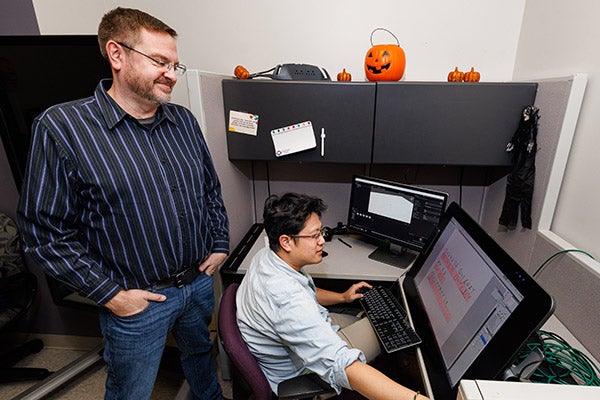
Josh Peery, an instructional technology specialist with the College of Nursing, discusses Kuan-Hun Chen’s graphic work that will be used in an educational project for nursing students.

Josh Peery, an educational technological innovation expert with the School of Nursing, discusses Kuan-Hun Chen’s graphic do the job that will be utilised in an academic project for nursing learners.

The research and setting up important to acquire a match state of affairs is a sneaky way to establish analytical dexterity and forces the college student to believe laterally, which is usually lacking from the regurgitative type that learners frequently encounter when making ready for an anatomy and physiology test.

When Pamela Reis, the division chair of nursing science and Ph.D. plan director, taught an elective system at the Brody College of Drugs she experienced her professional medical college students perform interprofessionally with Eu nursing college students to produce simulated affected person instances that could be involved in the Virtual Clinic video game. Reis, a senior college member at the College of Nursing, who practiced clinically as a nurse midwife and neonatal nurse practitioner, tasked her pupils with acquiring the narrative structure for a virtual appointment with a individual. Students experienced to build four scenarios through the study course — to come up with realistic maladies influencing a digital individual, exploration the signs connected with the patient’s complaint and look at the purple herring diagnoses that could be provided to a activity participant.

“Players had to talk to the individual selected inquiries to occur up with the proper analysis,” Reis claimed. “They obtained points deducted if they failed to check with the suitable concerns or talk to inappropriate queries. They had to create a Cleaning soap (nursing documentation) notice and then were assessed a final quality.”

Reis said building the eventualities involves mental gymnastics of the pupils, which facilitates discovering in a way that merely reading a textbook could not attain.

“It’s a excellent way for students to manage their ideas without judgment,” Reis reported. “The Digital Clinic is a way to existing learners with situations that they’ll see in clinical practice in a non-threatening atmosphere, whilst it is considerably threatening for the reason that the quality is involved with it.”

Lindsey Lang, from Durham, was a registered nurse prior to staying acknowledged to the Brody School of Drugs. She’s established to graduate in Could 2023 and will get her nursing and medical schooling with her into residency, such as the opportunity to create cases for the Virtual Clinic through just one of Reis’ elective courses.

“With my nursing history and my professional medical instruction qualifications, I constructed 4 unique instances,” Lang explained. “Josh took me by means of the gaming structure of how to input the information and facts, create the characters and input qualifications information and facts.”

1 of the circumstances Lang designed was a basic obstetrics scenario that included concerns that a health and fitness care supplier may inquire and corresponding solutions that a “patient” might answer with, each and every with different concentrations of realism. Lang values the options that occur from a better acceptance of digital education tools that she did not have previously in her medical coaching.

“When I was in nursing college, it was a lot of didactics. We would have some simulations, but now getting much more simulations is helpful,” Lang reported. “One point COVID has taught us is executing additional items nearly has been a profit to our education and learning.”

Long run of critical video games

Randy Brown, who a short while ago retired as vice president of Utilized Investigate Associates, an market chief in leisure and major online games, said that game progress is often restricted by the public’s demand for intensive, practical graphics.

“Students assume online games that glimpse fairly realistic in a large amount of scenarios,” Brown mentioned. “People really do not have Triple-A entertainment budgets for this, they’ve acquired coaching budgets and a large amount of instances that’s the last greenback for organizations.”

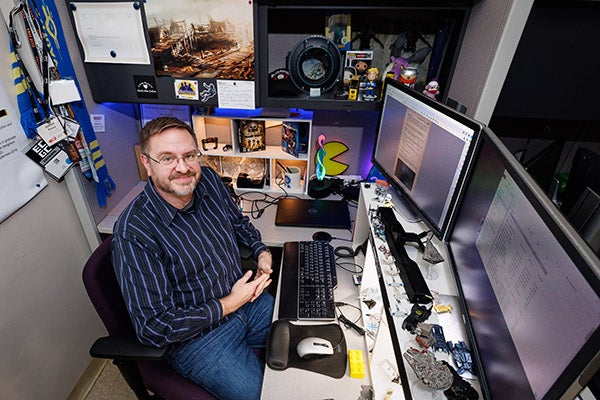
Peery, an instructional technology specialist with the College of Nursing, develops the Virtual Clinic serious game for nursing and other health sciences students.

Peery, an educational technologies expert with the School of Nursing, develops the Digital Clinic severe match for nursing and other wellbeing sciences learners.

For greater, more graphically intense games, Brown reported that a team of at minimum 5 to 7 people — animators, lights and script developers, and a project direct — are vital. But with recent advancements in activity growth and recycling of the fundamental code, it is possible for more compact teams to change out a quality instructional sport, like the Virtual Clinic.

When education and learning — imparting knowledge rather than driving profits — is the intention of the sport, and graphics are considerably less of a concern, the staff need can shrink.

“If the consumer is not so fixated on Triple-A graphics high-quality, that usually takes a good deal of force off. The cost of enhancement is really dropping simply because the (graphics) engines are getting to be so considerably less difficult to use, repurpose, prototype and establish on top rated of,” Brown claimed. “So, it tends to make it a group capable to make the articles.”

Sue Bohle, a previous tech journalist and community relations qualified, as well as the govt director of the Really serious Play meeting, believes that the College of Nursing is ahead of the recreation when when compared to establishments of its dimension.

Bohle explained that the quickest increasing sector of the major video game marketplace is overall health treatment since of the value discounts that appear from almost replicating complicated clinical eventualities for health-related and nursing college students.

“Usually, virtual fact systems also have assessment devices that can show when a scholar is not doing the treatment correctly and manual them to study,” Bohle reported. “They can exercise practically as if it is a virtual quiz in which there is no shame.”

The obstacle that quite a few health-related instruction establishments have with off the shelf serious games is the need to tailor the current video game to the requirements of the learners and college, which could be far more work than support. From time to time, Bohle mentioned, a perfectly-properly trained tutorial designer can use existing systems to make a customized-developed sport from scratch — identical to what Peery has completed at the School of Nursing.

“The do-it-on your own, create-it-yourself market place is as lively as the official technological know-how natural environment. Faculties do have the instruments to do things in property, less costly,” Bohle reported.

Bohle believes really serious activity growth has a brilliant foreseeable future, one particular that even financial analysts are not well prepared for.

“The video game-centered finding out sector will surpass the amusement field,” Bohle claimed. “The figures were in the past report that my analysts did. I took his data to the Wall Street Journal — they just didn’t believe that it.”

Peery and his development workforce have ideas to grow the Virtual Clinic sport to consist of professional refresher instruction and even self-care education and schooling for people and non-medical pros.

Additional Tales

Meeting consumers’ expectations: How digital health technology can help transform care

Meeting consumers’ expectations: How digital health technology can help transform care
Clinicians and people have differing viewpoints on and expectations of telehealth and other types of digital treatment. Digital health know-how product leaders perform a crucial role in aligning these viewpoints and expectations so that they can aid supply what healthcare people want without the need of introducing to clinicians’ burdens.

Ever more, individuals have large anticipations of their health care encounters, which include these that come about virtually.
Virtual technological know-how can assist address issues in obtain and ease of care through, for illustration:

  • Telemedicine
  • Healthcare clinics in retail suppliers and pharmacies
  • Digital health and fitness apps
  • Remote monitoring products and wearables
  • Or subscription-based memberships

Consumers want treatment delivered the place, when, and how the desire it. In addition, they want superior interaction, digital engagement, and conversation with companies.

Which is improved from in advance of the pre-pandemic baseline. Then, individuals and sufferers ended up primarily contemplating – and employing – virtual care for prescriptions refill. In accordance to a survey of 7,000 individuals by the Advisory Board, willingness has completely shifted currently. For example, extra than 60{08cd930984ace14b54ef017cfb82c397b10f0f7d5e03e6413ad93bb8e636217f} of individuals would now take into consideration going digital for ongoing treatment, pre-surgical appointments, and publish-surgical comply with-ups, or acquiring oncology benefits. And there’s much more.

Medical professionals are not so confident about digital treatment

Providers, nevertheless, never always see it the same way. A McKinsey survey uncovered that 62{08cd930984ace14b54ef017cfb82c397b10f0f7d5e03e6413ad93bb8e636217f} of doctors mentioned they recommend in-human being in excess of virtual treatment to sufferers. Many are also not certain that telehealth can boost the affected person encounter. This disconnect can be highly-priced, as sufferers can swap providers and alter modalities of care extra conveniently.

When some physicians are nevertheless on the fence, businesses are all in. In the 2022 KFF Study of Employer Well being Added benefits, 90{08cd930984ace14b54ef017cfb82c397b10f0f7d5e03e6413ad93bb8e636217f} of employers said telemedicine will be vital in offering obtain to care for behavioral, primary, and specialty care, and in remote options.

How can electronic overall health technological innovation help remodel care?

Digital health engineering companies and product leaders can engage in an crucial role in improving the healthcare knowledge and the wellness of people. For case in point, they can help decrease the disconnect amongst clients and providers.

A great digital care solution can also improve the romance amongst the patient and the supplier by aiding clinicians hone their “web-side” manner, the digital substitute to bedside manner. A further way is to emphasis on smart affected individual schooling with the proper content material and applications as an powerful alternate to help control queries questioned to clinicians.

Expectations and thoughts about virtual care and telehealth will most likely proceed to change. But for organizations and innovators in digital overall health technologies, the time to act on the prospect is now.

Uncover the vital position electronic overall health technologies corporations and leaders can participate in in aligning the expectations of clinicians, sufferers, and health and fitness plans, and how they can travel health care forward in our new whitepaper, Aligning Digital Treatment Delivery to Consumers’ Expectations.

Ron DeSantis and the rise of medical freedom

Ron DeSantis and the rise of medical freedom

ALL EYES ON THE FREE STATE OF FLORIDA — Florida Gov. Ron DeSantis has helped bring the once-fringe medical freedom movement onto the national stage, and lawmakers across the country are paying attention, POLITICO’s Megan Messerly, Arek Sarkissian and Krista report.

Building on his popular handling of Covid-19 in the state, DeSantis launched a “Prescribe Freedom” campaign last month that aims to permanently limit Covid-19 vaccination and mask requirements and give cover to doctors whose medical views depart from scientific consensus. It’s designed to protect “Floridians from the biomedical security state” — and if DeSantis declares his candidacy as expected, all Americans will start hearing more about it.

Many state lawmakers already like what they see. “Governor DeSantis has been leading the way,” Texas state Rep. Matt Schaefer told POLITICO. “A lot of people are looking to DeSantis to see what he’s doing at this point, and it gives cover to other governors, I think, to step out there.”

This year, state lawmakers have introduced more than 400 bills promoting a small-government vision for public health, according to the National Academy for State Health Policy. Some are Covid-specific, such as a bill in Indiana that would prohibit employers from requiring routine testing for the virus. Other proposals would make significant changes to the mandate-driven approach to public health.

Most aren’t expected to go anywhere. But their volume speaks to the backlash federal pandemic policies have engendered and how DeSantis’ proposals could be the inevitable result of so many Americans losing trust in local, state and federal health officials.

“Taking a different approach in public health requires a lot of guts,” Brian Miller, a non-resident fellow at the American Enterprise Institute, told POLITICO. “The public health community has historically not done a good job in integrating centrist, conservative and libertarian viewpoints.”

WELCOME TO WEDNESDAY PULSE. Nearly half of U.S. adults believe SARS-CoV-2 was leaked from a laboratory in Wuhan, China, dwarfing the quarter of Americans who believe it spilled over from animals to humans. Send your news and tips to [email protected] and [email protected].

TODAY ON OUR PULSE CHECK PODCAST, hear more from host Megan Messerly and Krista Mahr about the medical freedom movement and how Ron DeSantis is bringing it into the mainstream.

FIRST IN PULSE — Sens. Maggie Hassan (D-N.H.) and Mike Bruan (R-Ind.) will reintroduce a bill today that aims to close a loophole pharmaceutical companies have used to block other firms from selling competing drugs, including lower-cost generics, PULSE has learned.

What the bill would do: The FDA often requires manufacturers to have a Risk Evaluation and Mitigation Strategy program for potentially dangerous drugs, which some companies patent to delay other, potentially cheaper versions coming on the market. The Increasing Prescription Drug Competition Act would allow the FDA to immediately approve drugs if a REMS patent is the only barrier to approval.

Its reintroduction follows a Monday New York Times report on Jazz Pharmaceuticals’ use of this tactic to block the release of a drug from a competitor.

“Our bipartisan bill would finally close this absurd loophole that big pharmaceutical companies, such as Jazz, can use to slow down the release of better, cheaper drugs in order to line their own pockets,” Sen. Hassan said in a statement to Pulse. “For too long, Big Pharma has artificially inflated drug prices at the expense of patients, but it doesn’t need to be this way. I will continue working across the aisle to take on Big Pharma and lower health care costs for all Americans.”

AND SPEAKING OF WUHAN … Congressional Republicans want to use new Covid-19 lab leak reports to lash out at Beijing and paint President Joe Biden’s administration as soft on China, but they can’t agree on how to do that, POLITICO’s Alice Miranda Ollstein and Gavin Bade report.

A spectrum of responses played out Tuesday across nearly a dozen hearings and legislation markups aimed at deterring what GOP lawmakers say is increasingly aggressive behavior from China that the Biden administration hasn’t effectively addressed.

Some hope a reported new assessment from the Energy Department, concluding that the so-called lab leak theory is the likely explanation for Covid’s origin, will give new life to legislation that stalled last year — including introducing bills to declassify intelligence about the pandemic, setting up a 9/11-style nonpartisan commission to study the virus’ beginnings and restricting data-sharing with Chinese scientists.

Others want the White House to hold classified briefings on what they knew about Covid-19’s origins, when they knew it and what led to the latest agency assessment. Still others hope to use the lab leak assessment as momentum for sanctions and investment restrictions on the world’s second-largest economy.

THE LAST LINE OF CARE — A CDC report released today shows that from 2018 to 2020, Black adults sought help in emergency departments for problems related to mental health at far higher rates than white or Hispanic adults. Their rates of emergency visits for specific disorders, such as anxiety disorder and substance use disorder, were also highest among Black adults.

At the same time, ED visits by Black patients “were less likely to result in admission or transfer to a hospital” than visits by white patients, the report said.

Hispanic adults had the lowest rates of ED visits for any mental health disorders.

The backdrop: One in 5 American adults were estimated to be living with a mental health disorder in 2020, and less than half of those individuals received any services for the condition.

Black and Hispanic individuals are less likely to receive mental health treatment than white Americans.

OUCH — During the Trump Administration, Don Rucker oversaw the beginning of the Trusted Exchange Framework and Common Agreement, a health data-sharing project known as TEFCA. Rucker had some choice words for the way the CDC handles health data — and how the agency wants to use TEFCA — in a recent interview with Ben Leonard over at Future Pulse.

“The CDC doesn’t get modern computing,” Rucker told Ben. “If you want to fight the next pandemic, where you actually have to monitor a population in real time, you can’t generate enough queries to do that. TEFCA doesn’t lend itself to population-based surveillance.

“CDC should totally shift its focus from trying to ingest little pieces of information to funding every gap in health information exchanges in the states,” he said.

Theo Merkel will join the Paragon Health Institute as director of its Private Health Reform Initiative and a senior research fellow. Merkel is a former special assistant to the president for economic policy at the National Economic Council in the White House and former legislative director for Sen. Pat Toomey (R-Pa.).

In STAT, a former deputy chief of staff for the Department of Health and Human Services calls on the FDA to rethink how new drugs for rare diseases are developed and remove needless obstacles that hinder clinical trials.

The Chinese doctor who claimed to have genetically engineered babies has staged a rocky return to science, The Associated Press reports.

As tensions rise with Washington, D.C., Beijing is trying to rewrite its response to the pandemic, The New York Times reports.

What Dr. Simi tells us about Mexico’s healthcare crisis

What Dr. Simi tells us about Mexico’s healthcare crisis

He sports a bushy white mustache and a bit of a gut. He dances to reggaeton in cities and towns across Mexico. He has 2 million followers on TikTok and at concerts is routinely passed into the arms of pop stars. His face even adorns a mountainside.

He is Dr. Simi, the cartoon mascot of Farmacias Similares, Mexico’s largest drugstore chain, with more than 8,500 locations across the country. His ubiquity speaks to the company’s round-the-clock marketing strategy but also something darker: the failure of the Mexican government to deliver on its promise of healthcare for all.

Medicines are often in short supply in public clinics, where it can take weeks to get an appointment with a primary care doctor.

A woman with long dark hair sits at a computer terminal. On the desk are dolls of a man in a lab coat

At Farmacias Similares’ corporate headquarters, an employee sits at her desk adorned with Dr. Simi dolls and stickers.

(Luis Antonio Rojas / For The Times)

Farmacias Similares helps fill the gap with cheap generics and $2 doctor visits. The chain says its clinics next to each location provided 136 million appointments last year.

Many pharmacies feature an employee in a Dr. Simi padded bodysuit waving to passersby and engaging in antics such as challenging the cow mascot of Mexico’s Alpura milk brand to a dance-off.

A group of people dressed as mustachioed characters in different costumes pose for a photo

Various Dr. Simis pose for a photo at an event in 2022 to celebrate the company reaching its target of 8,000 pharmacies.

(Farmacias Similares)

At the company’s headquarters in Mexico City, a mural shows Dr. Simi with a raised arm declaring: “To serve God and the people!”

Dozens of employees there answer calls to the “Simitel” hotline that provides free access to doctors, nutritionists and psychologists — and for those who press “1” to Dr. Simi himself.

Operators who have perfected the mascot’s cheerful nasal voice answer several hundred calls a day by reading a joke from a binder or simply offering a friendly ear. Alberto González, who has played Dr. Simi for nearly 17 years, cherishes callers such as 27-year-old Luis, who dialed in more than a decade ago to talk about his parents’ divorce and still phones every few weeks.

A man sits at a workstation. Behind him is a poster of a mustachioed character and the words Bienvenidos a Similandia

Alberto González, who takes on the role of Dr. Simi on the company’s hotline, waits for calls from people who want to chat with the mascot.

(Luis Antonio Rojas / For The Times)

The operators never break character.

“Hello, hello! How are you?” goes the script. “You’re talking to Dr. Simi. Who is calling me?”

::

In 1997, Mexico began requiring drugs to be labeled by their active ingredient rather than a name brand. The idea was to increase confidence in medications and open up the market to generic drugs.

The new rules were a business opportunity for Victor González Torres, whose family company had long manufactured drugs for the government health system.

That year, he founded Farmacias Similares. The name is a reference to generics, which were advertised with the slogan “The same, but cheaper.”

Promising “up to 75{08cd930984ace14b54ef017cfb82c397b10f0f7d5e03e6413ad93bb8e636217f} in savings,” the company launched a marketing campaign that presented the chain as coming to the rescue of poor Mexicans and pushed back against transnational pharmaceutical companies that disparaged generics.

A mural along a set of stairs depicts a man holding a note near other people

A mural depicting Victor González Torres, the founder of Farmacias Similares, at the company’s headquarters.

(Luis Antonio Rojas / For The Times)

González wanted a mascot with the right combination of goofiness and wisdom. After rejecting several ideas from an advertising company, his team found an artist who designed the winner: a simple black-and-white drawing of a doctor joyfully holding up his arms. The inspiration came from a famous movie character from the 1940s, Don Susanito Peñafiel y Somellera.

Dr. Simi first appeared in newspaper advertisements. He then took shape as an animated cartoon and a puppet on television, happily explaining why the public should trust generics.

A woman holds a blue sign outside a storefront, near a passerby

An employee holds a sign advertising a sale outside the first Farmacias Similares pharmacy in Mexico City.

(Luis Antonio Rojas / For The Times)

Before long, Dr. Simis were dancing on the sidewalks. The company created a comic called “The adventures of Dr. Simi” and a band of “Simichicas,” well-known actresses and models who traveled with the founder and promoted new products such as the “Simicondom.” “SimiInsurance” offered medical treatment for a premium.

One of the chain’s key moves was to open clinics — which are operated by a sister company — alongside its pharmacies.

The cheap clinics made healthcare more accessible to the tens of millions of street vendors, taxi drivers and others working in the country’s informal sector. It was a population excluded from public health insurance systems — in apparent breach of the Mexican Constitution, which was modified in 1983 to make healthcare a universal right.

A masked man in a white coat holds a syringe near a masked woman seated on an examination table

A doctor prepares an injection for Carmen Maldonado, a regular patient at his clinic next to a Farmacias Similares pharmacy.

(Luis Antonio Rojas / For The Times)

Like some political parties, the chain also handed out free rice and offered social assistance in poor neighborhoods.

Its populist strategy worked. By 2003, Farmacias Similares had roughly 1,000 locations and was looking abroad.

The government healthcare system expanded substantially the next year under a new program known as Seguro Popular that offered health insurance to workers in the informal economy. But that didn’t appear to stall the growth of Farmacias Similares. Catering to hourly workers who couldn’t afford to take time off to travel to public health centers, the chain placed its pharmacies on busy streets, often near bus stops, and grew rapidly by offering franchises.

By operating on a massive scale and manufacturing many of its own drugs, the company cut costs further and passed on the savings to customers.

“Victor González Torres and Farmacias Similares executed a tremendously effective strategy,” said Michael Chu, a Harvard business professor who has studied the chain.

González’s profile was growing too. Long encouraging people to call him Dr. Simi, he did not hide his desire for prestige, declaring once that he wanted to be remembered as a revolutionary like Che Guevara.

He butted heads with officials in the public health system after alleging corruption in its drug-purchasing practices and campaigned for president as a write-in candidate in the 2006 election.

“Poor people can have power in a country where there are so many,” he said in an interview at the time. “They can choose a president.”

The company has also waded through a fair share of controversy. González’s brother was the founder of Mexico’s Ecological Green Party, which in 2010 faced accusations of conflict of interest after sponsoring legislation to provide people with vouchers for medications in private pharmacies. The media dubbed it the “Simi law.”

The law failed to pass, but Farmacias Similares continue to grow amid the government’s faltering attempts to improve the public health system.

More than a quarter of the population lacked access to care in 2020, according to the government’s most recent estimate.

That same year, President Andrés Manuel López Obrador replaced Seguro Popular with a new program he promised would reduce corruption. But it has been beset by medicine shortages that experts attribute to bureaucracy and the COVID-19 pandemic. The government is currently transitioning to yet another program.

As a result, clinics next to private drugstores have been booming and are now thought to serve roughly a fifth of the population. Farmacias Similares opens nearly two new locations a day on average.

Carmen Maldonado, who owns a shop that sells artisanal honey and cheeses, recently dropped by Farmacias Similares’ first store — located in Mexico City’s Portales neighborhood — to buy cold medication and antibiotic injections, which a doctor administered at the clinic next door. A sign outside advertised birth control, oxygen and blood sugar readings, stitches and ear cleanings.

Maldonado could opt to use the public system, but the clinic is near her home and she’s been seeing this doctor for 20 years.

“He’s like the family doctor,” she said.

::

In November 2021, a 19-year-old high school student named Avril Christelle Vega Martinez was on her way to a concert in Mexico City when she stepped into a Farmacias Similares to pick up some hand sanitizer.

She had also been looking for a Dr. Simi doll, so she was happy to find the store had one left in stock. The dolls come in different guises — including boxer, mariachi and fireman — but the one she bought was the classic version: Dr. Simi in his lab coat.

Plush dolls sit on a bookcase in the shape of the letters C and S, next to a larger version of the mustachioed character

A variety of Dr. Simi dolls fill the bookshelf of an employee at Farmacias Similares’ headquarters.

(Luis Antonio Rojas / For The Times)

Vega had taken the doll out of her backpack at the concert — Norwegian electro-pop singer Aurora Aksnes — when an idea popped into her head.

“I suddenly thought of the idea of maybe giving it as a present to Aurora,” she recalled. “Dr. Simi is a symbol of Mexican culture. We grew up seeing Dr. Simis dancing everywhere.”

And so she passed the doll up through the crowd until someone flung it onto the stage. Aurora picked up Dr. Simi and hugged him to her chest.

Captured on video, the incident went viral on social media, and it wasn’t long before Dr. Simi dolls were routinely being thrown onstage at concerts of pop stars including Dua Lipa and Rosalía. Joining in on the fun, a former chief justice of Mexico’s Supreme Court “ruled” on TikTok that doing so isn’t a crime.

The publicity was good news for Farmacias Similares. Dolls were selling so fast that the company boosted monthly production to 40,000 from 12,000. When one was left at a memorial for Queen Elizabeth II in Edinburgh last year, Mexican media outlets thought it newsworthy enough to cover.

The company carefully guards Dr. Simi’s image. The more than 1,000 staffers who wear Dr. Simi bodysuits are forbidden to speak to the public while in costume in order to preserve the character’s identity. One benefit of the job: lessons in dancing salsa, cumbia and the Simi pasito.

A communications team works a night shift to produce seven television shows a week, bringing in specialists to discuss anxiety and stress, as well as staffers from different areas to explain their jobs. Employees keep a close eye on social media, tracking down for an interview members of the public who have helped Dr. Simi go viral.

The company also promotes its brand through what Victor González Herrera, the son of the founder, called “conscious capitalism” — funding natural disaster relief, tree planting and food assistance for the hungry.

In December, the company raffled 25 cars to customers to mark its 25th anniversary. Before the winners collected their new car keys, pharmacy employees launched into the corporate anthem:

We have the courage
Dr. Simi has the heart
What we offer
We do with love

With pharmacies in all of Mexico’s 32 states and more than 400 in Chile, the company aims to reach its target of 10,000 pharmacies in the next five years and ultimately become the largest chain in the world.

“Simi has simply become necessary,” said Victor González Herrera, who recently took over as head of an umbrella group that includes the pharmacies and the clinics.

Health experts have warned that while the pharmacy clinics can treat immediate illness, they are not ideal for chronic conditions.

“Can it be a business that does good? Without a doubt,” said Dr. Andrés Castañeda, who coordinates health issues for Nosotrxs, a Mexican organization that promotes citizen participation in public policies. “But the health system can’t leave things 100{08cd930984ace14b54ef017cfb82c397b10f0f7d5e03e6413ad93bb8e636217f} in the hands of clinics adjacent to pharmacies.”

One problem is that the care may not be consistent, because the doctors tend to come and go.

But Cori Hayden, an anthropologist at UC Berkeley who recently published a book on Farmacias Similares called “The Spectacular Generic,” said that many people have resigned themselves to “something is better than nothing” when the state fails to provide healthcare.

“It’s a force. It’s wild,” she said of the chain. “It’s totally wild.”

But its true power remains something of a mystery, because Farmacias Similares keeps its sales figures private.

“It’s a gray area,” said Jorge Perichart, director of the National Assn. of Sales Executives of the Pharmaceutical Industry. “We don’t know what we’re competing against.”

::

Four people look out of an upstairs opening in their home, which painted in blue with black stripes

A family peers out from a home in the “Simi Neighborhood.”

(Luis Antonio Rojas / For The Times)

About 30 miles north of the center of Mexico City, in a mountainside community in the municipality of Ecatepec, the homes have bare concrete floors and tin roofs. Access to running water is a luxury.

For Farmacias Similares, the Lomas de San Carlos neighborhood was not just a symbol of neglect: It was a canvas.

Last year, the company sent in representatives offering residents food assistance and free house painting. Then painters got to work on 305 houses.

The result was an advertisement for Farmacias Similares visible from the nearby highway.

White houses make up a man’s bushy mustache, pink houses his tongue, and black-striped houses the three wiry hairs on each side of his head.

It was, of course, Dr. Simi.

A view of homes in a neighborhood painted to depict the likeness of a cartoon character with a white mustache

Hundreds of houses in the municipality of Ecatepec have been painted to form a mega-mural of Dr. Simi.

(Luis Antonio Rojas / For The Times)

The company — which also remodeled the community center, built a vegetable garden and opened two new pharmacies nearby — dubbed Lomas de San Carlos “Simi Neighborhood.” Reporters rushed to cover the story.

“No one has ever paid this much attention to us,” said Hortencia Olivares Ramos, whose home was painted blue — the background of the mural.

At the mountain’s peak, Eva Ojeda López lives with her husband and four children in a house painted to match the hairs on Dr. Simi’s balding head.

The stay-at-home mother buys her hypertension pills at Farmacias Similares when the public pharmacies run out and frequents the company’s clinics for basic ailments such as colds.

Ojeda swore that the arugula from the new community garden lowered her cholesterol levels. One of her daughters read the book that Farmacias Similares gifted the family: the founder’s autobiography, “My Life Is a Struggle.”

Another daughter Johana, 18, joked about how some of her neighbors lived by Simi’s tongue or his eyes.

“We consider ourselves a part of Dr. Simi,” she said.

Geriatric Physical Therapy Residency Program | VA Northern California Health Care

Geriatric Physical Therapy Residency Program | VA Northern California Health Care

Dr. Neil Gregor, PT, DPT, GCS, CEEAA

PT Residency and Gerofit Director

Dr. Gregor obtained his Doctorate in Physical Therapy in 2008 and his Geriatrics Specialization from the American Board of Actual physical Therapy Specialties in 2014.

Neil has provided Geriatrics centered treatment in property health and fitness, competent nursing and outpatient configurations. 
Dr. Gregor is a Director of the Northern California VA Well being Treatment System’s (VANCHCS) Work out and Wellness Program, GEROFIT. He is also Director and a Mentor for the VANCHCS Geriatric Actual physical Treatment Residency Method. As a credentialled Clinical Teacher, Neil has taught Actual physical Therapy college students for in excess of 10 many years.

Dr. Gregor has graciously donated his time to his career. He has served as a general public reviewer for medical apply recommendations for rehabilitation next hip fracture and as a state advocate for the Academy of Geriatrics beneath the American Actual physical Therapy Affiliation. Neil has a deep seeded passion for Geriatrics centered instruction, rural wellness care and preventative drugs companies. Previously mentioned all, what Dr. Gregor loves most in his vocation, is offering individual-centered care, acquiring meaningful connections with individuals he serves, and the countless lifestyle classes figured out from them.

Dr. Angela Brigham, PT, DPT

Web page Coordinator of Clinical Training

Dr. Angela Brigham received her Doctorate in Actual physical Remedy degree from Samuel Merritt University in 2009.

After graduating, she started off her vocation in the private sector at a experienced nursing facility.  In 2011, Dr. Brigham began her journey with the VA, taking a place in the Heart for Rehabilitation and Prolonged Care in Martinez, CA. She took above the role of Site Coordinator of Clinical Education and learning (SCCE) for the Northern.
California Well being Care System in 2014. Due to the fact having in excess of the position as SCCE, she has put dozens of learners at various web-sites in the course of Northern California. Angela is a accredited clinical teacher and individually can take 1-2 learners every year.
Angela is currently serving her 2nd two-year phrase as a member of the Countrywide Clinical Education and learning Strategic Workgroup, a group aimed to guide Actual physical Therapy medical educators in VAs throughout the nation. Angela serves as the coordinator for the Geriatric Residency Application and will also serve as a mentor for the resident.

Dr. James A. Patrizi PT, DPT, CWS, FACCWS

APTA certified medical teacher

Patrizi attained his Actual physical Treatment diploma from Northwestern College and his transitional Doctorate in Actual physical Therapy from the University of the Incarnate Phrase.

He earned his Wound Professional Certification and Diplomate designation from the American Board of Wound Management in 1999 and was named a Fellow of the Faculty of Accredited Wound Professionals in 2005. He has been adjunct college for two DPT applications for 15 many years, training the Integumentary curriculum.
Patrizi’s apply concentration has been limb salvage for people with vascular condition and edema management. On top of that, he has been a voting member of the VISN 21 Interprofessional Subcommittee, the Wound Care Process Pressure, and the Merchandise Evaluate Committee. He routinely conducts team training and just one-on-one mentoring for DPT college students and RN, LVN, PA, NP pupils, and MD/DO people rotating by the facility. Other things to do involve ongoing evaluation/implementation of rising state-of-the-art products and solutions linked to tissue therapeutic, wound cleansing/irrigation, and vascular system variety for rental/acquire for the inpatient and outpatient populations. Patrizi is an APTA qualified Clinical Teacher.

Dr. David Crivello, PT, DPT, OCS, CSCS

Physical exercise and wellness plan, Gerofit co-director

Crivello received his Doctorate of Physical Therapy Degree from the University of the Pacific in 2012.

He reached his Orthopedic Specialization from the American Board of Bodily Remedy Experts in 2019.
Crivello’s clinical encounters lie principally in outpatient orthopedics but consist of Residence Health and fitness Bodily Treatment and Acute Care Physical Treatment. Crivello joined VA Northern California in 2015. In preparing for his Orthopedic Specialization, Crivello attended a yearlong Musculoskeletal Residency at Baylor College in 2018. He at this time serves as the Co-Director of the VA Northern California Gerofit System. He is also a board member of the National Pilot Application for Joint Wellbeing Administration in conjunction with the Memphis VA. Dr. Crivello also is a accredited Dry Needling practitioner. Crivello serves as a facility member and mentors for the VA Northern California Geriatric Residency Program.

Dr. Maggie Limmer, PT, DPT, OCS

Instructor

Limmer earned her Doctorate in Bodily Therapy in 2018 from the University of Evansville.

She then entered the Utah Orthopaedic Bodily Treatment Residency, from which she graduated in 2019. Her passion for the VA began right here, as she put in most of her clinic time at the George E Wahlen VAMC in Salt Lake City. She worked at the College of Utah Health and fitness system’s Utah Orthopaedic Centre. The time break up between these two facilities allowed Limmer to attain knowledge in numerous orthopedic situations, from managing geriatric sufferers with chronic discomfort to NCAA Division I athletes.
Limmer then took her profession to Northern California, in which she acknowledged a job in outpatient orthopedics at Kaiser Permanente. She gained her Orthopaedic Specialization from the American Board of Actual physical Treatment Specialties in 2020. At Kaiser, she was element of a pilot application furnishing telehealth physical remedy providers, which proved handy as the COVID pandemic hit shortly right after. The change in clinical apply owing to pandemic safety measures permitted her to use her telehealth expertise. Just after two a long time at Kaiser, Limmer knew it was time to return to the VA method. She started out at Mather VAMC in August 2021, pivoting roles to function in acute care. She instantly became a part of the Acute Treatment for Elders (ACE) Staff, focusing on optimizing clinic outcomes for the senior populace. She also functions as a liaison for the Emergency Division and sufferers with orthopedic problems who land in acute treatment. Her eventual objective is to meld her orthopedic track record with her acute treatment expertise and develop into a musculoskeletal screener operating mostly in the Unexpected emergency Department.

Dr. Carolyn Patten PhD, PT, FAPTA

Teacher

Dr. Patten is a neuroscientist and bodily therapist who specializes in evaluating and treating motor dysfunction associated with growing old and adult neuropathologies, such as stroke.

She directs the UC Davis Biomechanics, Rehabilitation, and Integrative Neuroscience (Brain) Lab is a Co-Director of the UC Davis Middle for Neuroengineering and Medicine. In addition to her key college role at UC Davis University of Medication, Dr. Patten is a senior investigator with the VA Northern California Wellness Care Process. She holds Investigation Vocation Scientist standing.

Exploration Emphasis

Dr. Patten’s investigation focuses on knowing the neural foundation of human movement, investigating human motor manage, and learning from a standpoint of neuromechanics. Her laboratory has made approaches sensitive to motor impairment utilizing concurrent behavioral and neurophysiological procedures. The lab’s recent work emphasizes identifying biomarkers to predict motor recovery pursuing stroke and the essential components contributing to rehabilitation efficacy. To realize these goals, the Mind lab researches the neural mechanisms and biomechanical effects of CNS pathologies causing motor dysfunction, including novel strategies to induce neuroplasticity and motor restoration and unique versions in the program of motor restoration and responses to therapeutic interventions.
Healthier Getting older in a Digital Environment – a UC Davis Large Notion, the Countrywide Science Foundation, the Office of Veterans Affairs (Rehabilitation R&D), and the College of California CITRIS support Dr. Patten’s study (Heart for IT Exploration in the Curiosity of Modern society). She has continuously held federal, peer-reviewed challenge funding as Principal Investigator since getting her first Vocation Advancement Award from VA Rehabilitation R&D in 1998.

Dr. Kate Schopmeyer, PT, DPT, CSCS, CPE

Instructor

Dr. Schopmeyer is a clinician, educator, and application coordinator specializing in interdisciplinary soreness rehabilitation.

She is actively driving apply adjustments for soreness treatment by means of countrywide and regional committees and workgroups, both equally in just the VHA and the non-VA wellbeing care local community. Her main objectives in medical perform are to foster active patient engagement by instruction, teach behaviors that promote self-management, and educate folks how to re-engage in life although dwelling with persistent suffering. She thinks ache care is a “team sport,” that expertise is ability, and that motion is the finest drugs.