WASHINGTON — On November 26th, the Unitary Platform and the Maduro regime introduced the resumption of talks in Mexico City a humanitarian arrangement targeted on schooling, wellbeing, meals security, flood response, and electrical energy packages that will profit the Venezuelan men and women and arrangement on the continuation of talks targeted on the 2024 elections. Subsequent this announcement and reliable with U.S. authorities coverage, the Division of the Treasury’s Place of work of International Assets Regulate (OFAC) issued Venezuela Common License (GL) 41, authorizing Chevron Corporation to resume minimal natural resource extraction operations in Venezuela. This action displays longstanding U.S. coverage to supply targeted sanctions aid based mostly on concrete measures that ease the struggling of the Venezuelan persons and support the restoration of democracy.
This authorization prevents PdVSA from receiving profits from the oil product sales by Chevron. GL 41 authorizes action related to Chevron’s joint ventures in Venezuela only, and does not authorize other action with PdVSA. Other Venezuela-similar sanctions and limitations imposed by the United States continue being in location the United States will vigorously implement these sanctions and will continue on to maintain accountable any actor that engages in corruption, violates U.S. regulations, or abuses human rights in Venezuela.
GL 41 authorizes transactions ordinarily incident and essential to particular functions linked to the procedure and management by Chevron Company or its subsidiaries of its joint ventures involving blocked Venezuelan state-owned oil business Petroleos de Venezuela, S.A. (PdVSA) or any entity in which PdVSA owns, straight or indirectly, a 50 percent or greater fascination.
The bulletins by the Unitary System and the Maduro regime are critical steps in the right course to restore democracy in the region. The United States welcomes and supports the reopening of negotiations involving the Unitary System and the Maduro regime, as element of our longstanding plan to help the peaceful restoration of democracy, free of charge and honest elections, and respect for the legal rights and freedoms of Venezuelans.
Concurrent with the issuance of Venezuela GL 41, OFAC also issued general public assistance indicating that U.S. folks are approved to present goods and providers for certain pursuits as specified in GL 41 and that non-U.S. people frequently do not danger U.S. sanctions publicity for facilitating transactions that are authorized by GL 41. In gentle of Venezuela GL 41, OFAC also extended Venezuela GL 8K and eradicated Chevron from that license.
Examine Venezuela Basic License 41 and Venezuela Common License 8K.
Luke is passionate about healthtech and innovation. He’s a moonshot thinker, grounded in tactic and pushed by effects. CEO of foxo.com.
getty
Concerns like incumbent sellers generating up the backbone of the industry, facts breaches costing companies millions of pounds each individual yr and out-of-date, asynchronous devices these as fax and telephone triage have remaining quite a few of us trying to collectively navigate away from the previous-faculty “wild west” point out of healthcare.
Unsurprisingly, a lot of other industries that have deserted legacy devices have had the foresight to avoid remaining tethered to dated engineering and facts-sharing processes.
As a wellbeing tech founder, I believe that our sector should abide by in the footsteps of the likes of fintech and conversation tech, in which obtainable, interoperable, market-pushed software program generally wins out.
Here are 5 critical procedures that leaders can place into action to support accelerate this style of transformation.
1. Hire fit-for-function interaction platforms.
I’ve viewed how clinicians and their teams have normally been pushed to self-remedy the important obtain and transfer of clinical data by falling again on client platforms these as Facebook Groups, SMS and WhatsApp. These tools are ample for bringing folks collectively across the healthcare landscape. But, the cracks begin to clearly show when it comes to medical software. Safe image storage, scientific workflows and procedure interoperability are some of the initially casualties.
As a consequence, health care teams and overall companies grow to be each vulnerable and stifled they come to be vulnerable to info breaches, medicolegal liability and medical faults as effectively as stifled in progressing past the essentials that empower new designs of treatment and clinical efficiencies.
Conversation pace is a enormous component below. When a patient’s health hangs in the balance, you need to have to come across means so that test outcomes and clinical tips can be sent or accessed swiftly, with any interaction inefficiencies minimized.
When deciding on workforce engineering, I advocate healthcare organizations hone in on the platforms that align especially with their demands, regardless of whether they’re main care specialists, radiologists or health-related service providers.
2. Place field-specific stability criteria to start with.
Details breaches and cybersecurity difficulties are running as rampant as ever. In Australia, among July and December 2021, there ended up 464 facts breaches reported, and the major 3 industries that deal with the most sensitive knowledge are:
1. Wellbeing assistance companies.
2. Monetary companies.
3. Authorized, accounting and administration companies.
Close to 50 million people had their sensitive health knowledge uncovered in 2021. Whatsoever the induce, info breaches can lead to personalized facts leakage, identification theft, organizational disruptions, reputational destruction and enormous financial expenses.
I imagine inserting business-specific security protocols entrance and middle of health progress and deployment is the option. Making a higher common for info transfer commences with wellbeing tech adhering to storing delicate details via the next channels.
• HIPAA (Health and fitness Insurance coverage Portability and Accountability Act).
• GDPR (Standard Data Protection Regulation).
• ISO 27001 DC (a info protection certification).
• IRAP (an Australian protection evaluation certification).
Legacy methods are typically engineered with the sole concentration on safety and privateness, which, as mentioned, is a critical factor of developing well being technologies for the modern day working day. On the other hand, locking down computer software with no selection for interconnection and innovation usually means you produce a “walled garden” with a path that potential customers to the similar outdated issues.
I assume that siloed software program pitched as “all-in-one” has no area in modern day healthcare, exactly where interaction, collaboration and data sharing concerning stakeholders is essential for powerful and economical results.
We can study from other industries whereby engineering shoppers have set their religion and spending budget into tech that aligns with the way we reside and work now. Seem for highly integrated devices that enable knowledge and information to seamlessly and securely stream in between tools. For illustration, when comparing money software package, manyassessments demonstrate Xero as normally favored around MYOB when it arrives to its indigenous integrations and accessibility with other technologies. Xero is using interoperability as its superpower.
4. Embrace open up and accessible marketplace platforms.
Without interoperability, integration and open and accessible (although even now protected) program purposes, you depart clinicians and corporations with no solution but to cobble alongside one another a wellness engineering ecosystem.
Communicating across quite a few disparate platforms increases the probabilities of missing details, skipped notifications and incorrect details. When these occur, corporations waste time adhering to up and locating info, introducing inefficiencies and likely mishandling of delicate affected person data.
Development produced in the office communication platform house has demonstrated the customer worth and competitive edge of utilizing cloud-centered engineering focused on the even larger picture. For instance, I see the acceleration of Microsoft Groups for health care as currently being owing to its market brazenly integrating scientific instruments into its ecosystem, enabling bespoke use scenarios.
5. Preserve momentum and establish for the upcoming, not just today.
Unfortunately, I believe health care distributors that are gradual to innovate or fearful of alter management will simply get left powering. To start building a actual influence on these troubles and navigate by means of the “wild west” of healthcare communication, it will get a potential-targeted strategy to transformation and technologies adoption.
Partaking modern protocols like the Rapidly Health care Interoperability Useful resource (FHIR) regular for becoming a member of alongside one another systems for effective and protected healthcare data trade is a phase in the suitable route. For instance:
• Progressive health care companies like observe intelligence business, Cubiko, are going higher than and beyond in this space and launched their have FHIR-compliant API and interoperability platform for health care software integrators to connect facts and infrastructure in a “safe, safe, and scalable way.”
• Google Cloud’s Healthcare API, which is both equally HIPAA compliant and FHIR suitable, enables services companies to swiftly make clever health care scenarios in the cloud.
• Numerous other world-wide healthcare businesses have embraced, created or connected with APIs and interoperable methods to share vital health-related knowledge securely, maximize collaboration and do away with data siloes in buy to drive the sector forward.
The present-day and potential uptake of forward-thinking health data platforms with open APIs has and will sky-rocket as distributors are not just tackling the flawed processes and units we are compelled to deal with today but also aligning with in which the field is heading, ultimately supporting and safeguarding the potential of health care.
Soon after his father died of Covid previous tumble, Donkan Martinez was confused by grief and turned to an not likely outlet: digital truth.
The 24-year-previous uncovered himself wading into an emerging subject of virtual psychological health and fitness care, by means of a support named Innerworld, which features peer-led psychological wellbeing guidance by its app. The notion is to bring the concepts of cognitive behavioral therapy, or CBT, into the metaverse and help end users to interact with other individuals as nameless avatars via voice- and text-centered chat.
CBT aims to aid individuals alter unhealthy contemplating or behavioral styles by creating related skills and coping techniques. The American Psychological Association describes it as a type of therapy that helps persons “learn to be their own therapists.”
Innerworld, however, offers everyday consumers the opportunity to produce help to a single one more. Its founder, Noah Robinson, emphasizes that the company should not swap skilled treatment. On registering, Innerworld users must acknowledge that they understand the application is not remedy.
“It’s not treatment and we just can’t supply crisis intervention,” Robinson stated. “Our purpose with Innerworld is to be a for a longer period-term area that folks can appear to enable them reduce by themselves from getting to the point of currently being in disaster. Or we have people today who are hospitalized who come out and are on the lookout for supplemental assistance.”
Upon moving into Innerworld, users can pick out from a assortment of configurations that emulate environments like hiking trails or libraries. From there, they can engage with other avatars or browse a listing of peer-led events, these as group meditation periods, dependancy assistance groups and workshops on navigating social anxiety. Martinez mentioned that when, he joined a recreation in which end users guessed what other folks were being drawing.
The efficacy of Innerworld’s strategy is unstudied, so gathering very long-expression data is important to assessing this or any similar plan, said Barbara Rothbaum, a psychologist at the Emory University College of Medicine. Rothbaum posted a paper on the use of VR to take care of a dread of heights in 1995.
“As far as virtual actuality, most of the programs now have made use of a serious therapist,” she explained.
Nonetheless, Rothbaum included, “I do think [VR] could be helpful for self-help, but the applications that have been examined haven’t been developed for that.”
Skip Rizzo, director of medical digital actuality at the University of Southern California Institute for Resourceful Systems, reported he initially identified VR’s possible for mental health makes use of in the 1990s. Rizzo helped pioneer the use of VR to treat PTSD between members of the navy. A 2005 report documented the situation of a Vietnam war veteran taken care of with VR treatment who professional a 34{08cd930984ace14b54ef017cfb82c397b10f0f7d5e03e6413ad93bb8e636217f} reduce in clinician-rated PTSD.
Innerworld.Innerworld
Rizzo claimed he sees the prospective of Innerworld — as long as the application continues to make apparent that it is not clinician-operate.
“People that are apprehensive about stigma about whichever the problem is that they have, or they are ashamed, they could not want to admit to a different man or woman straight that they are obtaining these difficulties,” Rizzo claimed. “But they may possibly be extra possible to in an avatar-based mostly world wherever they can maintain their anonymity but continue to interact with men and women.”
Martinez reported he and other consumers he is met on Innerworld felt they weren’t having the empathy they essential in the actual environment.
“My actual friends don’t know that I’m incredibly emotional. I’m incredibly conservative with my thoughts with my real good friends,” he reported. “I’m ready to open up in Innerworld for the reason that I know I’m not going to be judged. I’m not going to be attacked.”
Donkan Martinez.NBC Information
Robinson reported he was inspired to generate Innerworld soon after finding solace in an on the net neighborhood in his individual everyday living. When he was 13, he claimed, he became depressed just after realizing he was homosexual, and he turned to the on the net activity RuneScape. The anonymity manufactured him far more relaxed exploring components of himself he was afraid to confront in the genuine environment. Robinson mentioned he sooner or later arrived out to his on-line close friends.
Innerworld is not the only application trying to use VR to assistance persons entry mental well being support.
In his personal perform, Rizzo is piloting a clinician-facilitated VR challenge that features social guidance to Ukrainian refugees. Refugees who have relocated to Bucharest, Romania, can enter a virtual model of a town square in Kyiv, where they can speak with fellow refugees as anonymous avatars.
A startup called BehaVR, meanwhile, released its app, called To start with Resort, last 7 days. The VR application guides people by means of “chapters” on competencies that would be taught in CBT periods.
Risa Weisberg, a professor at the Boston University Chobanian and Avedisian University of Medication, is BehaVR’s chief scientific officer. She reported that simply because people’s brains method VR activities in the exact way they would a authentic-existence experience, “you don’t encounter the interventions as some thing that you’re reading or listening to you working experience them as a little something which is occurring to you.”
Weisberg thinks that’s why VR publicity treatment has yielded benefits in the past.
VR’s access could increase to 64 million men and women in the U.S. this year, in accordance to a 2021 estimate by eMarketer. Weisberg reported that enlargement is happening at a time when far more people today are searching for mental overall health care, but also as lots of are getting itinaccessible because of to high charges.
“All that will come together at the very same time to make the subsequent number of yrs truly ripe for obtaining mental overall health procedures and interventions in VR,” she claimed. “I consider we’re heading to see a substantial uptick in this.”
Rizzo claimed his most important worry about Innerworld, on the other hand, is that individuals who need to have specialist help could possibly consider to substitute the application as a substitute. Rothbaum, in the meantime, said a lot much more exploration is desired to determine whether or not these types of applications truly get the job done. Preferably, she claimed, there ought to be medical experiments with manage teams that track users’ results.
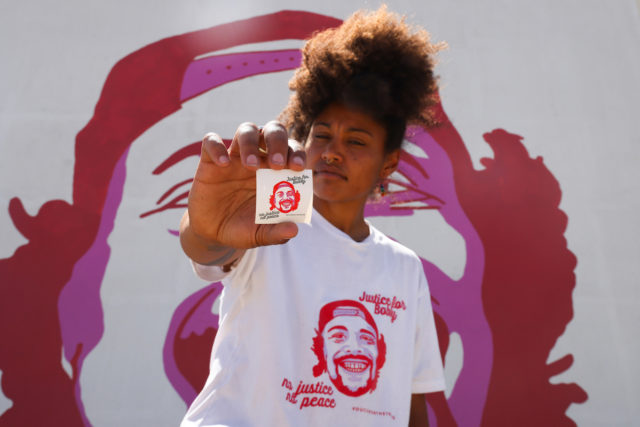
Rae Duckworth holds a “Justice for Bobby” sticker on July 2, 2022, near murals in Salt Lake City remembering the victims of police shootings. Her cousin, Bobby Duckworth, was killed during a mental health call in 2019. (Laura Bargfeld/News21)
Support Journalism
(Editor’s note: ReporterLaura Bargfeld contributed to this article, which is part of “In Pursuit,” an investigation into police reform and accountability in America, produced by the Carnegie-Knight News21 program. For more stories, visit inpursuit.news21.com.)
SALT LAKE CITY — Rae Duckworth rummaged through her fanny pack and produced a sticker showing a portrait of a man painted with bright pink and red ink.
The man smiles brightly, eyes crinkling. On the bottom of the sticker, it says “No justice. No peace” and “#DUCKWORTHSTRONG.”
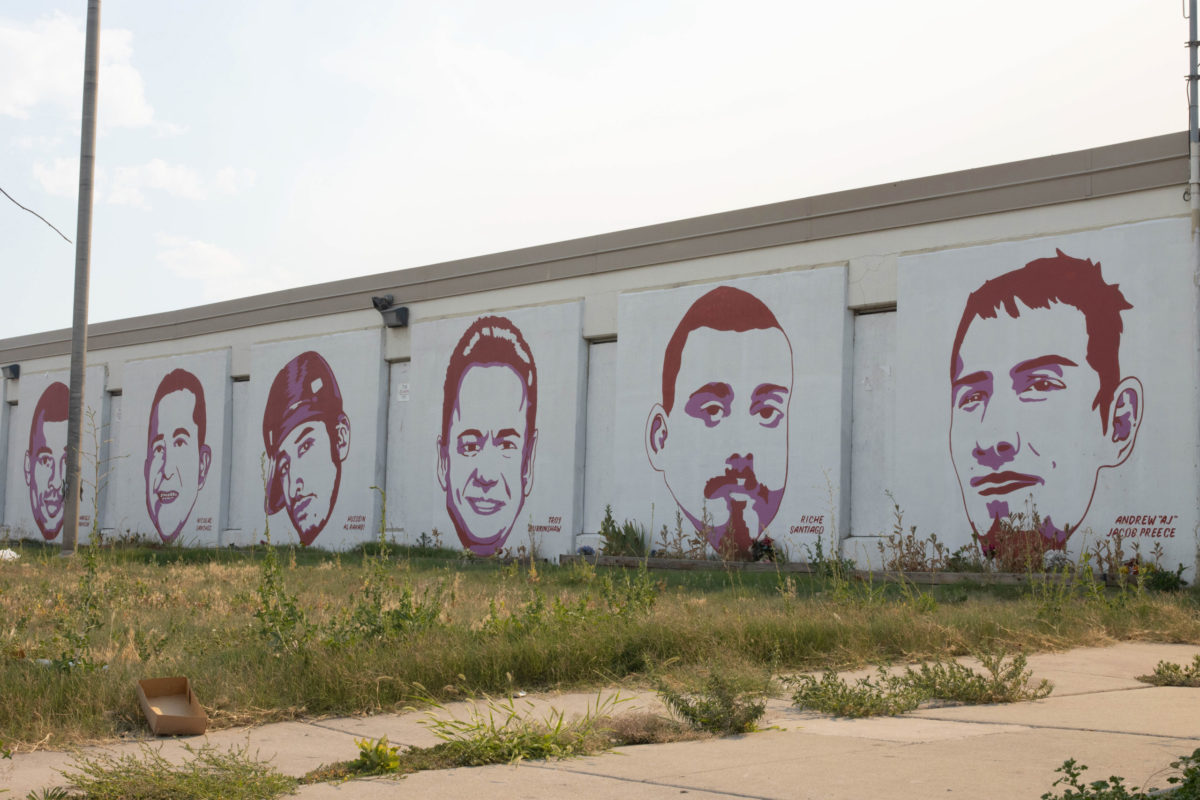
Utah residents may recognize the man as one of the many faces painted on the murals in downtown Salt Lake City to memorialize victims of police brutality.
His name is Bobby Duckworth. Rae Duckworth, Bobby’s cousin and leader of Black Lives Matter Utah, passes these stickers out to everyone she meets, hoping one day she will see her cousin’s face everywhere.
Police officer Garrett Safley shot and killed Bobby Duckworth in the rural town of Wellington, southeast of Salt Lake City, in September 2019. Bobby’s fiancée told local reporters that the 26-year-old was having a mental health crisis at the time.
After a round of investigations, prosecutors determined that Safley’s action was lawful.
“I truly believe Bobby needed a hug and not bullets,” Rae Duckworth said, holding back tears. “The whole system failed him. He didn’t have any support.”
She joins protesters every other Thursday at Washington Square Park, outside Salt Lake City’s mayor’s office, to protest the decision to pull out of meetings of the Community Activists Group. Duckworth also has spent hours at the Utah State Capitol to speak on various police reform bills, including those addressing mental health crisis response.
“Police reform is overdue,” she said. “I will always speak up for bills that support the community.”
In February, Duckworth spoke to the Utah Legislature to support a bill that would allocate funds for what’s known as co-response, which pairs social workers with police officers on mental health crisis calls. The model has grown in popularity across the country as police departments grapple with how to respond to a growing number of calls involving people in mental health crises.
A 2020 analysis by the Center for American Progress that looked at 911 calls from eight cities found that between 21 to 38 percent involved homelessness, behavioral health crises, substance use, quality-of-life concerns and other community conflicts.
“Police are the de facto mental health providers in our community because we have historically underinvested in mental health,” said Zack Stoycoff, the executive director of Healthy Minds Policy Initiative, an Oklahoma nonprofit developing statewide data-informed policies on mental illness and substance abuse. “(But) police know they don’t have the training to handle mental health conditions.”
The public knows that, too, and now it’s demanding change in both the criminal justice and mental health systems. Fifty-eight percent of the 1,352 respondents to a 2020 survey created by Data for Progress said they support the creation of a nonpolice first-responder agency to handle issues that don’t require police presence.
Every state, county and city across the country must figure out what works for them. Most strategies focus on such trends as shifting funds away from police and toward social services, creating diversion programs to triage low-level 911 calls and training officers on how to better respond.
There’s no simple set of solutions to this nationwide problem. Experts, advocates and the public say the answer must rely on a combination of efforts: reduce or eliminate law enforcement’s role in behavioral health crisis response, train and equip law enforcement officers when they do need to respond, and improve treatment for psychiatric care.
But these approaches take time and money, political and community support and collaboration between agencies.
Amy Watson, a nationally recognized expert on mental health crisis response, has spent two decades examining police encounters with people with mental illnesses.
“There’s been various efforts at police reform that have really sort of chipped away at edges but not necessarily made significant, lasting change,” said Watson, a social work professor at the University of Wisconsin-Milwaukee. “To make that bigger change, we need to be at a point where we look at those other systems that we want to play a bigger role so that we can shift some things away from police and really redesign the law enforcement role.”
Defining the problem
A mural in Salt Lake City, Utah, depicts people who have died at the hands of police. (Donovan England/News21)
When he became a law enforcement officer, 33 years ago, Capt. Kevin Ickleberry of the Bartlesville Police Department in Oklahoma did not imagine he would answer mental health calls every day.
“If you’re not involved with somebody that has mental health crises, you don’t really understand either how well the system works or how poor it works,” he said.
Bartlesville police recently launched a pilot program to pair officers with social workers.
“The last thing we want to do is handcuff somebody and stick them in the back of a police car or behind the cage,” Ickleberry said. “We want everybody to be safe. We want everybody to have a better life, and part of that is trying to get them the best services we can.”
But the mere presence of police cars and uniformed officers can exacerbate feelings of distress in those experiencing a mental health crisis. Watson said police presence further stigmatizes mental health and defines these situations as dangerous and criminal.
“If someone feels really triggered, their behavior may be such that the officer thinks it’s resistant, and it sort of builds to a really awful situation for people,” Watson said. “Instead of having someone who’s there to help me, there’s basically somebody (there) to protect others from me and potentially arrest me.”
A 2018 U.S. Department of Justice survey of nearly 770 training academies across the country found that new recruits receive an average of 14 hours of mental health response training, compared with 68 hours of firearm training.
With little understanding of mental health crisis response, police officers can react with force. As of Sept. 10, according to the Washington Post’s database of fatal shootings by police, 1,640 of the 7,729 people killed by the police since 2015 were experiencing a behavioral health crisis.
Sara Foreman, a certified peer recovery support specialist (PRSS) who works for a mental health center in Pryor, Oklahoma, said these kinds of incidents are shown on the news all the time.
“Instead of de-escalating the situation, [some officers] either get scared or overwhelmed,” Foreman said. “They pull their gun out and shoot.”
Diverting mental health calls
Anna LaDamus, the director of crisis services at the Central Utah Counseling Center in Ephraim, says mobile crisis team services are more cost effective than most emergency room visits. (Taylor Bayly/News21)
The murder of George Floyd by a Minneapolis police officer in May 2020 enraged millions and amplified Black Lives Matters protests around the world. “Defund the police” became the rallying cry for efforts to reallocate funds from law enforcement agencies to public health organizations and other social services.
Although few police departments have fully “defunded,” the movement to intercept behavioral crisis calls before they reach police has grown, specifically with crisis lines and mobile teams.
With crisis lines, trained call takers provide emotional support for people in crisis as an alternative to calling the police. Ideally, those answering the calls can make referrals, dispatch mobile crisis teams and follow up with callers.
One of the most notable crisis lines is the 10-digit National Suicide Prevention Lifeline, which was recently replaced by the three-digit 988 Suicide and Crisis Lifeline.
“By calling 988, you really bypass, in most situations, the need for police to even come out, which is good,” Stoycoff said.
Since it launched July 16, this 24-hour hotline has faced concerns about underfunding and understaffing because it’s managed by more than 180 call centers nationwide, according The New York Times. Some advocates and researchers warned the public against calling the number because of its ties with the police and the possibility of being involuntarily hospitalized.
The origin of the 988 Suicide & Crisis Lifeline can be traced to Utah state Sen. Daniel Thatcher, who worked to implement the idea in his state. Eventually, more than 20 community hotlines were consolidated into a statewide system.
In fiscal year 2021, Utah’s crisis line received 92,532 calls, according to the Huntsman Mental Health Institute. Eighty-six percent of the crisis calls were resolved over the phone, and a mobile crisis outreach team was dispatched for 8 percent. Law enforcement had to intervene 2 percent of the time.
Thatcher predicted use of the national crisis line will spike — and he worries it could be overwhelmed.
“The entire system, I think, is going to work really well,” he said. “The only worry that I have is what happens if there are not enough people to answer the phones? That’s what’s keeping me up at night, because you only get one chance to make a first impression.”
As the crisis lines continue to grow, so might the use of mobile crisis teams.
Licensed therapists or clinicians, certified peer recovery support specialists or case managers typically make up the 24/7 response teams, which attempt to provide immediate crisis stabilization services and connect people to long-term mental health resources.
“It is absolutely the best practice that mobile crisis responders respond instead of police in most situations, except where scene safety is needed,” Stoycoff said. “We have to figure out when it’s appropriate to have a police presence. And how do you do that? You do that through relationships and trust and collaboration and shared understanding of the roles of each of these people.”
Mobile crisis teams are not necessarily a new idea. The White Bird Clinic in Eugene, Oregon, has operated a program called Crisis Assistance Helping Out on the Streets (CAHOOTS) for 33 years. It has been widely used as a model throughout the U.S.
A recent Stanford University study indicated mobile crisis teams have the potential to reduce police involvement and save money. In Denver, the Support Team Assisted Response effort helped law enforcement agencies avoid almost 1,380 “criminal offenses” within six months of the pilot program’s operation. That came with significant savings, as the study said it could have cost four times as much if police had responded.
“It’s really appealing because it just makes so much more sense to get the right people there and to have a response that’s not frightening for people,” Watson said.
Some states have expanded the use of mobile crisis teams.
The Utah Legislature passed a bill to fund more crisis receiving centers and mobile crisis team expansion in rural areas. Utah ranks last in the nation for adult mental health care access because of provider shortages, and Utah’s rural communities face significant challenges, according to Mental Health America’s 2021 report.
In Ephraim, a town of about 5,700 people in central Utah, the Central Utah Counseling Center provides mental health services to six rural counties that cover 17,000 square miles.
A year since its inception, the mobile crisis outreach team has responded to 584 calls, many of which involved individuals with suicidal ideation or the intention to harm themselves.
“It’s well worth the money spent,” said Anna LaDamus, the center’s director of crisis services. “It’s well worth the time invested. It’s worth all of the growing pains.”
Allan Taylor runs the four-person police force in Salina, about 34 miles south of Ephraim. Before the crisis teams became an option in central Utah, he and his officers relied on their own de-escalation skills.
“It’s really important for our team to not escalate things,” he said. “I don’t care if it takes all night to negotiate with somebody or talk with somebody. I’d rather do that than the other alternatives.”
But now, his officers can call for help from mental health professionals.
Providing tools and resources
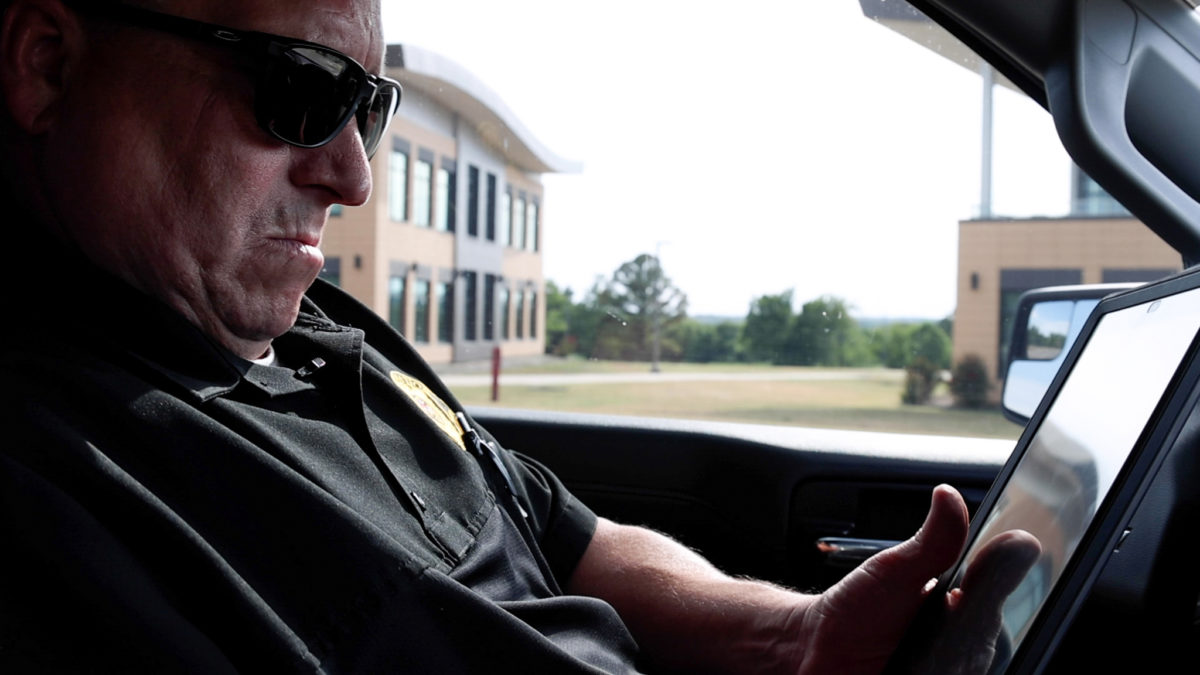
Osage Nation police Officer Rocky Davis looks at an iPad he received from GRAND Mental Health outside department headquarters in Pawhuska, Oklahoma, on July 12, 2022. “I think we must do better in helping people that have mental health issues,” Davis says. (Laura Bargfeld/News21)
Experts agree that police shouldn’t respond to most behavioral health calls. But when they do, they should have the training and tools to deal with the situation. Police departments across the country have spent millions of dollars and uncounted hours training officers in crisis intervention.
One of the most popular models is the crisis intervention team, or CIT. The National Alliance on Mental Illness said there are more than 2,700 CIT programs in the U.S.
Ron Bruno, executive director for CIT International, said the model isn’t just about training. It involves bringing together behavioral health services, law enforcement agencies, advocates, people with lived experiences and other resources to develop a plan that works.
That plan should include developing a crisis response system that is the most compassionate, most effective and least intrusive to the lives of people with mental health disorders, Bruno said.
This summer, the Arizona health care system Mercy Care brought together several law enforcement agencies for a CIT training event in Tempe. They spent 40 hours in the span of five days learning about de-escalation tactics and practicing them. They heard from people with lived experiences, and the training included sessions titled “family perspective,” “veteran perspective” and “hallucinations and hearing voices.”
Although many departments have signed on to CIT programs, Bruno said, only a small number are certified. CIT International in 2021 established a certification process to ensure departments are following best practices. As of September, only 15 programs were certified.
Bruno said many law enforcement agencies have misused CIT programs.
“There were so many people that claimed that they were doing CIT,” he said, “but then we’d get these calls from the community saying, ‘See, it doesn’t work. Our CIT officers just shot an unarmed person.’”
Bruno said most departments try to get all their officers CIT-trained when they should select a few vetted patrol officers.
“Not every officer has the skill set to handle everything perfectly, and we need to start realizing that,” Bruno said. “It has to be somebody that has the desire to work with this special population.”
Ickleberry, the police captain from Bartlesville, Oklahoma, was involved with CIT 20 years ago as a crisis negotiator. He said he learned the importance of using the right tone when speaking to a person in crisis.
“A lot of times when law enforcement shows up, it’s the uniform that’s the threat, so we need to figure out a way to take that threat away,” he said. “The biggest way to do that is being able to talk to people.”
Other training may involve cultural competency.
Melissa Pitts Johnson, a health care professional in Pryor, Oklahoma, said that’s an important element in crisis response. As a citizen of the Cherokee Nation, she said certain cultural traditions and practices may get misconstrued as symptoms of a mental health disorder.
“Sometimes that means we ask for help and education from the people that we’re serving because there’s no better expert in that,” she said.
In addition to training, some communities have found tools that have helped improve communication between law enforcement and health care professionals.
In northeast Oklahoma, that came in the form of iPads.
“Our iPad program is a level of care that literally puts treatment on demand in your hand,” said Johnson, the regional clinical director for GRAND Mental Health. “It has the ability to receive outpatient care from your team regardless of your location and to be able to get crisis support and 24/7 care literally at the touch of a button.”
GRAND Mental Health, which serves 12 counties and has headquarters in Claremore, has distributed more than 10,200 iPads in about six years at a total cost of about $4.8 million. They have distributed about 8,500 of them to clients and nearly 1,700 to first responders and hospital personnel.
The state reimburses the company for all crisis services — including the iPads — provided to Medicaid beneficiaries.
Nicholas Allgood, chief clinical officer of crisis services, said the iPads are especially effective in rural areas because they can provide immediate service.
“You’re not traveling anywhere,” Allgood said. “You’re not using gas. You’re not dependent on the client’s income. Your no-show rates go down for your sessions because they’re right there.”
Ickleberry said all Bartlesville patrol officers have iPads, and they have been a great tool. The department usually handles three to four calls a day with the help of the iPad, he said.
Officers can connect people with mental health help with the click of a button. And most of the time, it does not require the officer to transport somebody to a hospital and spend long hours waiting as they receive treatment.
Reducing the role of law enforcement
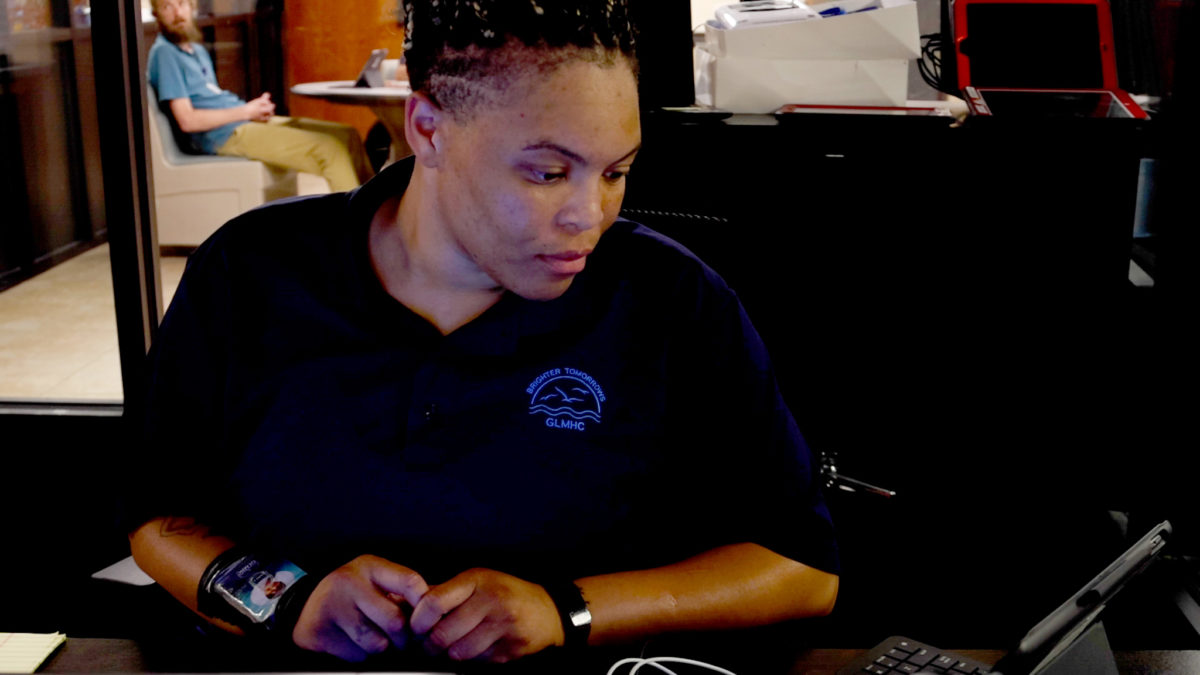
Sara Foreman, a certified peer recovery support specialist, speaks with a client through an iPad at GRAND Urgent Recovery Center in Pryor, Oklahoma, on July 15, 2022. (Laura Barfeld/News21)
Foreman, the PRSS, sits in GRAND Mental Health Crisis Center’s Pryor location with her laptop on a table and an iPad propped next to her.
The iPad rang, and Foreman’s face brightened when she saw the name on the screen. The caller was a regular who she dubbed one of her “special ones.” It did not matter why the person called. She would listen to every word they had to say. As a peer recovery support specialist, her job is to relate to clients and restore hope in them.
“I see miracles every day working at this job,” Foreman said.
GRAND Mental Health’s service area covers 10,000 square miles, so instead of having one central crisis center, it has 22 locations that serve as an alternative for emergency rooms and jails.
Foreman said she has seen people end up behind bars because officers don’t know how to handle a mental health crisis.
“Just sending that person to prison is not going to help the situation,” she said. “They need to be stabilized and medicated.”
In 2016, 56 percent of the U.S. prison population indicated a recent or previous mental health disorder, according to the Prison Policy Initiative.
For a comprehensive system to work, it needs three parts: a crisis call center to help get the right help to people, a crisis mobile team to respond when necessary and crisis receiving and stabilization facilities, according to the Substance Abuse and Mental Health Services Administration’s best practice guide.
GRAND Mental Health serves as a crisis receiving and stabilization facility. It has reduced inpatient psychiatric hospitalizations from 841 adult clients in 2015 to one in 2019 with the help of iPads and crisis receiving centers, according to a study by the National Association of State Mental Health Program Directors Research Institute.
The study also reports that the GRAND model has produced an estimated $62 million in cost savings by diverting clients from inpatient hospitalization. As for the law enforcement side, the model has saved these agencies a total of 13,831 hours, or more than 576 days, in time previously spent transporting people to a psychiatric hospital.
An Oklahoma law passed in 2021 requires third parties to transport a person in crisis to the nearest treatment facility if the distance is greater than 30 miles. Previously, that responsibility fell on the shoulders of law enforcement agencies.
“In the old days when we transported people, we were transporting two to three people per day to mental health facilities,” Ickleberry said. “Since the iPad came along and then since the law changed in Oklahoma, GRAND Mental Health is the one that now transports them to their facilities, so that’s taking the load off us.”
What’s next for mental health crisis response?
State Rep. Steve Eliason, photographed at his home in Sandy, Utah, has sponsored a number of bills promoting access to mental health services in the state, including suicide prevention and increasing mental health access for frontline workers and health care professionals. (Taylor Bayly/News21)
Making any crisis response reform work requires funding, support and collaboration from all the key players — policymakers, law enforcement agencies, health care leaders and the public.
Stoycoff said a successful response involves everyone.
“It’s not up to one sector,” he said. “It’s not up to the mental health treatment system alone. You need to have a community that is responsive and able to provide pathways to treatment where and when they’re needed because it allows that treatment to occur sooner before it escalates to a crisis.”
State lawmakers have taken the launch of 988 as an opportunity to introduce legislation to strengthen and expand care. For example, in 2021, Virginia created a Crisis Contact Centers Fund to develop a comprehensive crisis system involving contact centers, mobile crisis teams and crisis stabilization centers. Similarly, Washington state appropriated $23 million to fund the operations of crisis contact centers, whose staff has the ability to deploy mobile crisis teams. In September, Oklahoma dedicated $125 million in American Rescue Plan Act funding for the construction of two new psychiatric hospitals. Another pediatric behavioral health hospital operated by the University of Oklahoma is being expanded.
The same goes for Utah, where legislators supported funding to increase access to mental health crisis services in rural areas.
Utah state Rep. Steve Eliason has introduced more than 30 mental health-related bills since 2011.
The Republican legislator said his child was hospitalized a few years ago and needed to see a child psychiatrist. They eventually found one, but not before going through the emergency room. His experience showed him the need for improvement in the mental health system.
One of the bills he sponsored in 2021 involved requiring Utah police officers to go through mandatory training to learn how to better interact with people on the autism spectrum and other mental illnesses. The governor signed the bill into law later that session.
“Our support has been very strong, very broad, very bipartisan,” he said. “It’s an area of police reform that I think everybody can agree with.”
Even with legislative support and funding, building a new system takes time.
Rachel Lucynski, director of crisis services at the Huntsman Mental Health Institute, said the creation of an integrated crisis response system in Utah represented more than a decade of partnerships with elected officials, commission members and state departments.
But for some, the pace of change is too slow.
Rae Duckworth, the activist in Salt Lake City, said she hopes the day will come when police don’t need to respond to mental health calls at all.
The younger generation gives her hope.
“The kids are way smarter, and if we’re not listening to them, we’re in trouble,” she said. “I don’t want them marching for stuff we could literally figure out. We can figure this out. We just got to all sit down and talk about it.
“If we’re all participating, and we’re all realizing that the power is actually in our pockets, then we’re going to be unstoppable.”
There are all over 65 lung transplant applications in the United States, but 85 per cent of the surgeries are carried out by only about 20 packages. Irrespective, even the scaled-down applications — some that do just a handful of transplants for each calendar year — have to have ample staffing in get to continue to be open up. As in so quite a few locations of the world’s collective workforce, the provide of lung transplant medical practitioners is dwindling, though at the very same time the total amount of lung transplants is predicted to increase thanks to the ravages of COVID-19 on lung wellbeing.
Should some of the more compact transplant systems close?
Popular perception would dictate so, but, as in a lot of corners of our health treatment overall economy, the concern is much more complex, and the reply a lot less apparent, than a single would consider. Here’s why.
Even if little, the hospitals want their transplant systems to keep open for two reasons: Initially, centers want availability of all good organ transplants (coronary heart, kidney, liver and lung) in purchase to facilitate “one cease shopping” for insurance policy providers who want to contract throughout all organ strains. Second, the existence of a transplant program of any organ sort provides collateral small business to the clinic in that unique ailment team, building up-and down-stream revenue that is tough to exchange when it’s gone.
The 2022 Global Modern society for Heart and Lung Transplantation (ISHLT) assembly in Boston very last spring was enlightening in lots of means — not just mainly because it was the 1st in-individual meeting of cardiothoracic transplant pros considering that 2019, but also since it was an option for the transplant community to celebrate an crucial milestone: far more than 40,000 folks are now being transplanted per year — a amount that proceeds to rise — and clients are living longer. Regardless of these positives, I left the conference experience anxious, since the inadequate number of lung transplant physicians and surgeons to workers the present transplant programs is receiving even worse. I could scarcely walk 50 feet in the convention middle with no someone stopping me to talk to, “Do you know of any lung transplant medical doctors wanting for a new placement? We have a work opening.”
Doctor shortages are not a new trouble, nor confined to the transplant arena, but it is an difficulty which is finding worse in lung transplantation, because of to expansion of the field frequently and a workforce that is not staying resupplied in purchase to continue to keep up with demand. The acute and long-term consequences of COVID-19 pneumonia have improved, and that will have a domino influence on the volume of lung transplants done. As it pertains to the transplant workforce, lack of man or woman-ability is a pre-pandemic trouble that will only worsen as we leave the acute section of the pandemic.
So, why the absence of skilled people today to employees these applications?
When I posed this extremely problem to pulmonary medicine trainees when I was at Stanford — the team from whom we would count on to get our lung transplant fellowship candidates — the responses were both distressing and not entirely sudden. People dying consistently, lack of handle of do the job hours, and the duty of carrying a waiting list crammed with patients who could deteriorate at any time are qualities of the career that are not accurately interesting to the latest era of doctors who are considerably less swayed by the wonder of transplant, the euphoria when things went effectively, and the profound gratitude that this affected individual team often shows to transplant providers. These are all elements of the position that I liked — and missed when it was time for me to move away from the frontlines. In several means, interacting with the field now in a consulting function, I can see the issue of these more youthful doctors seeking for a various profession route. Maybe they are suitable to guard on their own from the rigors of the field.
But how does the lack of transplant clinicians influence individuals? In a term, adversely. Individuals who are cared for by harried, stretched slender clinicians suffer poorer outcomes. These clinicians are usually on the proverbial hamster wheel, remaining urged by hospital directors to do a lot more transplants and by regulatory bodies and insurance coverage organizations to produce far better outcomes. When I appraise a method with outcomes challenges in my consulting exercise, the amount one particular challenge is approximately usually a very simple one particular: lack of appropriately qualified physicians, either younger kinds to manage the rising number of recipients or, even a lot more relating to, mid-job physicians who have the eyesight, know-how and determination to lead applications in an ever much more complicated transplant environment. In simple fact, a lot of of the extra seasoned physicians at some of the finest programs in the country are on the lookout for a way out, considerably before than what would be considered “normal” retirement.
What is the resolution?
Very first, we require to use technology to unburden the transplant groups, specifically close to the organ procurement method which is physically exhausting (traveling out in the center of the evening to retrieve organs from a distant clinic), high-priced and demands staffing that many transplant packages do not have.
Moreover, the surgeons who are flying all around the region in the middle of the night to procure organs are often the identical ones that have scheduled cases the following working day, like complicated cardiac surgeries. Would you like your heart surgical procedure completed by the surgeon that has retrieved organs the earlier night time or one that has been at property speedy asleep? Uncomplicated respond to.
Systems to preserve organs “alive” do exist, retaining organs practical until a daytime transplant operation can be scheduled but, at the moment, are not becoming absolutely adopted by transplant facilities, mostly owing to absence of specialized familiarity with these new devices, absence of being familiar with of reimbursement problems for these systems, and, frankly, absence of willingness to embrace the transplant foreseeable future.
Second, the transplant programs will need to employ a diverse treatment model dependent less on applying physician trainees for getting the get the job done carried out and more on non-medical professionals workforce customers who can adhere to treatment method protocols for earning regimen remedy adjustments, have a tendency to the electronic health care record and see transplant clients who are stable in the outpatient clinic. Utilizing this model not only achieves a additional rational existence for trainees and extra skilled physicians but also provides clients with continuity of treatment, a familiar experience that will be all-around very long right after the trainees have still left for other possibilities.
The responsibility of having the infrastructure wanted to make the transplant treatment natural environment far more palatable will slide on the software administrators who will require to make a convincing circumstance to their clinic administrators that this route is the only way ahead.
Third, hospitals want to carry on to foster an natural environment wherever medical professional wellness is a priority. Lots of are starting off to do so — an encouraging pattern propelled ahead by the pandemic, not only for the supplier herself but also for the patient’s sake. Research have proven unequivocally that overall health care vendors that have obtained harmony in between their life outside of the hospital, and their lifestyle in it, give superior care.
Finally, the most controversial solution. If there is an at any time-expanding client team that wants fully commited, specialised treatment, a classic supply and desire problem arises when the source (in this case, lung transplant physicians and surgeons) seems incredibly unlikely to boost any time quickly. Therefore, we will have to minimize the demand from customers by minimizing the quantity of lung transplant systems.
Obtaining been in the transplant arena for many years, I am fully knowledgeable that hospitals will not voluntarily near their transplant programs in buy to serve some higher good. There are way too quite a few tempting fiscal and aggressive incentives for a healthcare facility to take into consideration shutting down unilaterally. But some ought to, considering that not currently being in a position to adequately serve this really ill affected person group in a method that they are worthy of violates each tenet of our occupation.
We don’t want our current variety of transplant packages —we as an alternative need only the amount that most effective serves our affected individual population. And that means, less.
BOSTON – A West Roxbury male pleaded guilty today in federal court in Boston in link with a scheme to defraud an insurance plan service provider for bodily therapy companies that ended up not delivered to people.
Slava Pleasure, 42, pleaded responsible to 1 rely of conspiracy to dedicate mail fraud. U.S. District Court Choose Richard G. Stearns scheduled sentencing for March 23, 2023. Satisfaction was indicted in February 2021 together with co-defendants Anna Barenboym, Gyulnara Bayryshova and Raya Bagardi.
Delight was a actual physical remedy assistant at Brighton Bodily Remedy (BPT), a Brighton-centered physical therapy clinic owned by Bayryshova. Barenboym and Bagardi were also employed at BPT as a certified physical therapist and a accredited physical therapist assistant, respectively. According to the charging paperwork, from October 2018 by June 2020, Pleasure and his co-defendants conspired to induce an insurance coverage corporation to reimburse them for physical remedy solutions that were not essentially presented and/or have been not medically vital and, in some circumstances, have been provided by people today not certified to present the providers. Specially, Delight and, allegedly, his co-defendants falsely billed for companies purportedly rendered to people wounded in car incidents when the companies were not basically supplied. It is additional alleged that BPT paid out sufferers for referrals, referred clients to lawyers to guide with patients’ insurance settlements and recognized kickbacks from people attorneys in return.
Pride is the next defendant to plead responsible in the circumstance. On March 17, 2022, Barenboym pleaded guilty to her function in the conspiracy and is scheduled to be sentenced on April 4, 2023.
The charge of conspiracy to dedicate mail fraud delivers for a sentence of up to 20 many years in prison, three yrs of supervised launch and a fantastic of $250,000. Sentences are imposed by a federal district court docket decide centered on the U.S. Sentencing Recommendations and statutes which govern the perseverance of a sentence in a legal scenario.
United States Legal professional Rachael S. Rollins Joseph R. Bonavolonta, Exclusive Agent in Charge of the Federal Bureau of Investigation, Boston Division Anthony DiPaolo, Main of Investigations of the Insurance policy Fraud Bureau of Massachusetts Boston Law enforcement Commissioner Michael Cox and Quincy Law enforcement Chief Paul Keenan manufactured the announcement today. Assistant U.S. Lawyer Laura J. Kaplan of Rollins’ Structured Criminal offense & Gang Unit is prosecuting the scenario.
The details contained in the charging files are allegations. The remaining defendants are presumed innocent except if and until eventually demonstrated responsible beyond a realistic question in a courtroom of legislation.