
Inflation and money woes are forcing Americans to delay medical care : Shots

Inflation and money woes are forcing Americans to delay medical care : Shots

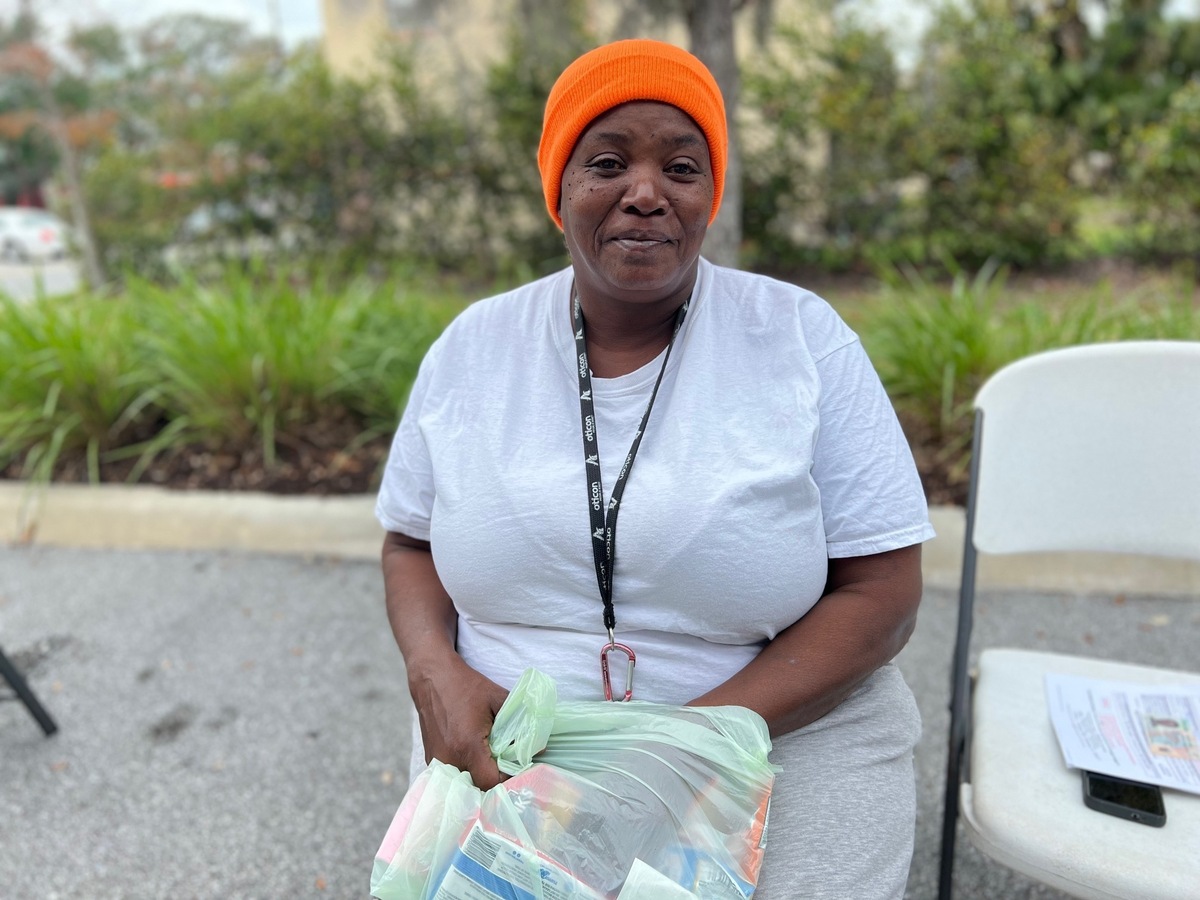
Substitute teacher Crystal Clyburn, 51, doesn’t have health insurance. She got her blood pressure checked at a health fair in Sarasota, Fla.

Stephanie Colombini/WUSF


hide caption

toggle caption

Stephanie Colombini/WUSF


Substitute teacher Crystal Clyburn, 51, doesn’t have health insurance. She got her blood pressure checked at a health fair in Sarasota, Fla.

Stephanie Colombini/WUSF

At a health-screening event in Sarasota, Florida, people milled around a parking lot waiting their turn for blood pressure or diabetes checks. The event was held in Sarasota’s Newtown neighborhood, a historically Black community.

Local resident Tracy Green, 54, joined the line outside a pink and white bus offering free mammograms.

“It’s a blessing, because some people, like me, are not fortunate and so this is what I needed,” she said.

Green said she wanted the exam because cancer runs in her family. And there’s another health concern: her breasts are large and cause her severe back pain. A doctor once recommended she get reduction surgery, she said, but she’s uninsured and can’t afford it.

In a recent Gallup poll, 38{08cd930984ace14b54ef017cfb82c397b10f0f7d5e03e6413ad93bb8e636217f} of Americans surveyed said they had put off medical treatment last year due to cost, up from 26{08cd930984ace14b54ef017cfb82c397b10f0f7d5e03e6413ad93bb8e636217f} in 2021. The new figure is the highest since Gallup started tracking the issue in 2001.

A survey by The Kaiser Family Foundation last summer showed similar results. It found people were most likely to delay dental care, followed by vision services and doctor’s office visits. Many didn’t take medications as prescribed.

The health screening event is part of an ongoing effort provide health services to low-income Floridians who are uninsured. Attendees could have their blood pressure checked or receive screenings for diabetes. A bus also delivered mammogram services.

Stephanie Colombini/WUSF


hide caption

toggle caption

Stephanie Colombini/WUSF


The health screening event is part of an ongoing effort provide health services to low-income Floridians who are uninsured. Attendees could have their blood pressure checked or receive screenings for diabetes. A bus also delivered mammogram services.

Stephanie Colombini/WUSF

The neighborhood screening event in Newtown — organized by the non-profit Multicultural Health Institute in partnership with a local hospital and other health groups — is part of an effort to fill in the coverage gap for low-income people.

Tracy Green explained that her teeth are in bad shape too, but dental care will also have to wait. She doesn’t have health insurance or a stable job. When she can, she finds occasional work as a day laborer through a local temp office.

“I only make like $60 or $70-something a day. You know that ain’t making no money,” said Green. “And some days you go in and they don’t have work.”

If she lived in another state, Green might have been able to enroll in Medicaid. But Florida is one of eleven remaining states that haven’t expanded the program to cover more working-age adults. With rent and other bills to pay, Green says her health is taking a backseat.

“I don’t have money to go to the dentist, nothing, it’s so expensive,” she said. “Now, to get one extraction, one tooth pulled, it’s like $200-300 that you don’t have. So I don’t know what to do. It’s like fighting a losing battle right now.”

Tracy Green, 54, joined the line outside a pink and white bus that offered free mammograms. Green said she wanted the exam because cancer runs in her family.

Stephanie Colombini/WUSF


hide caption

toggle caption

Stephanie Colombini/WUSF

Tracy Green, 54, joined the line outside a pink and white bus that offered free mammograms. Green said she wanted the exam because cancer runs in her family.

Stephanie Colombini/WUSF

In the Kaiser poll, 85 percent of uninsured adults said they found it difficult to pay for health care. Nearly half of insured respondents said they struggled with affordability as well.

The U.S. experienced record high inflation rates last year, and parts of Florida, including the nearby Tampa metro area, often fared even worse.

“We see an increasing desperation,” said Dr. Lisa Merritt, executive director of the Multicultural Health Institute.

The Institute, which helps people access low-cost care, is based in Newtown. The neighborhood, inland from Sarasota’s lavish beach communities, has many residents who live below the poverty line, lack insurance and face other barriers to consistent and affordable care.

“It’s very difficult for people to be concerned about abstract things like getting screenings, getting regular health maintenance, when they’re contending with the challenges of basic survival: food, shelter, transportation often,” Merritt said.

‘Horrible’ housing costs put squeeze on health needs

Merritt and her team of volunteers work to build trust with community residents who may not be aware that support is available. They help people apply for low-cost insurance coverage, free medication programs and other resources that can reduce treatment costs.

Volunteer Bonnie Hardy said the people she serves have many financial worries, but one thing tops the list.

“Right now? A place to stay,” said Hardy. “Housing is horrible.”

High housing costs have started to ease in recent months, but data shows rent in Sarasota has gone up nearly 50 percent since the pandemic began in 2020.

Hardy helps people find housing and connects them with programs that cover costs like utilities and security deposits. The goal is to help people stabilize their day-to-day lives, and that in itself can improve health, she said.

“Because they’re more comfortable now,” she said. “They feel like, hey the rent is paid, I can let my guard down, maybe I can go get the medical attention I need.”

Dr. Lisa Merritt and her team of volunteers work to build trust with community residents who are uninsured but may not be aware that support is available.

Daylina Miller/WUSF


hide caption

toggle caption

Daylina Miller/WUSF


Dr. Lisa Merritt and her team of volunteers work to build trust with community residents who are uninsured but may not be aware that support is available.

Daylina Miller/WUSF

Research shows putting off health care can lead to bigger problems.

The Gallup poll found 27{08cd930984ace14b54ef017cfb82c397b10f0f7d5e03e6413ad93bb8e636217f} of respondents delayed treatment due to costs even for “very or somewhat serious” conditions.

Another reason people may be holding off on treating medical issues is that they already have health care debt. An investigation from NPR and Kaiser Health News found about 100 million people in America had medical debt. About 1 in 8 owe more than $10,000, according to a KFF poll.

Treating cancers or chronic conditions like diabetes early can not only save lives, it can also be less expensive than treating advanced-stage illnesses, according to the Centers for Disease Control and Prevention.

Doctors at the health screening event in Newtown said it’s critical to help residents access preventive care.

At the health fair, substitute teacher Crystal Clyburn, 51, got a mammogram on the pink-and-white mobile bus and had her blood pressure checked. Clyburn doesn’t have health insurance and she relies on events like this to stay on top of her health.

“I just try to take advantage of whatever that’s out there, whatever that’s free,” she said. “You have to take care of yourself because you can look healthy and not even know you’re sick.”

After the cuff came off, a doctor told Clyburn her blood pressure was a little high. But then the doctor kept talking, and she smiled.

Although her pressure was high, it wasn’t high enough that she needed to take medication. She thanked him and left, relieved to know that was one expense she wouldn’t have to worry about. Not yet, anyway.


Millions of Americans could lose Medicaid insurance as the pandemic winds down

Millions of Americans could lose Medicaid insurance as the pandemic winds down

Perhaps the greatest success of the American health care system these last few benighted years is this surprising fact: The uninsured rate has reached a historic low of about 8 percent.

That’s thanks in part to the pandemic — or, more precisely, the slew of emergency provisions that the government enacted in response to the Covid crisis.

One policy was likely the single largest factor. Over the past three years, under an emergency pandemic measure, states have stopped double-checking if people who are enrolled in Medicaid are still eligible for its coverage. If you were enrolled in Medicaid in March 2020, or if you became eligible at any point during the pandemic, you have remained eligible the entire time no matter what, even if your income later went up.

But in April, that will end — states will be re-checking every Medicaid enrollee’s eligibility, an enormous administrative undertaking that will put health insurance coverage for millions of Americans at risk.

The Biden administration estimates upward of 15 million people — one-sixth of the roughly 90 million Americans currently receiving Medicaid benefits — could lose coverage, a finding that independent analysts pretty much agree with. Those are coverage losses tantamount to a major economic downturn: By comparison, from 2007 to 2009, amid the worst economic downturn of most Americans’ lifetimes, an estimated 9 million Americans lost their insurance.

Some will lose coverage because they are no longer eligible due to a change in income or circumstance, such as a child turning 18. States are supposed to direct these people toward other insurance options, such as the Affordable Care Act marketplaces.

But many of the people who end up losing their benefits — even most, according to some projections — could be people who are actually still eligible for Medicaid but slip between the cracks of the system. People who have recently moved are one particular concern, as are children and people with disabilities.

For people who watch health policy closely, the coming “redetermination” process is one of the biggest stories of the year, with major ramifications for Americans’ health.

A lot of people are going to lose coverage no matter what. That is inevitable. The emergency “continuous coverage” provision, which cost nearly $150 billion over the past three years, was never going to be indefinite. The US health system is not set up to provide that many people, some of whom are no longer eligible for the program, with indefinite health benefits, unless they are old enough to qualify for Medicare.

But the goal, according to people who advise and advocate for people on Medicaid in states across the country, should be to minimize the number of Americans who lose their Medicaid benefits even if they are still eligible for them, and to make sure that the people who no longer qualify for Medicaid get other coverage.

Don’t let too many people fall through the cracks. Otherwise, the coverage gains of the past few years could be quickly eroded.

“If people lose Medicaid, whether they’re ineligible or remain eligible for Medicaid, and they’re not connected with another form of insurance, that’s potentially devastating for individuals,” Emma Morris, a policy analyst at the Oklahoma Policy Institute, told me. “This is a really pivotal point.”

This year’s coverage losses could be particularly dramatic. But they’re also a symptom of a bigger, more persistent problem that predated the pandemic: People cycle on and off Medicaid coverage all the time, including for reasons as mundane as paperwork. It’s a problem that, historically, many states have shown little interest in solving, and one that is now reemerging with a vengeance.

The end of Medicaid emergency continuous coverage, explained

The task in front of public officials is enormous: check the eligibility of every single one of the 90 million people currently on Medicaid to confirm they still meet the criteria for their benefits. And if they don’t happen to reach someone because that person moved, or they think a notice from the state is junk mail? That person will find themselves out of luck — and out of Medicaid.

Preventing that worst-case scenario will depend on states getting the word out early and often and using all of the tools available to them to reach people. Whether they will actually do that is already creating some concern. Congress has given states up to 12 months to complete the redetermination process. But in Texas, where as many as 1 million people may lose coverage, state officials have said they want to finish it in eight months, for reasons that are not clear.

“That raises a concern of trying to do this fairly complex job in a shortened timeline and the risk that might lead to adverse redetermination outcomes for people that that still are entitled to being in Medicaid,” Jason Terk, a physician and chair of the Texas Public Health Coalition, said.

In an ideal scenario, many beneficiaries won’t have to do anything to affirm their Medicaid eligibility. States can check existing data sources to verify a person’s income. If they are still eligible, they will keep their benefits. If they are not, the state should let them know what their insurance options are. (We’ll come back to that.)

The problem is these automatic checks are something a lot of states were terrible at doing prior to the pandemic. Almost all states say they conduct what are known as ex parte renewals, meaning they use existing public data to verify people’s eligibility without the person having to do anything. Ex parte renewals were supposed to be mandatory under the Affordable Care Act. But, according to Jen Wagner at the Center on Budget and Policy Priorities, enforcement has been lax: A few states don’t do them at all, and 20 of them said they completed less than half of their renewals this way. Some states, including Texas, have decided not to adopt policies that make ex parte renewals easier, such as assuming people who are eligible for SNAP, or food stamps, are also eligible for Medicaid.

Now states’ ability to perform those tasks is crucial. Most states say their redetermination plans start with ex parte renewals, which will test the effectiveness of their databases and IT systems. And many Medicaid offices are beginning this process understaffed: One in five jobs posted at state Medicaid offices were unfilled, according to the National Association of Medicaid Directors. In some states, nearly half of the jobs, more than 40 percent, were unfilled.

“We’re seeing states struggling right now to keep up now, when you’re not doing renewals,” Wagner said.

The first way states are trying to minimize risk is by starting the process with certain groups of people who may be at less risk if they lose coverage, such as those who have never filed a claim while enrolled in Medicaid; for those recipients, the possibility of disrupting medical care seems lower. In states like Oklahoma, Missouri, North Carolina, and Florida, where I interviewed patient advocates and state Medicaid officials to get a better sense of states’ preparation, the plan was usually to save more vulnerable populations — older people, people with disabilities, and children — for the later phases.

For people whose eligibility cannot be confirmed via a public database, states will have to do it manually. That will mean sending out mail and other forms of communication to ask beneficiaries to send in information so their eligibility can be verified.

That can be a difficult task. People move, some frequently. They ignore mail. They may not know this is happening in the first place. Most states allow people to report eligibility details or change their contact info on their websites or over the phone, but not all do — and those services, such as a call center, have to be adequately staffed. Otherwise, problems can arise and people may give up rather than put up with a hassle.

In Florida and Texas, two states worth watching closely given their large size and right-leaning politics, Republican leaders have not appeared very engaged on the issue, even as doctors and activists in those states credit the state health agencies with taking it seriously.

“The political leadership is not particularly enamored with or concerned about necessarily enhancing Medicaid policy here in the state of Texas,” Terk said. “I would hope, and I would try to be optimistic, that the governor’s office would be more forceful in his messaging. … It would be helpful if that were to happen. But I’m not sure that it’s reasonable to expect that.”

There are myriad ways administrative friction leads to people losing benefits when they shouldn’t. States have to be invested in preventing it. In states like Missouri and Oklahoma, top elected officials have been actively fighting against the implementation of Medicaid expansion, which made many low-income adults newly eligible for the program; now many of the people who became eligible through the expansion in the past few years will have their eligibility checked for the first time. Policy analysts worry some of those people could lose coverage simply because they aren’t familiar with the process.

Another way people could lose coverage in the coming months is if they are legitimately no longer eligible for Medicaid but fail to get enrolled in a different insurance plan.

States could make a big difference in preventing that, by directing people to the ACA marketplaces (where they may qualify for government assistance) and the navigators who receive federal funding to help people sort their marketplace options and sign up.

Medicaid offices across the country have been planning for this for months. But it’s not clear some states are doing everything they can on to make sure people who are no longer eligible are enrolled in a new health plan In Florida’s redetermination plan, for example, the actual mechanisms for directing people to their other coverage options are left vague and navigators are not mentioned at all.

“A lot of these plans sound excellent. The question is, what do they look like in implementation?” Alison Yager, executive director of Florida Health Justice, told me. “There are invariably going to be challenges. This is too huge for there not to be challenges.”

According to the Georgetown Center for Children and Families, nine states have not even posted their public plan for this Medicaid unwinding. A similar number have not shared any kind of communications toolkit, which could be useful to the advocates and providers who will be on the front lines of educating people about the situation. (Here is an example from the state of Texas.)

Some people may have no viable option for coverage at all, if they’ve had a change in circumstance that renders them ineligible (such as a child turning 18) but they live in a state that hasn’t expanded Medicaid under the ACA nor do they have a high enough income to qualify for subsidies to purchase private insurance.

Florida is one of those non-expansion states. One family there, who shared their story with Florida Health Justice, has three members who all need regular monitoring and check-ups because of complex medical conditions. They were supposed to lose their Medicaid coverage in 2020, when their son turned 18, but that was postponed through the continuous coverage provision. When that policy ends, they may become uninsured because Florida has not expanded Medicaid under the ACA.

It all adds up to a dramatic and sudden US health policy problem that has laid dormant for the past three years: churn.

The problem of Medicaid churn remains

It is an absurdity of the American health system, compared to those of other developed countries, that millions of vulnerable people could end up becoming uninsured in a matter of months. But even in normal times, because of how our health system is set up, people with low incomes shift frequently between different insurance coverage, going from Medicaid to ACA insurance subsidized by the federal government or not having any insurance at all.

It’s called “churn,” and it has long been recognized as a problem. In 2018, about 10 percent of Medicaid enrollees cycled on and off the program within a year.

Sometimes, people can simply have a few months where they pick up extra work hours, boosting their income to the point they are no longer eligible, and they lose coverage. (Eligibility checks vary across states in normal times.) The next month, their earnings may drop back down, making them eligible once again — but then they have to sign back up.

It adds to the workload for those understaffed Medicaid offices and it can disrupt health care for the patients too. People don’t fill prescriptions when they have to pay more money out of pocket. They skip doctor’s appointments and other vital services.

Now, after the three-year pause on redeterminations eliminated that problem, the end of the emergency coverage will bring it back.

States could be doing more to prevent Medicaid churn — but, at least so far, they’re not. The low rate of ex parte renewals that automatically confirm eligibility was one way the US was coming up short pre-pandemic.

Some states are also not taking advantage of other optional policies that the federal government has made available. A state can, for example, extend coverage for a woman who becomes eligible during pregnancy through their first year after her child is born. According to the Kaiser Family Foundation, more than a dozen states still have not adopted that policy since Congress authorized it in 2021.

A year of continuous coverage for kids is more common, and states such as Oregon and Washington have even approved multi-year continuous eligibility for children. On the other hand, more than a dozen states have not adopted that policy either and a number of others have conditions that limit their effectiveness.

Congress has recently added some new requirements to address the problem for the longer term, including that all states provide children with 12 months of continuous coverage starting next year. That should help. But it won’t eliminate the problem entirely. It will come back again to how well states perform in checking and re-checking people’s eligibility, now and in the future, and whether they are being held accountable when they fall short.

There has been more sustained interest in the problem of Medicaid churn with the end of the emergency coverage provision approaching. But it remains to be seen how long it will last. A reversion to the pre-pandemic normal would put beneficiaries at a higher risk going forward of losing their coverage than they should. Research has routinely shown people have more access to health care, use more health care, and self-report better health when they are enrolled in Medicaid. That is what people are losing when they lose their benefits.

Churn is inevitable in the multi-payer structure that the US has set up to finance its health care. But we could be handling it better. The massive redetermination process will be an immense test, forcing states to re-check the eligibility of every single beneficiary. But even once it’s over, individual patients will still face the risk of losing coverage when they perhaps should not. The problems churn creates are not going away.

“Churn doesn’t have to be what it is. Unwinding doesn’t have to be a disaster,” Wagner told me.

The stakes for the rest of 2023 are enormous, and Medicaid agencies have not always performed well in the past in making sure everybody who is eligible for Medicaid gets on it. Now, health coverage for millions of Americans hinges on their being able to get it right.

Correction, February 13, 2 pm ET: An earlier version of this story used an outdated source on the number of states providing 12 months of postpartum Medicaid coverage.

A record number of Americans have health insurance, but churn is likely on the way

A record number of Americans have health insurance, but churn is likely on the way

Comment

Happy Thursday, where today the nation’s top federal official overseeing Medicare becomes eligible for the program. Xavier Becerra, the Health and Human Services secretary, is turning 65. 

Today’s edition: All the details on the Republican leadership of the House Energy and Commerce Committee. The Food and Drug Administration’s top food safety official resigned, citing flaws in the agency’s crisis response. But first … 

A record number of Americans are enrolled in marketplace coverage, but others could soon get kicked off Medicaid

President Biden has staked his health agenda on lowering the cost of care and building on the Affordable Care Act. 

He got some good news yesterday: A record-breaking 16.3 million Americans signed up for Obamacare plans during the health law’s 10th enrollment season — a figure that comes after the country’s uninsured rate dipped to its lowest level early last year. 

Separately, state health officials will soon be faced with the herculean task of determining who is no longer eligible for Medicaid after three years of being allowed to stay on the program amid the pandemic. And several experts — as well as groups involved in the effort — are worried the number of Americans without insurance could begin to rise. They fear some who lose Medicaid won’t know where to turn to get health insurance next, posing a new challenge for both federal and state health officials.

“What I’m worried about is that we may have hit the high-water mark on our nation’s coverage rates,” said Sabrina Corlette, a co-director at Georgetown University’s Center on Health Insurance Reforms.

Health and Human Services Secretary Xavier Becerra:

Last year’s sweeping government funding bill marked the beginning of the end for pandemic-era Medicaid rules, which have prevented states from kicking people off their coverage. The spending package gave states the greenlight to begin booting people no longer eligible for the safety net program off their coverage beginning in April. 

“We absolutely as an administration are committed to working with states and other entities to make sure that we get people redetermined in a way that either helps them retain coverage, whether it’s Medicaid, whether it’s marketplace, or whether it’s moving into employer-sponsored insurance,” Chiquita Brooks-LaSure, the head of the Centers for Medicare and Medicaid Services, said on a press call yesterday. 

She noted that top federal marketplace and Medicaid officials — such as Ellen Montz and Daniel Tsai — are having conversations together with states to discuss the issue.

There are varying estimates about what could happen over the course of the next year-plus. In an August report, the federal health department predicted that roughly 15 million people could lose their Medicaid or Children’s Health Insurance Program coverage when the continuous enrollment provisions came to an end. 

  • Roughly 2.7 million are expected to qualify for financial aid on the ACA health exchanges, and of those, 1.7 million are likely to be eligible for marketplace plans without any premiums. 
  • About 5 million are expected to obtain other coverage, particularly through employer-sponsored plans. 

In 2021, Democrats’ coronavirus relief package boosted tax credits for low-income shoppers and granted them to middle-income Americans for the first time. The party avoided a major headache when it passed a measure to extend the new subsidies through 2025 in last year’s Inflation Reduction Act. 

Biden officials have largely attributed the roughly 13 percent jump in Obamacare enrollment to the extra financial aid. And the Department of Health and Human Services believes the enhanced tax credits will provide “a key source of alternative coverage” for some who will no longer be eligible for Medicaid. 

But for such a fallback plan to work, Americans who can hop on the Obamacare exchanges will need to know about the option. 

“There’s a big concern that people won’t know that that’s the next place to go,” said Cynthia Cox, a vice president at the Kaiser Family Foundation. “There’s a role for states, there’s a role for insurers, there’s a role for the federal government to do more marketing and outreach.”

Sharing those concerns is Jodi Ray, the program director for Florida Covering Kids and Families, which operates a large navigator program that helps people sign up for coverage. She says her group has been preparing for this moment for over a year, and that increased funding from the Biden administration has helped keep her staffing at a high level year-round, instead of just during the ACA enrollment season. 

On the Medicaid front, states have been developing transition plans required by the federal government, said Kate McEvoy, the executive director of the National Association of Medicaid Directors. State Medicaid officials are prepping public education campaigns, partnering with navigator organizations and asking enrollees to update their contact information.  

  • “States want to be as deliberate about this as they can,” she said, “so they’re looking to be careful about how fast this process moves, and just be really conscious of how to do that fairly.”

On tap today: Biden will deliver his first major economic speech of the year in Virginia, where he’s expected to blast the GOP over its economic agenda, including over some Republican lawmakers’ interest in changes to entitlement programs, like Social Security and Medicare, per a White House official.

Rodgers lays out House Energy and Commerce leadership

Rep. Brett Guthrie (R-Ky.) has been named chair of the House Energy and Commerce health subcommittee, the full panel’s chair, Rep. Cathy McMorris Rodgers (R-Wash.), announced yesterday.

The news isn’t exactly a surprise. Guthrie was the subcommittee’s top Republican in the last Congress as well as co-leader of the House GOP’s Healthy Future Task Force. As subcommittee chair, Guthrie said he plans to prioritize combating the overdose epidemic, making health care more affordable and increasing the development of and access to lifesaving treatments.

  • “A new wave of oversight and accountability in health care is coming for the Biden administration to improve health care agencies and prevent future crises,” Guthrie said in a statement.

Rodgers also announced that she tapped Rep. Morgan Griffith (R-Va.) to helm the committee’s oversight and investigations subcommittee, of which he had previously been a ranking member. Rep. Kelly Armstrong (R-N.D.) will serve as vice chair of the full committee.

More from Rep. Cathy McMorris Rodgers (R-Wash.): 

FDA food safety official resigns, cites flaws in agency’s crisis response

The Food and Drug Administration’s top food safety official resigned yesterday, citing shortcomings in the agency’s ability to handle foodborne illnesses, including last year’s nationwide infant formula shortage, our colleagues Laura Reiley and Jacob Bogage report.

Frank Yiannas, the agency’s deputy commissioner for the office of food policy and response, will leave his post next month. The FDA is expected to announce more changes within its food safety division in the coming days.

The details: “The decentralized structure of the foods program that you and I both inherited significantly impaired FDA’s ability to operate as an integrated food team and protect the public,” Yiannas wrote in a resignation letter to FDA Commissioner Robert Califf, which was obtained by The Post. He recommended that Califf restructure the agency to include a “fully empowered and experienced” deputy commissioner for foods, with direct oversight of the centers and offices responsible for human and animal products.

His advice isn’t far off from recommendations of a recent independent review of the agency by the Reagan-Udall Foundation, which concluded that the FDA’s hobbled response to the infant formula shortage — of which Yiannas was at the center — was hampered by flaws in the leadership structure and poor communication.

CDC: Bivalent booster offers similar protection against latest variants

Data released yesterday by the Centers for Disease Control and Prevention suggests that the protection offered by Pfizer-BioNTech and Moderna’s updated coronavirus booster shots hold up against the new subvariants fueling infections across the country, The Post’s Fenit Nirappil and Lena H. Sun report.

According to the study, which looked at data from coronavirus tests conducted at pharmacies from Dec. 1 to Jan. 13, bivalent boosters cut the risk of symptomatic infection caused by the now dominant XBB.1.5 subvariant by about half for most adults, and by more than one-third for people 65 and older.

“Bottom line: We did not see reduced vaccine protection against symptomatic illness for XBB/XBB.1.5 compared with recent BA. 5-related variants, which is reassuring,” said Brendan Jackson, who heads CDC’s coronavirus response.

Why it matters: Earlier lab studies had raised concerns because the bivalent booster produced lower levels of virus-fighting antibodies against the XBB-related subvariants than the BA.5 omicron subvariant it was designed to target. But that does not seem to be the case in the real world, CDC officials and experts said.

Also … Additional data posted by the agency yesterday shows that the updated booster reduced the risk of death from covid-19 by more than twofold compared with people who had only received the monovalent vaccine. It cut the risk of death by nearly 13 times in those who are unvaccinated.

  • Sen. Joe Manchin (D-W.Va.) said yesterday that House Speaker Kevin McCarthy (R-Calif.) privately agreed to leave cuts to Medicare and Social Security off the table in debt ceiling negotiations, Forbes reports.
  • The Justice Department filed federal charges yesterday against a man accused of setting fire to an Illinois Planned Parenthood. The announcement comes a day after a federal grand jury indicted two Florida residents for allegedly spray-painting threatening messages on crisis pregnancy centers in the state.
  • A North Carolina OB/GYN is suing the state over its restrictions on medication abortion, arguing that the FDA’s federal authority to regulate mifepristone preempts the state’s restrictions on the drug and that the law should be declared invalid.
  • Tennessee rejected millions of dollars from the federal government for HIV/AIDS prevention, which critics say was triggered due to the inclusion of transgender and abortion rights groups as grant recipients, The Post’s Ariana Eunjung Cha and Fenit Nirappil report this morning.

Unmet Needs: Critics Cite Failures in Health Care for Vulnerable Foster Children (By Andy Miller and Rebecca Grapevine | Kaiser Health News)

California enacts new abortion laws, expecting copycats (By Alice Miranda Ollstein | Politico)

The drug was meant to save children’s lives. Instead, they’re dying (By Rosa Furneaux and Laura Margottini | Bureau of Investigative Journalism and Stat)

Thanks for reading! See y’all tomorrow.

Anti-Asian violence causing a mental health crisis for Asian Americans

Anti-Asian violence causing a mental health crisis for Asian Americans

Medicare begins to rein in drug costs for older Americans

Medicare begins to rein in drug costs for older Americans

Steve Lubin used a large amount final yr on insulin to regulate his Kind 2 diabetes.

A retired nurse in Philadelphia, Lubin depends on Medicare for wellness protection, which includes a Aspect D program to cover drug expenditures. However, his out-of-pocket prices kept mounting, which include a deductible of $480, regular materials of two types of insulin, and better charges after he entered the “coverage hole.” His full insulin tab in 2022: $1,582.

So, Lubin, 68, was cheering for the sprawling federal Inflation Reduction Act, which among the other provisions identified as for capping insulin price ranges for Part D beneficiaries at $35 a month, with no deductible. He signed petitions circulated by the American Diabetic issues Affiliation and the Pennsylvania Overall health Access Network inquiring Congress to approve it.

“My earnings is unquestionably down from when I was working, and the charges go up,” he explained. “It’s tricky.”

Lubin also supported the monthly bill simply because, just after doing work in an intensive treatment unit for decades, he experienced observed sufferers experience the critical effects of diabetes when they could not find the money for their prescriptions.

“You’d take their history and discover out that they had been rationing their insulin or could not take it at all,” he recalled.

In August, Congress handed the monthly bill, and President Joe Biden signed it. Lubin’s out-of-pocket insulin prices for 2023 will fall to $630. The legislation establishes other specifications to decrease drug charges for Medicare beneficiaries, about 3-fourths of whom have Component D programs.

“It’s just one of the most significant changes to the way Medicare promotions with prescription medicines,” claimed David Lipschutz, associate director of the Centre for Medicare Advocacy. “It signals lawmakers’ willingness to just take on a very effective lobby.”

Some provisions took effect Jan. 1 some others will phase in in excess of many several years. “Collectively, these symbolize significant out-of-pocket price tag personal savings, especially for individuals who use expensive medications,” claimed Juliette Cubanski, deputy director of the Kaiser Loved ones Foundation’s Medicare policy software. They could also bolster Medicare by reducing its investing.

Beneficiaries will see three sizeable improvements in 2023.

The very first is the $35 month to month cap on insulin, which will have an impact on additional than 1 million insulin buyers who have Component D via Medicare Gain plans or free of charge-standing options acquired alongside with common Medicare.

From 2007-20, beneficiaries’ mixture out-of-pocket insulin costs quadrupled, even however the selection of users only doubled. They spent an average $54 a month on insulin in 2020, in accordance to a Kaiser Spouse and children Basis analysis.

The cap will help save ordinary consumers at the very least 35{08cd930984ace14b54ef017cfb82c397b10f0f7d5e03e6413ad93bb8e636217f} and applies straight away, with out demanding them to initially spend the Portion D deductible, which amounts to $505 in 2023. About 10{08cd930984ace14b54ef017cfb82c397b10f0f7d5e03e6413ad93bb8e636217f} of Component D insulin users, these kinds of as Lubin, compensated more than $1,300 out of pocket in 2020 and will help you save considerably a lot more.

Though all Element D plans ought to cap the price, they are not expected to offer you each and every form or manufacturer of insulin.

“People should really make further confident their system is not dropping their insulin from the formulary,” Cubanski stated.

But Medicare’s open-enrollment period finished Dec. 7, and its on the internet cost-comparison tool doesn’t replicate changes mandated by the new legislation, which was passed just after Aspect D ideas experienced previously established rates.

“People may have created different options if they’d had far more facts,” Cubanski stated.

So, Medicare has started a a person-time unique enrollment time period by the stop of 2023, permitting insulin people to fall, include or alter Part D ideas. Beneficiaries have to call the 1-800-MEDICARE quantity to make a switch. Counselors at Condition Wellbeing Insurance policy Guidance Packages can also enable with the final decision.

In the 2nd important transform, grownup vaccines included by Element D, ordinarily available at pharmacies, are now free of charge, with no deductibles or copays, just as the flu and pneumonia vaccines (included by Aspect B) have been.

That will, in distinct, improve access to the shingles vaccine, the most expensive adult vaccine. In 2018, the Kaiser Family Basis described, Element D enrollees paid out $57 for each dose out of pocket — and each and every recipient demands two doses.

Although shingles risk rises with age, only 46{08cd930984ace14b54ef017cfb82c397b10f0f7d5e03e6413ad93bb8e636217f} of adults more mature than 65 experienced been vaccinated by 2020, the Centers for Disorder Command and Prevention reported. Costs were being much reduced amongst Black and Hispanic older adults.

“It’s disappointing due to the fact this is a spectacularly efficient vaccine,” reported Dr. William Schaffner, an infectious disorder professional at Vanderbilt University Health care Center. Shingrix, the present-day vaccine, is about 90{08cd930984ace14b54ef017cfb82c397b10f0f7d5e03e6413ad93bb8e636217f} successful, and a new examine has located that its protection persists a decade following vaccination.

A significant condition in itself, shingles can also induce the lingering nerve ache identified as article-herpetic neuralgia. “It differs from becoming annoying to currently being totally lifetime-shifting,” Schaffner mentioned.

With Shingrix out there at pharmacies without having cost, “the receptivity to vaccination for more mature adults will improve significantly, primarily amongst underserved populations,” he predicted.

Also free: hepatitis A and hepatitis B vaccinations, and Tdap, which protects against tetanus, diphtheria and pertussis (whooping cough).

The third main modify: When selling prices for drugs included below Element D, and some below Aspect B, enhance speedier than the inflation charge, the legislation now demands drug makers to pay rebates or facial area rigid penalties.

Whilst all those rebates will go to Medicare, not to persons, “if you are liable for a part of a drug’s value and there are limitations on how significantly that can enhance, in theory, your expenditures ought to lessen,” Lipschutz stated.

It will just take months for Medicare to identify which price improves will prompt rebates and how considerably the rebates will sum to. But the Congressional Budget Business has believed this provision will help save Medicare more than $56 billion around 10 a long time.

Medicaid has employed a comparable tactic given that 1990. “It certainly has an effect on keeping shelling out in examine,” Cubanski stated. “The hope is that it will have the exact same outcome for Medicare.”

Americans Sour on U.S. Healthcare Quality

Americans Sour on U.S. Healthcare Quality

Tale Highlights

    &#13

  • A lot less than 50 {08cd930984ace14b54ef017cfb82c397b10f0f7d5e03e6413ad93bb8e636217f} now rate U.S. health care high quality as fantastic or great
  • &#13

  • Americans’ 72{08cd930984ace14b54ef017cfb82c397b10f0f7d5e03e6413ad93bb8e636217f} optimistic rating of individual health care good quality also a new lower
  • &#13

  • Evaluations of U.S. healthcare coverage, charge are a lot more subdued but steady
  • &#13

WASHINGTON, D.C. — For the 1st time in Gallup’s two-decade pattern, significantly less than half of People in america are complimentary about the good quality of U.S. healthcare, with 48{08cd930984ace14b54ef017cfb82c397b10f0f7d5e03e6413ad93bb8e636217f} ranking it “excellent” or “good.” The slight the vast majority now level health care high-quality as subpar, which include 31{08cd930984ace14b54ef017cfb82c397b10f0f7d5e03e6413ad93bb8e636217f} indicating it is “only fair” and 21{08cd930984ace14b54ef017cfb82c397b10f0f7d5e03e6413ad93bb8e636217f} — a new substantial — contacting it “poor.”

###Embeddable###

The most up-to-date excellent/good score for U.S. healthcare excellent is just two share factors decrease than in 2021 even so, it is very well under the 62{08cd930984ace14b54ef017cfb82c397b10f0f7d5e03e6413ad93bb8e636217f} high issue two times recorded in the early 2010s. It also trails the typical 55{08cd930984ace14b54ef017cfb82c397b10f0f7d5e03e6413ad93bb8e636217f} looking through because 2001.

These results are from Gallup’s yearly Overall health and Healthcare study. The most current update was conducted Nov. 9-Dec. 2, 2022.

A vital motive sights of U.S. healthcare high quality have been trending downward in recent years is that Republicans’ constructive rankings have been subdued considering the fact that President Donald Trump remaining business. Currently, 56{08cd930984ace14b54ef017cfb82c397b10f0f7d5e03e6413ad93bb8e636217f} of Republicans level health care quality as outstanding or great, whereas 69{08cd930984ace14b54ef017cfb82c397b10f0f7d5e03e6413ad93bb8e636217f} felt this way in 2020 and 75{08cd930984ace14b54ef017cfb82c397b10f0f7d5e03e6413ad93bb8e636217f} in 2019. Republicans’ sights of healthcare high quality also dropped in 2014 just after implementation of the Economical Care Act in advance of rebounding under Trump. Meanwhile, Democrats’ beneficial ratings have been regular at a reduced level (now 44{08cd930984ace14b54ef017cfb82c397b10f0f7d5e03e6413ad93bb8e636217f}).

On top of that, given that 2012, public gratification with health care has trended downward between center-aged and youthful older people, when remaining large amid individuals 55 and more mature. Regardless of whether this change (seen throughout party traces) stems from growing healthcare fees for these not on Medicaid, perceived variations brought about by the ACA, or a thing else is not crystal clear. The far more new declines among the youthful older people may well replicate adjustments to health care that have taken position amid the COVID-19 pandemic or curtailed access to abortion due to the fact the Supreme Court’s Dobbs choice.

###Embeddable###

Constructive Sights of Have Health care Excellent Also Shrink

Americans’ evaluations of the high quality of healthcare they individually get are also at a low ebb — albeit better than their U.S. score — with 72{08cd930984ace14b54ef017cfb82c397b10f0f7d5e03e6413ad93bb8e636217f} supplying it outstanding or fantastic marks. This low studying has been two yrs in the producing, with the metric slipping six details to 76{08cd930984ace14b54ef017cfb82c397b10f0f7d5e03e6413ad93bb8e636217f} in 2021 and an additional four factors in the previous calendar year.

###Embeddable###

The first drop was witnessed about evenly throughout all age groups, even though the fall in 2022 is completely between grown ups 18 to 34. Scarcely 50 percent of this youthful age group (53{08cd930984ace14b54ef017cfb82c397b10f0f7d5e03e6413ad93bb8e636217f}) is now upbeat about the good quality of care they receive, versus 72{08cd930984ace14b54ef017cfb82c397b10f0f7d5e03e6413ad93bb8e636217f} of all those 35 to 54 and 85{08cd930984ace14b54ef017cfb82c397b10f0f7d5e03e6413ad93bb8e636217f} of individuals 55 and older.

No Alter in Sights of Health care Coverage

The exact poll asks Americans to price health care coverage — both of those in the nation and their possess. The scores hole concerning these is even broader than that viewed for health care quality, with 32{08cd930984ace14b54ef017cfb82c397b10f0f7d5e03e6413ad93bb8e636217f} of Us residents considering health care protection nationally to be exceptional or excellent compared to 66{08cd930984ace14b54ef017cfb82c397b10f0f7d5e03e6413ad93bb8e636217f} ranking their own protection this highly.

###Embeddable###

Contrary to health care good quality, nevertheless, these are not the worst scores for healthcare coverage, traditionally. The national rating of 32{08cd930984ace14b54ef017cfb82c397b10f0f7d5e03e6413ad93bb8e636217f} is very similar to 2021’s 29{08cd930984ace14b54ef017cfb82c397b10f0f7d5e03e6413ad93bb8e636217f} and equal to the ordinary from 2001 to 2021. And though Americans’ constructive ranking of their individual coverage is down 5 details from 2021, the figure has been as very low as 63{08cd930984ace14b54ef017cfb82c397b10f0f7d5e03e6413ad93bb8e636217f} beforehand (in 2005).

Value Stays a Pain Position

Community fulfillment with the whole cost of health care in the U.S. is rather standard of what it has been around the earlier two many years, with just 24{08cd930984ace14b54ef017cfb82c397b10f0f7d5e03e6413ad93bb8e636217f} happy and 76{08cd930984ace14b54ef017cfb82c397b10f0f7d5e03e6413ad93bb8e636217f} dissatisfied. The proportion satisfied has averaged 22{08cd930984ace14b54ef017cfb82c397b10f0f7d5e03e6413ad93bb8e636217f} given that 2001, only the moment straying a lot more than a couple of details from that — in 2020 for the duration of the pandemic, when 30{08cd930984ace14b54ef017cfb82c397b10f0f7d5e03e6413ad93bb8e636217f} ended up glad.

In the meantime, amid higher inflation in 2022, 56{08cd930984ace14b54ef017cfb82c397b10f0f7d5e03e6413ad93bb8e636217f} of Americans report being contented with the whole value they have to fork out for healthcare — the most affordable Gallup has measured because 2016. The most affordable in the trend was 54{08cd930984ace14b54ef017cfb82c397b10f0f7d5e03e6413ad93bb8e636217f}, recorded in 2006.

###Embeddable###

Two-Thirds However Diagnose System With Key Problems or Even worse

Most likely reflecting their growing problems about healthcare excellent, Americans’ notion that the U.S. healthcare system is in a state of crisis has developed to 20{08cd930984ace14b54ef017cfb82c397b10f0f7d5e03e6413ad93bb8e636217f}, the best considering the fact that 2013. Even so, the 68{08cd930984ace14b54ef017cfb82c397b10f0f7d5e03e6413ad93bb8e636217f} all round indicating it is in crisis or has important challenges is identical to the figure in most many years from 2002 to 2021.

###Embeddable###

Bottom Line

For most of Gallup’s tracking of Americans’ sights on healthcare due to the fact 2001, there was a crystal clear difference in between the superior regard persons had for the high quality of treatment in the region versus the challenges they noticed in healthcare administration, such as coverage and price tag. That is no longer the circumstance, with general public praise for U.S. health care high quality dipping beneath 50{08cd930984ace14b54ef017cfb82c397b10f0f7d5e03e6413ad93bb8e636217f} and the slight greater part now viewing high-quality as only reasonable or weak.

Some of this shift displays partisan positioning, because considering that implementation of the ACA in 2013 below former President Barack Obama, Republicans have been much less possible to offer a good assessment of health care quality less than Democratic presidents (as they are now beneath President Joe Biden) than they were less than Trump or, in advance of that, below George W. Bush. But the shifts by age recommend extra components are at do the job.

Even as they lament the price tag, a bulk of Us citizens continue to have significant regard for the quality of their personal healthcare and healthcare protection. Still even their possess healthcare quality ratings are not what they at the time were. Ought to these proceed to worsen, Us residents could be considerably less resistant to rocking the U.S. health care boat. That could, in turn, influence the sorts of plan modifications they may perhaps be willing to take in the furtherance of improved public well being outcomes.

To keep up to date with the most current Gallup Information insights and updates, comply with us on Twitter.

Find out far more about how the Gallup Poll Social Series operates.