
How brain blast injuries hurt soldiers’ mental health.

How brain blast injuries hurt soldiers’ mental health.

Welcome to State of Mind, a section from Slate and Arizona State University dedicated to exploring mental health. Follow us on Twitter.

I’ll never forget the way my body felt after that blast inside a dugout trench in northern Iraq. It was 2016, and I was there as my unit’s journalist, accompanying Sgt. Joshua James and the seven other men in his team. Each time James and his section fired their artillery piece—a long-range cannon that could shoot high-explosive rounds for miles—the force of the explosion was so strong it knocked the breath out of me and caused a shudder in my bones. As the dust cloud began to form from the sand blown off the walls and ground, filling our noses and staining our uniforms, I also felt a dull pain in my head, like I had just gotten hit in the face.

Blast overpressure, it’s called: the “near-instantaneous pressure rise” in the area around an explosion, according to researchers. The men in James’ unit experienced it each time they stood feet away from their gun as it fired. During their nine-month deployment, the unit would launch shells toward their enemies around 6,000 times. As a result, some incurred noticeable concussions, and each blast had the potential to cause what the Centers for Disease Control now call “primary blast injury of the brain,” with symptoms similar to other types of mild traumatic brain injuries, or mTBIs: headaches, irritability, cognitive deficits, and even death.

Each brain injury suffered from blast exposure also increases the chances of a service member developing symptoms akin to those seen in Chronic Traumatic Encephalopathy, or even developing CTE itself. CTE, a degenerative brain disease, is understood as a driver behind negative mental health outcomes for NFL players, including Andre Waters, Junior Seau, and Aaron Hernandez. For the thousands of military personnel who serve in units like James’, the threat to brain health comes not only from IEDs or incoming artillery fire, but from their own weapons systems.

The Department of Defense has estimated that more than 380,000 personnel have suffered some sort of mTBI since the start of the War on Terror in 2001. Over that same period, the suicide rate among service members has skyrocketed. More than 30,177 service members and veterans who served during the War on Terror alone have died due to suicide, four times the number of troops lost in combat during that period. Importantly, not all these deaths are related to blast injuries—the military’s mental health crisis is complex and involves factors including military sexual trauma, poor leadership, combat exposure, quality of life issues, and many others. But medical research released in March found military personnel with mTBIs have a suicide rate that is almost three times the national average, and that risk is even higher if they seek care through the VA.

When they returned home from Iraq, half of the men in James’ eight-man section found themselves with mental health conditions such as depression and PTSD. One of them was James himself; on Nov. 15, 2022, James, age 35, died by suicide, the second in five years from his platoon of fewer than 30 people, leaving behind his wife and two young children. We may never know the exact role multiple blast overpressure events played in deaths like James’—in large part due to military failures which continue today.

The DoD has not properly documented the role of blast-related brain injuries in the military’s mental health crisis. This is despite explicit instruction by Congress to do so; for example, in 2020 Congress required the agency to include detailed records of troops’ blast exposure in their medical records. This tracking is critical for service members and veterans who want to receive treatment for their injuries. In February, the DoD released the findings from its Suicide Prevention and Response Independent Review Committee, a research program mandated by Congress. The report highlighted a lack of mental health workers and issues with the military’s promotion system and suicide prevention training, among other problems. But in discussing the next steps to be taken in light of the findings, the DoD did not highlight the effect of TBIs on suicide risk at all.

This omission is especially glaring because the DoD has known for years about the risks from blast exposure. In 2017, the same year James’ unit returned home, a Marine artillery unit in Syria found itself with multiple members stumbling around in a daze from concussions at times. Others began literally bleeding from their ears during the fighting. The DoD grew so concerned by the prevalence of these injuries that it conducted a study the following year on the Marines.

Their findings were startling: Based on the rate of head injuries the Marines in Syria suffered, the DoD estimated that an artillery crew firing at the same rate would find themselves with degraded combat abilities within three weeks and be almost totally ineffective in two months.
Furthermore, the report (based on service members’ medical records) highlighted that head injuries among these personnel began to occur during training, before they even got into combat. The DoD calculated that in a larger unit with similar demands, brain injuries could disable hundreds of personnel, and replacements could not be trained fast enough to make up for the losses.

The Syria report suggested having Marines wear devices that would notify a service member when they reached the maximum level of blast exposure in a 24-hour period, but that suggestion has effectively gone nowhere. In fact, simple helmet sensors that gather, monitor, record, and maintain data on blast pressure exposure have been available since at least 2009. But James and his unit weren’t even given these before they deployed. Put simply: Tech that could help aid in the diagnosis of concussions and TBIs should be widely distributed. It isn’t.
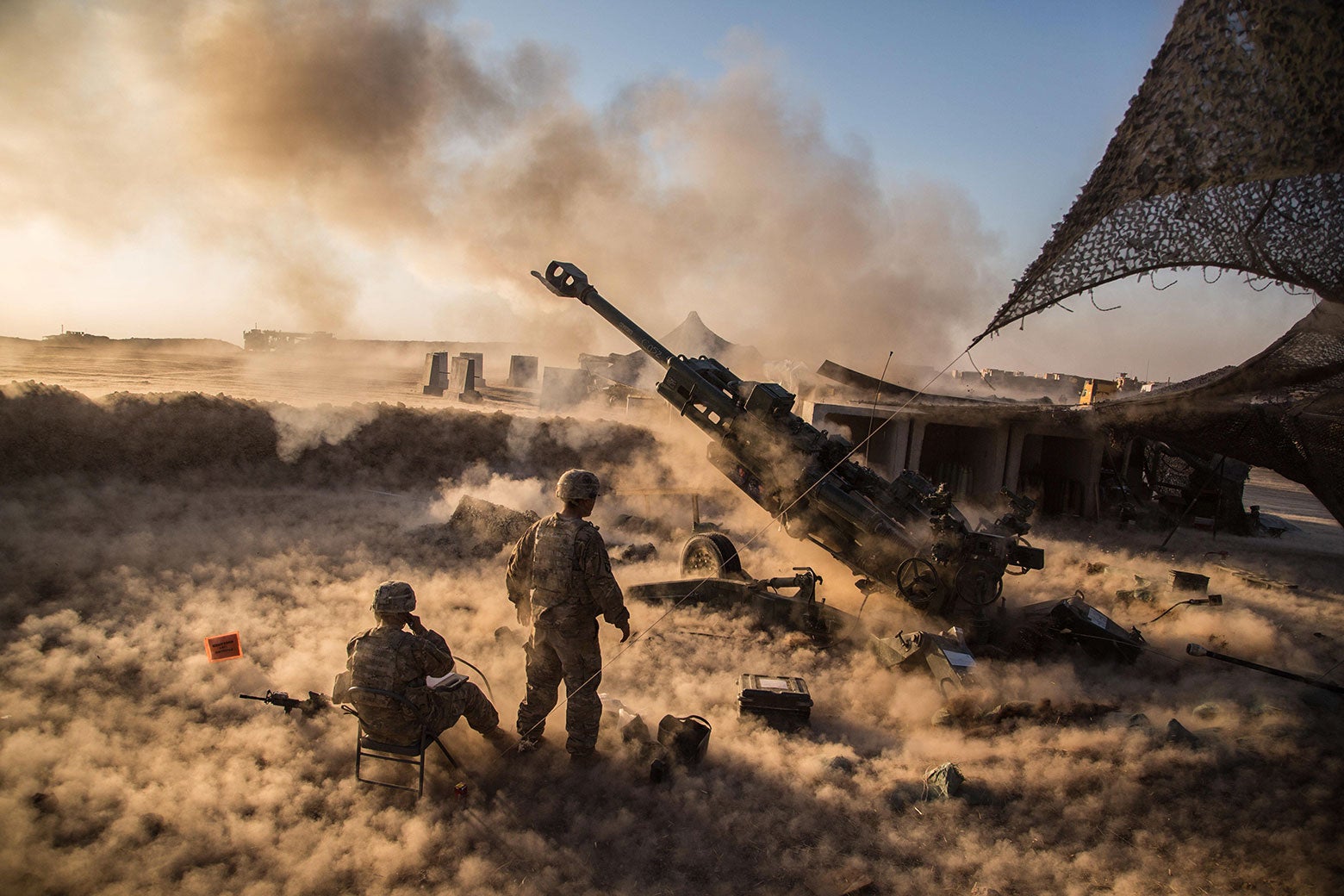
Two soldiers stand next to a smoking cannon as sand swirls around them dramatically.
U.S. soldiers in Iraq on Nov. 29, 2016.
Spc. Christopher Brecht/U.S. Army

This wasn’t the only way the DoD failed James and his unit. Although the soldiers underwent a pre-Iraq health assessment that looked at neurological health, they told me there was no follow-up upon their return to analyze potential damage incurred during their deployment. (Pentagon policy requires such a follow-up if servicemembers display signs of a brain injury). Soldiers in James’ unit also told me that they were rebuffed or ignored when they asked their superiors about the post-deployment assessment, even as the military continued to send artillery units to the Middle East with combat tempos that were just as high as before. I had a similar experience: Three years after I returned from Iraq, I attempted to go to an on-base TBI clinic after suffering from headaches and dizziness, but I was refused treatment and analysis because I hadn’t “underwent evaluation in time,” the medical personnel at my unit told me. When I asked a Department of Defense spokesperson about these experiences in a telephone interview, they were surprised to hear the issues we had obtaining access to these assessments and told me the agency was moving toward a more holistic continuous evaluation system that isn’t just based on pre- and post-deployment health assessments.

As for the status of military brain-health initiatives, in the same interview the Department of Defense pointed me to interim guidance on managing brain risk from blast overpressure, which is meant to raise awareness of the issue among military personnel (there is no ETA for when this text will be finalized). This guidance, on one page, suggests units and commanders follow rules about explosive safety that have been in place for more than a decade. (These rules, the Syria report shows, have done little to keep service members truly safe from blasts.) Making potential interventions trickier, each service branch has different safety requirements—and in an email exchange, the DoD did not answer my question about what is being done to standardize policy.

In response to congressional efforts in 2018 and 2020, there has been some attempt to better document cognitive health. The DoD added a specific diagnostic code for primary blast injuries to the brain, which the DoD spokesperson said in the email would make such injuries easier to track. Before that change, blast history was regularly documented “as a mechanism of injury in the medical record, but no diagnostic code existed for blast injury to the brain specifically,” the spokesperson wrote. This progress is admirable, but the Pentagon’s own December 2022 statement to Congress acknowledges that lawmakers requested more than just a diagnostic code. The congressional correspondence also explained that monitoring and documentation of blast events had “not routinely included a measure of blast pressure” or tracked blast exposure history as the 2020 law had requested, and that there was no current ETA for when it would.

The science behind blast brain injuries is still developing, alongside knowledge of TBIs from other “physical” events, such as tackles, car accidents, or punches. Research suggests the recurrence of exposure matters. Injuries caused by objects around the blast are important, in addition to the pressure itself. And these injuries are hard to recover from. Although PTSD symptoms and TBIs are often concurrent, they are two separate phenomena with unclear influences on each other.

Further research, enabled by routine and widespread blast-pressure tracking, is especially urgent as militaries domestically and abroad shift toward relying more on artillery in current and potential future conflicts, including in the war in Ukraine.

The DoD often cites prospective recruits fearing for their safety—such as the expectation that they will develop mental health or other health issues due to military service—as a reason that it finds itself in a recruiting crisis, and this is a legitimate fear. By failing to complete even the bare minimum task given to it by Congress three years ago to begin tracking blast exposure correctly, the DoD has not fully supported service members like Joshua James and his unit. All the soldiers in the firing pit with me that day in northern Iraq were in their 20s or even teens. None had any idea that they were trading a piece of their future each time they fired.

The research is far enough along that the next generation of service members shouldn’t have to face such a destructive bargain.

​​If you need to talk, or if you or someone you know is experiencing suicidal thoughts, text the Crisis Text Line at 741-741 or call or text 988 to reach the Suicide & Crisis Lifeline.

Remember importance of physical therapy during Brain Injury Awareness Month

Remember importance of physical therapy during Brain Injury Awareness Month

Delaware State Information

Traumatic mind accidents have an impact on millions of people each year, with a extensive the greater part of them getting younger grownups or little ones.

These types of damage can absolutely alter a lifestyle, possibly creating lifelong actual physical, cognitive and behavioral modifications.

The Brain Harm Association of America functions to raise recognition through Brain Injuries Recognition Month in March. This calendar year, advocates are spreading information through the #MoreThanMyBrainInjury marketing campaign.

TBI and concussion distinctions

Not like concussions, traumatic brain injuries are severe and generally debilitating, and can result in physical and behavioral consequences for the relaxation of a patient’s lifestyle, stated Brooke Mihalek of Aquacare Physical Therapy, with locations in Delaware and Maryland.

These types of injuries can be triggered by a jolt or blow to the head that disrupts the regular working of the mind. This can final result in bruising, bleeding or tearing of mind tissue and a selection of symptoms, these as headache, nausea, confusion and decline of consciousness. TBIs can manifest owing to falls, sports activities accidents, car or truck incidents, actual physical assaults and a lot more.

On the other hand, she stated, a concussion is a delicate traumatic mind injury that takes place because of to a blow to the head but does not end result in any seen injury on imaging scans. Whilst concussions can induce indicators comparable to these of TBIs, they ordinarily take care of within just a couple of days or weeks with correct relaxation and administration.

The key difference involving the two injuries is in the severity and long-term consequences. Though a concussion may perhaps not final result in any long lasting harm, a traumatic brain damage can result in everlasting improvements in the brain’s construction and purpose.

A individual with a TBI may knowledge a variety of actual physical, cognitive and emotional symptoms, like trouble with motion, memory loss, personality changes and depression, which can substantially impact his or her quality of lifestyle.

How can actual physical remedy enable?

Traumatic brain accidents can have a profound affect on a person’s capacity to get the job done, manage relationships and have out working day-to-working day functions independently. For these explanations, it is critical to seek out prompt medical consideration and stick to a comprehensive rehabilitation system, Ms. Mihalek explained.

Bodily therapy is a crucial piece of the puzzle to healing, supporting the brain and the muscle mass reconnect. Most of the time, you do not have to believe about moving your hand to get a cup or lifting your foot to take a phase because these occur in a natural way. Nonetheless, for folks with TBIs, their brains may no for a longer period keep in mind how to do these matters. They require to be relearned through bodily therapy.

Bodily therapists perform on a variety of techniques — from smiling to going for walks, offering an individual a hug, buying up products or opening a doorway. They can work with people at any phase of restoration, she added.

For data, stop by aquacarephysicaltherapy.com.

How proton therapy helped my son with a childhood brain tumor

How proton therapy helped my son with a childhood brain tumor

My son Benjamin was born weighing only 3 pounds. He stayed in the NICU for 7 months. It was challenging and financially draining. We had a kindergartener and toddler at residence, although also viewing Benjamin at the hospital each individual working day. 

When Benjamin was capable to come household, he experienced a full parenteral nourishment (TPN) central line, an ostomy bag and a gastrostomy tube (G-tube) to get nourishment.  

By the time he was 1, he was in a position to try to eat and have the ostomy bag and G-tube taken out. Life was starting to sense usual.  

At 2 decades outdated, he jumped into a foam pit at a birthday occasion and arrived out keeping his head to the aspect. When I asked if he felt damage, he stated no. I waited a couple of times considering he had pulled a muscle in his neck. But the head tilt remained.  

When I took him to his pediatrician, they sent us to bodily therapy. Soon after two months, practically nothing had improved. We observed a neurologist who reported he seemed delighted and healthier with no other indicators other than a head tilt. The neurologist ordered an MRI to be protected, but I remember her telling me that she did not feel they would find everything.  

Right before we remaining the medical center parking whole lot, I gained a call saying the MRI final results were being in.  

A childhood mind tumor diagnosis 

That is when Benjamin was diagnosed with a sort of brain tumor named a Grade 1 pilocytic astrocytoma. His oncologist at our regional clinic advisable he start chemotherapy but prompt ready on radiation remedy to give his physique and mind time to develop so they could obtain the tumor greater. 

A number of months later on, tests showed the tumor had developed. His care workforce resolved to work. Benjamin experienced just turned 3 years outdated when he underwent brain surgical procedure. He then experienced two weeks of inpatient rehabilitation. This was tough on our spouse and children due to the fact we had two small ladies at home. 

Just after 6 decades of striving various forms of chemotherapy, together with two scientific trials, we have been ready to test radiation treatment. I understood the tumor was still escalating and Benjamin was obtaining signs or symptoms such as sleepiness and amplified face paralysis. So, we made a decision to just take a leap of religion, belief God and go to MD Anderson to have his tumor treated with proton beam treatment.  

Proton therapy is an sophisticated type of radiation cure that utilizes a beam of protons to produce radiation instantly to the tumor, destroying most cancers cells though sparing nutritious tissues.  As a final result, it minimizes facet consequences to protect against extended-phrase difficulties. Since of the bodily attributes of proton beams, it is ideal for pediatric most cancers patients with tumors found close to expanding tissues, particularly in the brain, backbone, eyes, ears or mouth. 

Perseverance via proton treatment treatment

In Sept. 2022, when Benjamin was 10 a long time previous, he began proton treatment at MD Anderson below the treatment of Dr. David Grosshans. He had a great practical experience at MD Anderson Proton Remedy Middle. Benjamin advised me it was the most straightforward cure he has been by way of. He bonded with his treatment team and loved using naps in the course of procedure. On Nov. 4, he celebrated his past cure by ringing the gong. 

All through remedies, he did not have side results. But following he concluded proton treatment, he experienced some numbness on the remaining facet of his entire body and weak point in his leg. He carries on to go to actual physical treatment and that assists boost his energy. 

Benjamin is performing effectively, and the tumor is stable. He is doing work tough to get caught up at faculty. Missing college for therapy influenced his studying the most. 

My suggestions to other moms and dads is to carry a reserve and a snack to remedy. Preserve a watchful eye on the affected individual and most of all, bear in mind to acquire it a person day at a time. 

Request an appointment at MD Anderson on the internet or by calling 1-877-632-6789.

Visually navigating on foot uses unique brain region

Visually navigating on foot uses unique brain region

News Launch

Wednesday, March 15, 2023

&#13
Occipital position place supports visually guided navigation, but only when walking not crawling.&#13
&#13

Applying eyesight to successfully shift by way of an space by foot takes advantage of a distinctive region of the brain’s cortex, in accordance to a tiny review funded by the Nationwide Eye Institute (NEI). The location, referred to as the occipital area location (OPA), fails to activate all through other modes of shifting, such as crawling. The obtaining may well enable clarify developmental milestones as children find out to interact with and navigate their in the vicinity of environments. The examine printed in the journal Cerebral Cortex. NEI is component of the Countrywide Institutes of Health.

Navigating by a physical setting – everything from a little room to a metropolis – necessitates the mind to approach many courses of information. Every single course of information and facts is processed in its have region of the brain’s cortex, which then do the job jointly to help navigation behavior, these kinds of as strolling. Loss of any one particular of these areas can impact how or no matter if someone can productively navigate.

Two main parts of the cortex are activated as individuals navigate by means of an ecosystem: the OPA and the retrosplenial complicated (RSC). Daniel Dilks, Ph.D., Emory University, Atlanta, theorizes that each of these regions supports a diverse type of navigation. The RSC supports map-based mostly navigation, which requires locating our way from a particular location to some distant, out-of-sight place (for case in point, finding our way from your household to your favourite restaurant). By distinction, he believes the OPA supports visually guided navigation, which requires acquiring our way by means of in close proximity to ecosystem, preventing boundaries and obstacles (for case in point, shifting by means of your kitchen with no bumping into matters).

On the other hand, his principle has been controversial, in part due to the fact the OPA does not show up to support visually guided navigation until finally about 8 yrs of age. However children somehow control to get about their properties and faculties prolonged before that time – even from the earliest ages, when they crawl alternatively than walk.

“We asked ourselves, does the OPA come on early but just mature slowly?” Dilks reported. “Or does crawling use an totally distinctive procedure?”

Even though most grownups and older youngsters mainly navigate environments by strolling, we retain the potential to crawl as we did in infancy. If OPA just matured slowly but surely, then it should really be activated by both modes of movement, Dilks reasoned. So, he and pupils Christopher Jones and Joshua Byland set out to find out irrespective of whether the OPA would activate in grown ups when crawling.

To check this, the scientists recorded films from the perspective of anyone going for walks as a result of an natural environment, and then similar movies from the perspective of a person crawling by way of that very same setting. They also patched with each other random pictures of the movies (scrambled) and took video clips from a flying-over-the-surroundings point of view, to consist of a mode of navigation not obtainable to people.

When viewing movies, our brains often activate as if we were doing the activity ourselves – a sympathetic response that created Dilks’ experiment feasible. Working with practical magnetic resonance imaging (fMRI), the scientists ended up equipped to keep an eye on the activation of mind areas in 15 adult research members as they had been viewing every single movie and imagining themselves moving by means of the natural environment.

When the members viewed the going for walks video clip, the location of the mind corresponding to the OPA was activated. But when they considered the other video clips – crawling, flying, or scrambled, OPA was not activated. In distinction, the RSC was activated when viewing all the films, suggesting that only OPA is specific for going for walks, as opposed to other modes of visible navigation.

In addition, numerous other brain regions ended up activated when the contributors seen the crawling video clips, suggesting extra areas that might be included in navigation early in lifetime.

“Not only does this analyze counsel that there’s a fully unique brain process managing navigation in early as opposed to late childhood, but it suggests that just about every of these parts of the navigation program appear on at different phases of progress,” Dilks reported. “Based on our review, we think OPA is specially tied to mature, successful walking.”

The analyze was funded by the Nationwide Eye Institute (R01 EY29724).

This push launch describes a basic research obtaining. Essential analysis increases our comprehending of human conduct and biology, which is foundational to advancing new and much better approaches to avoid, diagnose, and treat disease. Science is an unpredictable and incremental process— each and every study progress builds on previous discoveries, normally in unanticipated ways. Most medical advancements would not be doable without the information of essential standard research. To study extra about fundamental research, check out https://www.nih.gov/information-gatherings/essential-investigate-electronic-media-kit.  

NEI prospects the federal government’s analysis on the visible technique and eye ailments. NEI supports essential and scientific science applications to develop sight-conserving treatment plans and handle specific demands of persons with eyesight decline. For a lot more information, check out https://www.nei.nih.gov.  

About the National Institutes of Wellbeing (NIH):&#13
NIH, the nation’s professional medical exploration agency, consists of 27 Institutes and Facilities and is a element of the U.S. Office of Health and fitness and Human Companies. NIH is the major federal agency conducting and supporting fundamental, clinical, and translational professional medical study, and is investigating the leads to, treatment plans, and cures for each frequent and unusual diseases. For far more facts about NIH and its plans, pay a visit to www.nih.gov.

NIH…Turning Discovery Into Wellness®

References

Jones CM, Byland J, and Dilks DD. “The occipital spot place signifies visible details about going for walks, not crawling.” Cerebral Cortex, March 15, 2023. https://doi.org/10.1093/cercor/bhad055

###

One brain network may be involved in six mental health conditions, including depression, anxiety and OCD

One brain network may be involved in six mental health conditions, including depression, anxiety and OCD

Melancholy, nervousness, schizophrenia, bipolar problem, addiction and obsessive-compulsive ailment have all been connected to difficulties in the similar circuit of mind locations

Health


12 January 2023

One brain network may be involved in six mental health conditions

A single brain network has been joined with 6 mental wellness problems, including melancholy and stress

KATERYNA KON/SCIENCE Picture LIBRARY/Getty Visuals

Disturbances to a person community of mind areas may perhaps be concerned in the onset of 6 mental wellbeing circumstances.

The assert arrives from an analysis of current collections of clinical knowledge. The authors conclude that issues in the identical brain network may perhaps be involved in depression, stress, schizophrenia, bipolar dysfunction, habit and obsessive-compulsive condition (OCD).

Mind-scanning experiments have beforehand prompt that many distinctive regions of the organ are joined with a variety of psychological overall health issues, but their benefits were inconsistent, states Joseph Taylor at Brigham and Women’s Hospital in Boston, Massachusetts. Taylor and his colleagues wondered if that inconsistency was since a amount of different mind locations within one particular community could all participate in a purpose.

To discover extra, the crew appeared at the well being information of 194 Vietnam war veterans who experienced a bodily damage to their mind. The veterans had been more very likely to be identified with various mental wellbeing circumstances, including the six previously outlined, if they experienced injury to locations in direction of the back of the mind, together with an space identified as the posterior parietal cortex, which is connected with spatial perceptions.

They were being significantly less most likely to have these types of a analysis if they experienced been hurt close to the front of the mind, including in the anterior cingulate, a area linked with thoughts, and the insula, which is joined with self-awareness.

The team in comparison its conclusions with an present map of brain connections, identified as a connectome. This unveiled that when the identified areas at the back of the mind have lower action, the ones at the front are likely to have large exercise, and vice versa.

The researchers also seemed at 193 mind-scanning reports involving practically 16,000 folks. They discovered that people with any of the 6 psychological wellness ailments tended to have shrunken tissue in the regions at the front or in other spots joined to them.

Put jointly, the conclusions counsel that in men and women devoid of any mental wellbeing problem, the back areas of the brain inhibit the front regions, whilst in persons with damage to the back again areas, the entrance locations turn into also active, which may perhaps lead to mental illness and tissue shrinkage, says Taylor.

This is supported by earlier surgeries carried out by other researchers that wrecked modest components of the mind in individuals with serious mental health and fitness circumstances, these as OCD and despair that hadn’t responded to other treatment options. All the sites that were destroyed had been in the frontal regions.

Taylor’s staff has dubbed the circuit the transdiagnostic network simply because it would seem to be concerned in so several distinctive psychiatric diagnoses. He plans to boost brain activity in the posterior locations applying a strategy called transcranial magnetic stimulation as a possible procedure for psychological ailments.

The results suit with the concept that relatively than different psychological health problems getting disparate results in, they may possibly all have a shared fundamental result in, or “p factor”. The strategy is controversial for the reason that circumstances such as depression and schizophrenia have quite diverse signs.

“The effects increase to the developing pounds of proof that most psychiatric ailments share vulnerabilities,” says Terrie Moffitt at Duke University in Durham, North Carolina.

A lot more on these matters:

Marcus Institute for Brain Health Heals Veterans

Marcus Institute for Brain Health Heals Veterans

Training incidents, athletics injuries, and battlefield blasts set army servicemembers at risk for concussions and brain accidents. Most of these recover with regular medical remedy and time, but some are persistent and disruptive. Acquiring cure for these can be difficult and disheartening.

When Residence Depot co-founder Bernie Marcus located that out, he went to operate. He was on a 2007 check out to Shepherd Medical center, a best destination for neurological treatment, when he achieved a young brain-wounded servicemember who experienced recently regained his skill to walk after army medical doctors wrote him off as paralyzed for lifetime. In chatting to the younger man and then finding out about the rather significant prevalence of concussions and mind accidents in the military services currently, he resolved to start a private clinic to present attention to difficult cases. With his $2 million grant to Shepherd Healthcare facility, the SHARE Plan was born, presenting specialized treatment that is time-consuming and high priced, but does not price a dime for all those hurt in company.

Soon after registering successes, Marcus available to work intently and collaboratively with the Office of Veterans Affairs and Office of Defense, but was swiftly annoyed by the bureaucracy and territorial posturing of the federal government organizations. So he pushed the SHARE application ahead on its have, intensively dealing with around 40 individuals per year. But Marcus understood the potential and the want ended up much increased.

In 2014, he hired a youthful Military officer to aid him develop his philanthropy for veterans, and notably to start a wider energy in concussion remedy. They recruited a major qualified who experienced launched the Fisher-relatives-funded Nationwide Intrepid Centre of Excellence and thought of what non-public-sector treatment for brain-hurt veterans may seem like. They zeroed in on diagnosing underlying brings about of distinctive symptoms, recruiting medical professionals from a wide array of specialties, producing thorough therapy plans that contain loved ones members, and guaranteeing that veterans changeover home with ongoing treatment.

With this plan and a $38 million grant from Bernie Marcus, the College of Colorado Anschutz Health care Campus became the 1st website for the Marcus Institute for Mind Overall health. Marcus will next establish other web pages all-around the region to build a network of treatment. By early 2017, he had currently fully commited about $70 million to veterans’ results in, building him a person of the most generous donors to this inhabitants.