3M has introduced a new adhesive tape that can stick to the skin for up to 28 days for use with medical monitors, sensors and wearables — a significant improvement over the industry’s standard wear time.
The company is marketing the tape to medical device makers and original equipment manufacturers.
Known to consumers as the maker of Scotch tape and Post-it notes, 3M has more than 55 years of medical adhesion experience. The company produces more than 200 medical tapes and films.
“If you think of a Post-it note, you want to be able to remove it without damage to whatever you’ve stuck it to. You think of skin in the same way,” said Chad Reed, director of global business for 3M medical materials and technologies. “You want to stick something to the skin and be able to remove it without damage to the skin.”
The target market is wearable medical devices, for example, glucose monitors.
As device manufacturers work through developing a new device, they will incorporate the 3M adhesive, which can be worn in wet conditions, and will not fall off due to sweat.
“It is usually a patch,” Reed said. “Most patients won’t have any idea that a 3M product is incorporated into that device.”
Before last year, the industry standard wear time for medical adhesives was up to 14 days. In April 2022, 3M debuted an adhesive — 3M Medical Tape 4576 — that could last for up to 21 days. 3M developers in the U.S. and Japan spent about a year devising that longer-lasting adhesive.
The newest adhesive is 3M Medical Tape 4578, which can last for up to 28 days.
“This is a huge innovation,” said Michael Fry, senior principal product engineer with St. Paul-based Minnetronix Medical, a contract manufacturer of medical devices. “Longevity of the adhesive is an important factor. It really helps to lessen the intrusion on the patient’s life.”
Minnetronix currently has six wearable products under development and production. Patients with wearables using the new tape will not need to switch patches as often. As a result, Fry said, it could cut costs for device development because fewer patches will be needed.
It may also improve patient safety, he said. For a patient with an open wound under a wearable, fewer changes means lower risk of contamination.
A recent study from Deloitte found that 49{08cd930984ace14b54ef017cfb82c397b10f0f7d5e03e6413ad93bb8e636217f} of U.S. health care consumers use wearables, digital assistants or smart devices to track health and fitness.
“About one-third of consumers said they use a wearable device to monitor health issues — for example, blood sugar, blood pressure, breathing function, mood,” wrote Glenn Snyder, Deloitte’s global med tech practice leader, in a November blog post.
In July, 3M announced plans to spinoff its $8.6 billion health care business into a separate public company. It expects to complete the separation by the end of this year. The company has not shared new details or an updated timeline since announcing the plan.
It was around 2 a.m. on Oct. 24 when a mother named Carmen recognized her 12-year-previous daughter was in risk and desired help. Haley was not in her home — or any where in the home. Carmen used an application on her cellphone to track down Haley. She was relocating alongside a principal avenue in their central Massachusetts local community. Carmen’s intellect raced to terrifying alternatives.
“She really don’t know the threat that she was getting out there,” explained Carmen, her voice choked with tears. “Walking in the middle of the evening, everything can occur. I desired to see her once again.”
Carmen picked up Haley, unharmed. But in individuals early morning hrs, Carmen learned about additional likely risky conduct — provocative pictures the 12-calendar year-outdated sent and programs to meet up with an more mature boy. Carmen also remembered the time a number of decades back again when Haley was bullied and told Carmen she desired to die, which is why WBUR is only identifying Haley and her mother by their 1st names.
Nervous her daughter may harm herself, Carmen drove Haley to a UMass Memorial emergency area, the only put she knew to glimpse for assist in the center of the evening.
“That’s why we went to the medical center because also she had considered to destroy herself. It was a good deal,” explained Carmen.
Haley finished up on a gurney, in a hallway, with other younger folks. Carmen had to go home at instances to treatment for Haley’s siblings.
“Leaving [her] in there for times, viewing all these kids, it was terrifying for me,” Carmen stated.
And for Haley, as well.
“I did not know if they had been just going to ship me residence or place me in a really weird put,” she explained. “It was, like, genuinely nerve-wracking.”
That 7 days, Haley was a person of 115 kids and youngsters who arrived to a medical center crisis place in a psychological well being crisis and acquired trapped there. Quite a few waited days or weeks for an opening in an adolescent psychiatric unit. The difficulty, identified as boarding, has been on the increase for far more than a ten years. Some hospitals documented report superior quantities through the pandemic.
To pace up transfers to mental overall health care and lessen the pressure on ERs, Massachusetts is hoping some thing new. The condition has contracted with four businesses to present intensive counseling at household as an choice to psychiatric hospitalization. The approach is referred to as unexpected emergency department diversion.
To figure out what is most effective for every baby, the clinic begins with a psychological evaluation. Haley experienced just one on her second day in the UMass ER. DeAnna Pedro, the liaison between pediatrics and psychiatry at UMass, reviewed Haley’s report and viewed as recommending time in a psychiatric device.
“She was undertaking a good deal of higher possibility points,” Pedro mentioned. “So there was a good deal of thought specified to, would we need to have to go to anything extreme like a psychiatric admission, to hold her in position.”
But both equally Pedro and Haley’s parents concerned about this option. It would be a remarkable transform for a 12-calendar year-aged whose only working experience with mental health treatment was her college counselor.
“Put her on an inpatient psych unit with likely little ones who’ve been enduring a ton of other items,” Pedro claimed, then paused. “Parents ended up worried, properly so.”
So Pedro contacted Youth Villages, one particular of the youth diversion agencies Massachusetts hired through the pandemic. The state pays the charge: $8,522, on common, for the standard course of care. At Youth Villages, that is 3 45-60 moment counseling classes a week for 3 months.
The price savings is important. 1 research calculated the price tag of pediatric boarding at $219 bucks an hour, or $5,256 for just 1 day. And that does not contain expenditures tied to treatment in a psychiatric device.
Haley’s loved ones achieved a Youth Villages supervisor in the UMass ER. The very first dwelling go to the next day bundled a safety sweep.
“We glimpse beneath rugs, we appear powering image frames, we glimpse in the dust of crops,” said Laura Polizoti, the counselor assigned to Haley’s scenario. “We’ve experienced youngsters hide things in the filth of a plant.”
Haley experienced to give up her cell phone. So the sweep incorporated earning confident she did not have an previous just one tucked away. Youth Villages delivered window and doorway alarms that Haley’s moms and dads could activate at night. The program also provides lock bins, if necessary, for drugs or sharp objects a relatives wishes to keep out of reach. Counseling for Haley and her mom and dad started out ideal absent.
A essential target was to fully grasp why Haley was sneaking out at night time and taking sexually inappropriate photos. All through a counseling session one particular afternoon in December, Polizoti focused on Haley’s anger at herself and her mom.
“Have you at any time completed an emotional thermometer just before?” Polizoti questioned, laying an oversized picture on the desk in a non-public home at the neighborhood library. The image had blank traces for 5 thoughts, from neat to warm.
“It can enable you see the place your feelings are at,” Polizoti spelled out. “Then we will appear up with coping expertise for each individual stage.”
In the blank future to the base of the thermometer, Haley wrote, “chill.” At the major — in the pink zone — she wrote, “infuriated.”
“Infuriated, that is a very good word,” Polizoti reported. “So when you’re infuriated, how do you feel you truly feel physically, what do you detect?”
Haley advised Polizoti that her palms get sweaty, she stops speaking and she tends to make “a strange encounter.” Haley scrunched up her nose and frowned to exhibit. Polizoti laughed.
As the exercising unfolded, Polizoti asked Haley to think of approaches to tranquil herself right before discomfort turns to anger. Haley prompt spending time by yourself, viewing Television set, actively playing with her brothers or leaping on the family’s trampoline.
‘That’s a superior one, the trampoline,” said Polizoti. “Can we arrive up with one a lot more?”
“I could, like, talk with my mother,” Haley reported, her voice climbing as if she were asking a question.
“Awesome,” said Polizoti.
Haley frequently hits the crimson zone during a battle with her mom. It could possibly get started simply because Haley left out dirty dishes or didn’t clean up her area. From Haley’s stage of view, her mother is much too impatient.
“Sometimes I would like my mother would just question me [to do chores] alternatively of yelling at me,” Haley said.
Two of the worksheets used by Youth Villages counselors when functioning with clients. (Illustrations or photos courtesy Youth Villages)
Polizoti pulled out a further chart to aid Haley see the romance concerning ideas, feelings and behavior, what’s recognised in remedy as the cognitive triangle. Being familiar with these one-way links could aid Haley react in a different way when she and her mother battle.
Haley receives mad when her mom yells. She instructed Polizoti that makes her a lot more disrespectful.
“And the conduct is that you sneak out?” Polizoti requested. Haley nodded, indeed.
Polizoti qualified prospects periods with Haley and Carmen alongside one another far too, usually close to the kitchen area table or in the dwelling place. Polizoti proposed a technique identified as collaborative problem fixing to take care of the cleaning disputes. The first action is exhibiting empathy. Which is a hard one for Carmen. She likes a clean up property. And Carmen didn’t have the challenge of too several outfits or toys when she was Haley’s age.
“I’m trying to give my young children superior,” claimed Carmen, the emotion mounting in her voice. “I failed to expand up in a residence like this.”
Haley recommended a further dresser for her space. Carmen proposed providing away apparel Haley doesn’t don as considerably. As the hour finished, it was crystal clear cleansing will be a topic for foreseeable future periods. But over-all, Carmen stated the counseling is encouraging Haley. She has started vaping, but hasn’t remaining the residence at night time.
“She’s been great, truthfully, due to the fact you men have been in in this article,” Carmen stated to Polizoti.
The crisis department youth diversion program has grown rapidly from a pilot in March 2021 to the 37 hospitals that take part today. The point out Section of Psychological Wellness suggests as of early December, 470 youth, ages 4 to 18, had worked with a single of the four businesses. A extensive the greater part, 83{08cd930984ace14b54ef017cfb82c397b10f0f7d5e03e6413ad93bb8e636217f}, have not returned to an crisis room with a psychological well being concern. In all, 91{08cd930984ace14b54ef017cfb82c397b10f0f7d5e03e6413ad93bb8e636217f} of youth have satisfied their therapy aims or ended up referred for extra cure providers.
Advocates for mother and father of kids with psychological wellness problems say the key criticism they listen to is that hospitals don’t present the at-property treatment courses promptly ample and that when they do, you will find normally a wait around.
“We would appreciate to have extra alternatives to get these diversions with a lot more households,” stated Meri Viano, associate director at the Parent Experienced Advocacy League. “We’ve found in the facts and heard from families that this has been a terrific software to get kids in that next spot to recover quicker.”
There are households who be reluctant to consider diversion if their kid normally takes — or could will need to start out getting — psychiatric remedies. Youth Villages does not have prescribers on workers. Youngsters who need meds see a psychiatrist or most important care medical doctor outdoors the application.
Diversion systems feel to offer you some relief for overburdened hospitals and team. A report from the Massachusetts Wellness and Hospital Associations exhibits youth boarding figures dropped as much more hospitals begun referring family members to a person of the house-based choices. Demand from customers for psychological overall health treatment does fluctuate by season, but the MHA suggests the quantities are hopeful.
“I would assume it would be worse with out these applications,” explained Leigh Simons Youmans, MHA’s senior director of wellbeing care plan. “They assist hospitals manage capacity” and support youngsters get out of chaotic crisis rooms.
It is not distinct what proportion of children and teenagers who go to a healthcare facility crisis place for psychological overall health treatment can be addressed at home somewhat than in a psychiatric device. Residence is not always a safe location for a affected individual. But Matthew Stone, Youth Villages director in Massachusetts and New Hampshire, states in other instances residence-based mostly care can be the ideal possibility.
“Many of the mental overall health troubles that these young children are going through are pushed by things in their pure surroundings: their school, their community, their peer process,” explained Stone. “It’s our watch that you actually cannot perform on addressing individuals variables with a youngster in a placement.”
Clinicians in psychiatric units do function on family members and social difficulties, sometimes bringing relatives members into the healthcare facility for sessions. There’s no details but to review the outcomes.
Massachusetts is unusual in working with diversion as a way to relieve psychological wellbeing boarding for kids and teenagers. There’s some disagreement about irrespective of whether diversion is a small or very long term alternative.
“It has been helpful,” stated former Wellbeing and Human Services Secretary Marylou Sudders, who is now consulting for the Healey administration. But Sudders calls diversion “a stopgap in reaction to the immediacy of what emergency departments are encountering.”
Sudders argues that the want for diversion will subside as the condition launches a multi-12 months system to improve mental wellbeing care. The Roadmap for Behavioral Well being Reform consists of a new condition-large help line, more local community psychological overall health centers and additional urgent mental wellbeing alternate options. Advocates are watching to see if these expert services enable patients address mental health problems early, in advance of they escalate to the will need for an emergency space pay a visit to.
But for the time being, Carmen and other mother and father coping with their 1st mental wellbeing crisis will possible even now head for a clinic ER. Carmen hopes they do. She doesn’t like acquiring people today “in her small business,” but this knowledge Carmen reported she needs to share.
“A lot of mothers and fathers do not know what the children are heading by since they never want to acknowledge that your youngsters genuinely have to have enable,” she mentioned. “So that’s why I’m executing this, bringing you to my dwelling. Ideally this can enable another relatives.”
This story is part of 12 Days of Tips, helping you make the most of your tech, home and health during the holiday season.
Your flexible spending account (FSA) provides a delicate balance of risk and reward. On the positive side, you get tax-free contributions toward expected health costs like over-the-counter medicine, screening tests and medical equipment. On the negative side, you usually have to spend your money every year or you lose it. (Don’t let your company take your money.)
FSA funds can be used for medical treatments, insurance deductibles and copayments and for prescription medicine that isn’t covered by insurance, but a whole long list of items and health services can be FSA eligible, including several you may not have considered, like face masks, yoga classes or sunscreen.
Read on to find all of the possible ways to spend your FSA money before the end of 2022. For more, read about the best life insurance companies or the best pet insurance.
What is a flexible spending account, or FSA?
Flexible spending accounts (also called flexible spending arrangements) are a type of “cafeteria plan” from employers that allow people to use tax-free contributions from their paychecks for specific expenses. There are several types of FSAs, but the most common are health FSAs, which participants can use to pay for medical and dental costs that aren’t covered by insurance.
With an FSA, you’ll decide how much you want to contribute at the beginning of the year, and your employer will deduct a portion of it from every paycheck.
The maximum amount an employee can contribute to an FSA is $2,850 for 2022 and $3,050 for 2023. Employers might provide additional funds to FSAs as a benefit, but those funds do not impact the employee contribution limit.
Traditionally, employees with FSAs will file claims with their employers to receive reimbursement for eligible expenses. Some companies now issue a debit card with FSAs so that plan participants can make purchases directly from their accounts.
Most FSAs follow a “use it or lose it” system where unused funds at the end of the year revert to your employer, with two possible exceptions. Changes to the laws on FSAs in 2021 allow companies the option of giving employees either up to a two-and-half-month grace period (that is, until March 15, 2023) to use FSA funds; or carrying over funds up to $610 into the following year. If you do carry over money from 2022 into 2023, that does not affect your yearly contribution limit of $3,050.
Employers are not required to provide either FSA continuation option to their employees, however. Every company has its own FSA rules, so be sure to check with your FSA plan administrator or human resources department for the exact details of your plan.
What can I spend my FSA money on?
Along with medical treatment such as doctor and emergency room visits, insurance deductibles and copayments, and prescription medicine, there is a long list of approved products and services that are eligible for FSA coverage.
While some FSA items are automatically eligible for everyone, other products and services require a letter of medical necessity (LMN) from a licensed physician. The following list of FSA-eligible products is not completely exhaustive, but it covers all of the major categories of medical and dental care that can be paid for with FSA money:
Over-the-counter medicine: OTC medications were not FSA eligible until the passage of the Coronavirus Aid, Relief, and Economic Security Act in 2020. Now, cold, flu and allergy medications, pain relief like ibuprofen and acetaminophen, motion sickness pills, glucosamine sulfate for joint pain and other OTC medicine all qualify for FSA claims. First-aid kits and supplies like adhesive bandages and antibiotics are also eligible.
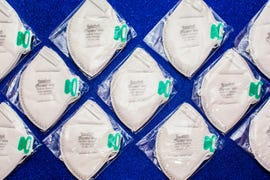
The IRS added COVID-19 protections like face masks to the FSA eligibility list in 2021.
Sarah Tew/CNET
COVID-19: COVID-related products such as face masks, at-home tests and hand sanitizer qualify for FSA reimbursement.
Dental procedures and products: Your dentures, implants, bridges and sealants are all covered by FSA, as are dental reconstruction and wisdom teeth removal. FSA funds can usually cover orthodontia, including Invisalign. Veneers require an LMN from a dentist.
Vision: Not only can you use your FSA funds for prescription eyeglasses and prescription sunglasses, you can also use them for non-prescription reading glasses or blue-blocker glasses. Similarly, contact lenses and supplies, including cleaning solution and lens cases, are eligible for FSA coverage, as are cataract and laser eye surgery.
Hearing: Your FSA money can be used for hearing aids, as well as batteries and maintenance for those aids. Telephones for the hearing impaired are also covered, as are products like ear cleaners and wax removers.
Breathing: Respiratory products such as nasal spray, inhalers and vaporizers are eligible for FSA coverage. With an LMN from a doctor, air conditioning, air filters and air purifiers can all be eligible for reimbursement.
Sleep:Along with OTC sleep medications, your FSA money can also be used for CPAP machines for sleep apnea and mouth guards to prevent teeth grinding. Prescription sleep medicine is also included. Items such as pillows with lumbar support or melatonin can be covered with an LMN from a doctor.
Preventive screenings: Take care of yourself with tests to evaluate your health that can be paid for with FSA money. Eligible screenings include DNA testing, heart scans, cancer screening, diabetes screening, HPV and HIV screening, breast cancer mammography screening and CT scans, as well as any blood tests that aren’t covered by insurance.
Pregnancy and sexual health: Most pregnancy related items and services are eligible for FSA funding, including pregnancy tests, prenatal vitamins, infertility treatments, intrauterine insemination and in vitro fertilization (IVF), as well as costs related to egg donors, surrogates, and egg and embryo storage. Men can use FSA funds on vasectomy reversal and Viagra.
Babies: FSA funds can cover many newborn-related expenses, including breast pumps, lactation consultants, breastfeeding classes, breast milk storage bags, diaper rash ointment, children’s sunscreen and baby breathing monitors. Infant formula can qualify, but only with an LMN from a doctor.
Contraception: FSA funds can help prevent unwanted pregnancies as well. Birth control pills, tubal ligation, vasectomies and condoms are all eligible. Levonorgestrel-based “morning-after pills” like Plan B One-Step or Take Action are eligible for FSA funding, as are all legal abortion procedures, including RU 486 pills (Mifepristone).
Menstruation: Pads, tampons, period underwear, pain relievers and other menstrual supplies all qualify as FSA expenses.
Medical equipment: Most products for measuring health are eligible for FSA money. Examples are thermometers, blood pressure monitors, blood sugar test kits and pulse oximeters.
Batteries: Along with the medical equipment itself, if you use batteries to power medical devices, they are FSA eligible.
Mental health: You can use FSA money for mental health treatments and services, including therapy and counseling in person or online. Visits to psychologists or psychiatrists are eligible, as are psychiatric care and prescription medicine. Unfortunately, marriage and couples counseling are not eligible for FSA reimbursement.
Addiction: FSAs can cover smoking cessation treatments and products to help stop smoking, like nicotine gum or patches. They can also cover donations to Alcoholics Anonymous meetings and the cost of transportation to attend, as well as other substance abuse programs and treatment for gambling addiction. An LMN is required to cover the cost of staying at a halfway house.
Weight loss: Weight-loss programs are eligible for FSA coverage, as are gastric bypass or lap-band surgeries. Prescription drugs for weight loss can also be covered by FSA money.
Yoga mats and classes can be paid for with an FSA, but only with a letter from a doctor.
Amanda Capritto/CNET
Physical fitness: Most fitness expenses aren’t eligible for FSA coverage unless they are prescribed by a physician with an LMN. These expenses, if doctor recommended, can include personal trainers, gym memberships and yoga classes.
Athletic protection: If you’re looking to keep yourself safe and healthy during athletic activity, your FSA funds will cover many items, including athletic tape, braces and bandages, cups, face masks and mouth guards.
Muscle therapy: Most physical therapy is eligible for FSA funding, including massage devices at home. You can also use your FSA money for carpal tunnel supports, back braces or heating and cooling pads.
Foot care: Even though you can’t use FSA funds for athletic shoes (no matter how orthopedic) you can still use FSA money for healthy feet. Supports for high or low arches, foot care products and corn removers are some of the items eligible for FSA coverage.
Transportation: FSA money can be used to pay for travel expenses related to medical care or advice, including airplane tickets, gas for driving, mileage and maintenance costs, parking, bus or train fares and lodging.
Alternative medicine: A few nontraditional medical products and practices are eligible for FSA funding, including acupuncture, chiropractic services, homeopathy and holistic medicine.
Health-related home improvements: If you need to make changes to your living situation to account for an injury or medical situation, your FSA money should be eligible for most of it, including wheelchair ramps, grab bar installations, wider doorways, lowered kitchen cabinets or counters and home elevators,
Mobility: For help getting around, FSA money can cover many products, including scooters, wheelchairs, crutches, canes and artificial limbs. Modifications to automobiles can also be eligible for FSA reimbursement with an LMN from a doctor.
Where can I buy products eligible for FSA spending?
You can purchase FSA-eligible products and services anywhere, as long as they qualify for reimbursement. Many major online retailers have created FSA-eligible stores that include all of the products that can be bought with FSA funds.
Amazon, CVS, Target, Walgreens and Walmart all have their own FSA/HSA stores to make it easy to find qualifying medical and dental products.
Which expenses can’t be paid for with FSA money?
Despite the long list of potential uses for your FSA money, there are some medical and dental items that don’t qualify. Here is a list of products, services and expenses that are not eligible to be covered by FSAs:
Adoption expenses
Athletic shoes
Baby bottles
Bug repellant
Cannabidiol (CBD) products
Car seats
Cotton swabs
Dehumidifiers
Dental floss
Deodorants
Hair regrowth or hair removal products (including electrolysis)
Health or dental insurance premiums
Lactaid or other lactose-intolerance medication
Latex or nitrile gloves
Liposuction
Marriage counseling
Mattresses
Medical marijuana
Paternity testing
Protective goggles or safety glasses
Shampoo, soap, shaving cream or skin moisturizer
Smoke or carbon monoxide detectors
Summer or athletic camps
Tattoo removal
Teeth whitening or bleaching
Toothbrushes or toothpaste
UV protective gear
Veterinarian costs
Weight-loss supplements
For more health-related reading, learn how colder weather in winter can impact your breathing.
(The Discussion) – Snow times, a nostalgic rite of passage for generations of college students across the northern United States, may possibly look destined to be a memory of school times earlier. For just about a century, colleges have canceled or delayed classes mainly because of weighty or unsafe snowfall that makes dangerous travel ailments. University calendars would contain a amount of “makeup” days, when any missed time could be rescheduled.
All through the COVID-19 pandemic, educational facilities transitioned to remote learning to continue to keep teaching when it was not protected for people to obtain. With students now understanding at house, approximately 40{08cd930984ace14b54ef017cfb82c397b10f0f7d5e03e6413ad93bb8e636217f} of faculties chose to forgo conventional snow days and carry on with distant finding out for the duration of the pandemic. These selections, and enhancements in on-line instruction, led several commentators to forecast the conclude of the snow day.
On the other hand, policy info collected from the 35 states with the highest regular yearly snowfall suggests that even though additional educational institutions are employing distant finding out times as an alternative of canceling classes, the common snow working day is considerably from extinct.
Snow days appear to be sticking all around, thanks to nostalgia, lingering concerns about the performance and accessibility of on the net discovering and a sentiment that households and small children want these unscripted, unplugged breaks.
A new alternative becomes offered
When universities shut because of inclement weather, it impacts students’ understanding.
For occasion, analysis in Colorado, Maryland and Virginia has proven that each and every added inch of snow led to much less continuity of studying, which in switch built it significantly less likely that elementary college learners would pass math assessments.
Even ahead of the pandemic, 14 states experienced policies that permitted faculties other selections moreover closing for inclement temperature. Commencing in 2011, Kentucky, New Hampshire, Kansas, Missouri and West Virginia allowed pupils to get the job done on preassembled packets that had been well prepared and despatched dwelling alternatively of contacting a snow day.
As engineering enhanced, colleges changed choose-residence packets with on-line assignments and instruction.
All through the pandemic years, a lot more educational facilities obtained improved at training on the web and noticed possibilities to minimize school closings through winter storms. With almost all states approved on community well being grounds to offer distant instruction throughout COVID-19, faculties began undertaking so for inclement climate, also.
In 2022, the New York Board of Regents authorized the state’s public universities to teach remotely instead of canceling class on snow days. Times before, anticipating the selection, New York City Schools Chancellor David Banks announced: “If a snow day arrives around, we want to make confident that our young ones continue on to learn,” incorporating, “so, sorry youngsters! No much more snow times, but it’s gonna be fantastic for you!”
Seven other states current their laws to enable remote finding out. For example, Maryland now allows up to 8 days a calendar year of remote discovering – so long as 5 of all those times involve stay periods with a teacher – and Virginia’s new regulation enables 10 days.
By the get started of the 2022-2023 school calendar year, around a few-quarters of snowy states had procedures in spot to significantly curtail school closures, preserve college students learning and protect against make-up times from stretching the school yr into the summer. Which is up from 50 {08cd930984ace14b54ef017cfb82c397b10f0f7d5e03e6413ad93bb8e636217f} of them in the 2018-2019 school yr.
For now: A wintry combine of snow times and remote learning
In just people states that enable remote mastering for inclement temperature, educational facilities have basically adopted 3 distinctive patterns: comprehensive on the net changeover, preserving standard snow days or a mixture of both.
Rather handful of school units – commonly in metro locations like St. Paul or St. Louis – have followed New York City’s direct in saying programs to go entirely on-line during what would or else be snow days. There are also quite a few college districts in really snowy locales – like New York’s snowiest district of Syracuse – that will not be working with remote mastering times.
Nevertheless, the most typical technique across the nation will be a combine of remote discovering and snow times relying on regional disorders. For example, in Baltimore, the superintendent announced that distant understanding would be utilized below the new Maryland plan only “as a very last resort” just after the 5 make-up times in the calendar had been fatigued. In West Virginia, educational facilities will use a portion of their allotted nontraditional instruction times but reserve an “old-fashioned snow day” for learners.
The nostalgic sentiment for preserving the snow day custom was epitomized in a viral write-up from Jefferson County, West Virginia, Superintendent Bondy Shay Gibson, who declared on the initial snow day of past 12 months that faculty would be “closed for pupils … closed for virtual … closed for employees.” She claimed, “For generations, family members have greeted the first snow day of the yr with pleasure. … It is a time of renewed surprise at all the points that each and every season holds. A reminder of how fleeting a childhood can be. An chance to make memories with your spouse and children that you will keep onto for lifestyle.”
For a lot of people this winter, the risk of a snow day stays. When the initially big storm of the 2022 winter season season bore down on western New York with as a great deal as 6 toes of snow, learners in the area waited anxiously for pending school conclusions: Buffalo Public Faculties selected to shift to remote finding out, but neighboring Niagara Falls canceled.