

Growing Demand for Medical Implants for Cardiovascular, Dental, and Orthopedics Drives 9.3{08cd930984ace14b54ef017cfb82c397b10f0f7d5e03e6413ad93bb8e636217f} Annual Growth

Growing Demand for Medical Implants for Cardiovascular, Dental, and Orthopedics Drives 9.3{08cd930984ace14b54ef017cfb82c397b10f0f7d5e03e6413ad93bb8e636217f} Annual Growth
Company Logo

Company Logo

Global Medical Coatings For Implants Market
Global Medical Coatings For Implants Market

Global Medical Coatings For Implants Market

Dublin, April 17, 2023 (GLOBE NEWSWIRE) — The “Medical Coatings For Implants Market Size, Share & Trends Analysis Report By Product (Hydroxyapatite), By Technology (Plasma Spray), By Application, By Region, And Segment Forecasts, 2023 – 2030” report has been added to ResearchAndMarkets.com’s offering.

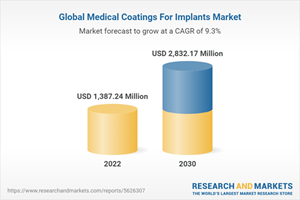
The global medical coatings for implants market size is expected to reach USD 2,832.17 million by 2030. The market is expected to expand at a CAGR of 9.3{08cd930984ace14b54ef017cfb82c397b10f0f7d5e03e6413ad93bb8e636217f} from 2023 to 2030.

The growth is mainly driven by growing demand for medical implants for cardiovascular, dental, and orthopedics on the account of rising health issues related to bones, dental, and heart. Increase in incidence of orthopedic injuries, diseases such as arthritis, osteoarthritis, and the rapid rise in geriatric population are propelling the demand for orthopedic implants, further driving the demand for medical coatings.

Increasing elderly population, rising need for medical care of the aging population, rise in the prevalence of chronic disorders & diseases, and increasing healthcare expenditure is also augmenting the demand for medical coatings for implants.

Medical device coatings provide beneficial properties, including lubricity, flexibility, biocompatibility, antimicrobial, drug-eluting, and thromboresistance, to medical devices. The consumption for medical coatings has largely surged among manufacturers of cardiac arrest devices, catheters, feeding tubes, epidural probes, stents, guide wires, and other devices, which are to be inserted in the human body. These coatings provide high resistance against Healthcare Associated Infections (HAI), which is very common among people, who have been implanted with foreign devices for medical health care purposes.

The growing demand for coatings is expected to augment industry growth, as they improve biocompatibility between living tissues and medical devices. Rising preference for implantable and non-implantable medical equipment, along with growing number of private and public hospitals, is likely to fuel market growth. Technological innovation, such as introduction of antimicrobial microRESIST technology for orthopedic implants and catheters with anti-microbial properties, are further expected to foster market growth over the forecast period.

Healthcare expenditure in North America is likely to be driven by the rising prevalence of chronic diseases coupled with the expansion of insurance coverage in the U.S. The strengthening of the Western European economies is expected to result in high provision for healthcare expenditure in the annual budgetary proposals. The healthcare expenditure in Central & South America is expected to be driven by developments in the healthcare industry in Brazil. Moreover, healthcare industry in Asia is expected to be fueled by the growing consumer wealth in economies such as China and India. The presence of a well-developed healthcare industry in India coupled with growth of medical tourism is expected to augment the demand for medical coatings for implants.

Medical Coatings For Implants Market Report Highlights

  • Nanoparticle is the fastest growing product segment by revenue with an expected to expand at a CAGR of 10.3{08cd930984ace14b54ef017cfb82c397b10f0f7d5e03e6413ad93bb8e636217f} on owing to the growing adaption of nano-technology in healthcare system

  • Physical Vapor Deposition (PVD) is the second fastest growing technology segment after others by revenue with an expected CAGR of 9.7{08cd930984ace14b54ef017cfb82c397b10f0f7d5e03e6413ad93bb8e636217f} due to its properties such as corrosion resistance of metallic implants and it reduces allergic reactions

  • Dental implants is the fastest growing application segment by revenue with an expected CAGR of 10.3{08cd930984ace14b54ef017cfb82c397b10f0f7d5e03e6413ad93bb8e636217f} due to growing demand for dental implants on the account of deteriorating teeth condition due to excessive consumption of junk food

  • Asia Pacific is the fastest growing region by revenue with a CAGR of 10.0{08cd930984ace14b54ef017cfb82c397b10f0f7d5e03e6413ad93bb8e636217f} because of growing population in the region

  • Medical Coatings for Implants manufacturers are striving to elevate their production capacities in order to ensure regular supply of the product due to its growing demand from automotive industry

Key Attributes:

Report Attribute

Details

No. of Pages

112

Forecast Period

2022 – 2030

Estimated Market Value (USD) in 2022

$1387.24 Million

Forecasted Market Value (USD) by 2030

$2832.17 Million

Compound Annual Growth Rate

9.3{08cd930984ace14b54ef017cfb82c397b10f0f7d5e03e6413ad93bb8e636217f}

Regions Covered

Global

Key Topics Covered:

Chapter 1 Methodology and Scope

Chapter 2 Executive Summary

Chapter 3 Medical Coatings for Implants Market Variables and Trends

Chapter 4 Medical Coatings for Implants Market: Product Estimates & Trend Analysis
4.1 Product Movement Analysis & Market Share, 2022 & 2030
4.2 Medical Coatings for Implants Market Estimates & Forecast, By Product (Tons) (USD Million)
4.2.1 Hydroxyapatite (HA)
4.2.2 Titanium Plasma Spray
4.2.3 Nanoparticle
4.2.4 Others

Chapter 5 Medical Coatings for Implants Market: Technology Estimates & Trend Analysis
5.1 Technology Movement Analysis & Market Share, 2022 & 2030
5.2 Medical Coatings for Implants Market Estimates & Forecast, By Technology (Tons) (USD Million)
5.2.1 Plasma Spray
5.2.2 Vacuum Spray
5.2.3 Physical Vapor Deposition (PVD)
5.2.4 Others

Chapter 6 Medical Coatings for Implants Market: Application Estimates & Trend Analysis
6.1 Application Movement Analysis & Market Share, 2022 & 2030
6.2 Medical Coatings for Implants Market Estimates & Forecast, By Application (Tons) (USD Million)
6.2.1 Orthopedic Implant Screws
6.2.2 Dental Implants
6.2.3 Cardiovascular Implants
6.2.4 Others

Chapter 7 Medical Coatings for Implants Market: Regional Estimates & Trend Analysis

Chapter 8 Medical Coatings for Implants Market – Competitive Landscape

Companies Mentioned

  • Himed

  • Hydromer

  • DOT GmbH

  • Lincotek Group S.p.A.

  • Medicoat AG

  • CAM Bioceramics B.V.

  • APS Materials, Inc.

For more information about this report visit https://www.researchandmarkets.com/r/ak08vm

About ResearchAndMarkets.com
ResearchAndMarkets.com is the world’s leading source for international market research reports and market data. We provide you with the latest data on international and regional markets, key industries, the top companies, new products and the latest trends.

Attachment

CONTACT: CONTACT: ResearchAndMarkets.com Laura Wood,Senior Press Manager press@researchandmarkets.com For E.S.T Office Hours Call 1-917-300-0470 For U.S./ CAN Toll Free Call 1-800-526-8630 For GMT Office Hours Call +353-1-416-8900

Continuing consumer education drives gut health sales

Continuing consumer education drives gut health sales

“Micro-what?” Sixty percent of consumers surveyed in recent Nutrition Business Journal research said they were either “not at all knowledgeable” or “not very knowledgeable” about the microbiome. Just 25{08cd930984ace14b54ef017cfb82c397b10f0f7d5e03e6413ad93bb8e636217f} of consumers said they considered themselves “knowledgeable” about gut and digestive health. At the same time, gastrointestinal health supplement sales reached $3,629 million in 2022, according to Nutrition Business Journal estimates. These data point to the vast potential for microbiome health supplement sales that a more educated consumer audience could unleash.

In the meantime, the market experienced 5.8{08cd930984ace14b54ef017cfb82c397b10f0f7d5e03e6413ad93bb8e636217f} growth between 2021 and 2022 (estimated), according to the 2022 NBJ Condition Specific Report, slightly faster than overall supplement growth (4.2{08cd930984ace14b54ef017cfb82c397b10f0f7d5e03e6413ad93bb8e636217f}). NBJ analysts forecast the category to reach $4,172 million in sales by 2025, with growth slowing to 3.9{08cd930984ace14b54ef017cfb82c397b10f0f7d5e03e6413ad93bb8e636217f}.

Dominated by probiotics, which account for 58.9{08cd930984ace14b54ef017cfb82c397b10f0f7d5e03e6413ad93bb8e636217f} of market share, the category was buoyed by new interest in the friendly bugs’ immune-boosting power. Sales grew by 7.3{08cd930984ace14b54ef017cfb82c397b10f0f7d5e03e6413ad93bb8e636217f} between 2019 and 2020 and by 9{08cd930984ace14b54ef017cfb82c397b10f0f7d5e03e6413ad93bb8e636217f} between 2020 and 2021. As anxiety around the pandemic cooled, so did category growth. From 2021 to 2022, the ingredient grew by 4.6{08cd930984ace14b54ef017cfb82c397b10f0f7d5e03e6413ad93bb8e636217f}. NBJ analysts estimate the pace will slow to 3.5{08cd930984ace14b54ef017cfb82c397b10f0f7d5e03e6413ad93bb8e636217f} by 2025. Recent sales or condition specific supplement formulas reflect shifting demand in the category. Those sales grew by 92.5{08cd930984ace14b54ef017cfb82c397b10f0f7d5e03e6413ad93bb8e636217f} in the 52 weeks ending February 26, 2023 (SPINS), to reach $98,000.

Gobbling up gut health potential

From probiotic-fortified breakfast burritos to beer, food and beverage sales are outpacing supplements in the microbiome space. People have long believed “you are what you eat,” and are applying that intuitive wisdom to gut health. In 2021, combined sales of pre-, syn- and probiotics added $197 million in market size. The combined food and beverage markets gained $736 million. In 2022, about half of consumers surveyed by NBJ reported regularly consuming foods and beverages that support gut health, according to the latest Nutrition Business Journal Microbiome Report. That proprietary research is parsed in the new report, which features data, market insights and analysis exploring the food versus supplement dynamic, among other critical issues around the future of the gut health market.

When it comes to supplement format preference, capsules and powders remain top choices, with sales reaching $449,128,979 and $313,182,952, respectively, in the 52 weeks ending February 26, 2023 (SPINS). But meteoric growth of liquid ready-to-drink products—which grew by 1,232{08cd930984ace14b54ef017cfb82c397b10f0f7d5e03e6413ad93bb8e636217f} in that period—show that people are looking for alternatives to pills. RTD sales reached $715,000 in the past year.

Probiotics decline, but new opportunities emerge

Probiotics sales growth has been on a slow decline since the mid-2000s, with just 0.4{08cd930984ace14b54ef017cfb82c397b10f0f7d5e03e6413ad93bb8e636217f} market growth in 2021. Synbiotics—products that combine prebiotics and probiotics—however, are rising stars. Now worth $1.03 billion, the synbiotics market is nearly double the size it was in 2017. By 2025, synbiotics are expected to be 80{08cd930984ace14b54ef017cfb82c397b10f0f7d5e03e6413ad93bb8e636217f} the size of the probiotics market. (“Supplement consumers today: Attitudes and behavior toward supplement and health,” New Hope Network NEXT Data & Insights and NBJ)

Growing rapidly then falling flat just as quickly, the probiotic market is proof of the power of marketing. “We learn this again with the more recent spiking sales of pre- and synbiotics,” write NBJ analysts in the Microbiome Report. “As consumer knowledge increases, synbiotics look to be the future of the microbiome supplement market.”

Meanwhile, in probiotic sales hit $1.714 billion in the 52 weeks ending February 26, 2023 (SPINS), up 3.7{08cd930984ace14b54ef017cfb82c397b10f0f7d5e03e6413ad93bb8e636217f}, an improvement over early forecasts.

Beyond the bugs

“Fiber may be the biggest deficiency in nutrition that the supplement industry is doing the least to suggest,” according to the NBJ Microbiome Report. Only 3{08cd930984ace14b54ef017cfb82c397b10f0f7d5e03e6413ad93bb8e636217f} of Americans are estimated to be eating enough fiber. It’s being undersold and wrongly sold, reports NBJ. Brands need to think beyond the bathroom and steer consumers to discussions around the ingredient’s other benefits: cholesterol support, weight and blood sugar management—topics shoppers are talking about.

Sales figures suggest that when smoothies became a staple for the locked-down legions, some large number of those smoothies featured fiber. Psyllium sales shot up 12.5{08cd930984ace14b54ef017cfb82c397b10f0f7d5e03e6413ad93bb8e636217f} in 2020. The spike was short-lived, however, and growth has returned to the steady pre-pandemic rates.

Fiber sales reached $1.130 million in 2022 with 3.6{08cd930984ace14b54ef017cfb82c397b10f0f7d5e03e6413ad93bb8e636217f} growth in 2022 by NBJ estimates [M-page 2]. Sales of fiber products and laxatives hit $515.6 million in the 52 weeks ending February 26, 2023 (SPINS) showing healthy 9.6{08cd930984ace14b54ef017cfb82c397b10f0f7d5e03e6413ad93bb8e636217f} growth rate.

Combination herbs for gastrointestinal health may be a fairly small share of the condition category, $114 million in a $3.46 billion market, but it has also been the fastest growing ingredient category in gastrointestinal health since 2019. Superfood and whole food supplements in the segment grew by 66{08cd930984ace14b54ef017cfb82c397b10f0f7d5e03e6413ad93bb8e636217f} in the 52 weeks ending February 26, 2023 (SPINS), to hit $23.8 million in sales.

Ginger is emerging as an old ingredient finding fresh zest, with growth for 2021 breaking into the double digits and better years ahead in 2022 and 2023 before it settles into more modest growth. Turmeric swung back into positive territory in the pandemic and looks to stay there, approaching double digits this year and next. Digestive enzymes saw remarkable growth in 2021, likely riding the industry- wide wave, but the market has since returned to earth and looks to stay there.

The formula to fight flattening growth: science + marketing

A flatter growth picture for gastrointestinal health supplements is on the way, report NBJ analysts, “without some combination of marketing and product innovation.” And what will drive that combination? Science.

Research is revealing more and more about how the gut microbiome is connected to, well, everything. “Research on the gut brain axis has advanced quickly over the last decade, revealing how gut health is connected to cognition and mood.  There’s also a growing body of research into how prebiotics and their metabolites and probiotics impact the gut microbiome and various aspects of health,” says Jeff Chen, MD, CEO and Cofounder of Radicle Science. The company enables supplements to affordably and rapidly prove their true effects beyond placebo through next-generation virtual direct-to-consumer automated clinical trials.  And the impacts of the gut microbiome extend beyond gut and brain health.  “Science is also starting to better understand how the gut microbiome impacts areas like skin health and even lifespan and longevity.”

Radicle Science has built a powerful tool to fuel new research into microbiome supplements. Their GI Health Trial is a standardized double-blind, randomized, placebo-controlled clinical trial, incorporating assessments developed by the National Institutes of Health PROMIS Initiative to measure functional outcomes like digestion, abdominal discomfort, gas, and bloating, as well as mood and anxiety,. “These assessments are validated in diverse healthy subjects experiencing a variety of gastrointestinal issues, which makes them ideal for substantiating structure/function claims compliant with FDA regulations and the FTC’s new Health Products Compliance Guidance,” says Chen. “And compared to traditional supplement trials, Radicle’s trials are conducted on larger and more diverse populations, offering a greater chance of successful results, and generating data that is more relevant to the individuals buying the products. 

Marketing that science will be key. Probiotic pioneer Jarrow Formulas which came together with Natrol under Vytalogy Wellness in 2022, has been funding and educating the public about gut health research for decades. The brand “uses superior science to make smarter formulas,” according to the company’s website. Jarrow has taken consumers beyond bug basics, helping further understanding on topics such as how more is not always mightier when it comes to the number of microbes in a product. “While many probiotic supplements claim ultra-high CFUs as a measure of efficacy, Jarrow Formulas takes a different, science-based approach,” according to Jarrow. “In reality, having clinically documented strains is significantly more important than high levels of CFUs.” Jarrow uses only clinically studied strains, created through years of intensive research alongside world-renowned partners. Customer satisfaction—and sales—follow the science, the company notes its Jarro-dophilus EPS formula was rated No. 1 in Probiotic Consumer Satisfaction by Consumer Labs in 2021.

Conveying the science to the public takes us back to the 75{08cd930984ace14b54ef017cfb82c397b10f0f7d5e03e6413ad93bb8e636217f} of consumers still awaiting gut health enlightenment. While “educating them on the particulars of microbiome science is a rabbit hole of infinite depth,” write NBJ analysts, consider this: Just 20 years ago, few Americans had heard of probiotics, and now they are a $1.74 billion supplement category. All that took was a simple message of “good bugs do good stuff.”