
Britain’s NHS was once idolized. Now its worst-ever crisis is fueling a boom in private health care

Britain’s NHS was once idolized. Now its worst-ever crisis is fueling a boom in private health care


London
CNN
 — 

Tens of thousands of nurses and nearly 12,000 ambulance workers went on strike Monday over pay and working conditions in the biggest walkout in the 75-year history of Britain’s National Health Service (NHS).

Escalating industrial action comes after years of falling wages, stretched budgets and staff shortages that have left the NHS in a state of crisis, with waiting times for treatment at a record high. At the same time, an aging population needs its services more than ever.

That unhappy mix is fueling a boom in demand for private health care from a much broader swathe of the UK population than ever before — a fundamental shift for a nation with one of the world’s best-known universal health systems.

“Our providers are telling us that people are going private, many for the first time, and the key factor driving that is the challenge in accessing NHS care,” said David Furness, policy director at the Independent Healthcare Providers Network, an industry body for private healthcare companies.
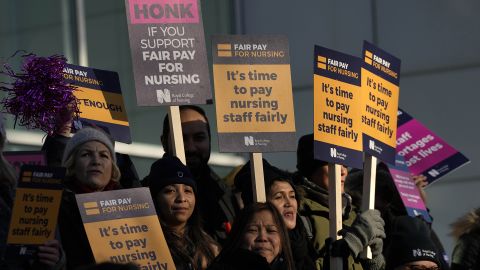
Nurses of the University College Hospital protest in London on  Monday, February 6, 2023.

At the end of November, a record 7.2 million patients in England were waiting for non-urgent medical treatment on the NHS, known as “elective” care. This spans diagnostic tests and scans, procedures such as hip and knee replacements, but also cardiac surgery, cancer treatment and neurosurgery.

More than half of those on the list had been waiting up to 18 weeks and about 400,000 patients had been waiting more than a year, according to data from NHS England.

To avoid joining a waiting list, more and more people are paying for their own private medical care or taking out health insurance.

In the second quarter of 2022, the number of patients paying directly for private hospital care increased 34{08cd930984ace14b54ef017cfb82c397b10f0f7d5e03e6413ad93bb8e636217f} compared with the same period in 2019 to reach 67,000, according to the Private Healthcare Information Network, which collects data on UK private healthcare.

The figures revealed a 184{08cd930984ace14b54ef017cfb82c397b10f0f7d5e03e6413ad93bb8e636217f} jump in the number of people paying privately for hip replacements over that period, a 153{08cd930984ace14b54ef017cfb82c397b10f0f7d5e03e6413ad93bb8e636217f} increase in self-pay for knee replacements and a 42{08cd930984ace14b54ef017cfb82c397b10f0f7d5e03e6413ad93bb8e636217f} rise in private cataract surgery.

To keep up with growing demand for their services, private health care providers are expanding at a rapid clip.

US group Cleveland Clinic plans to open its third UK facility in London later this year, adding to the 184-bed hospital and the six-floor clinic it opened in the capital city in 2021 and 2022 respectively.

HCA Healthcare

(HCA)
, another American group, which has over 30 facilities in London and Manchester, will be opening a £100 million ($120 million) private hospital in Birmingham — the second biggest UK city — later this year.
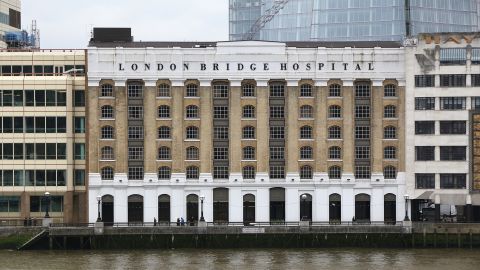
London Bridge Hospital, one of the UK's largest private hospitals operated by HCA Healthcare.

And Spire Healthcare, one of the largest private hospital groups in the United Kingdom, is adding new clinics, theaters and beds around the country as it races to keep up with demand.

CEO Justin Ash estimates that the market for private health care in the United Kingdom has doubled since before the pandemic to 15 million people.

“Our biggest single challenge is how do we treat the numbers of patients coming towards us,” he told CNN.

The group plans to develop two new clinics in 2023, which are quicker to build than hospitals and are designed for procedures that don’t require overnight stays — for example, those in ophthalmology, gynecology and dermatology.

Spire is also pushing into primary care services, citing demand for face-to-face appointments with general practitioners. In December, it acquired The Doctors Clinic Group, a network of 22 private GP clinics with a strong presence in central London.

Ash said that appetite for private health care spans a much broader set of ages and incomes than in the past.

“This is not the super-rich. This is ordinary people who are choosing to go private, and that is a shift,” he said.

One such patient is Emma Freeth, a website administrator. She decided to take out private medical insurance after waiting nine months to see a specialist on the NHS.

“That’s what really triggered it: the idea that I just want to be able to get the help when I need it, rather than having to wait and wait and wait,” she told CNN. “If I was in pain or discomfort this would be a real problem,” she said of her thoughts at the time.

In November, Freeth, 58, and her 55-year-old husband Peter, a photographer, took out medical insurance in their personal capacity for the first time in their lives.

Their story is mirrored in data from health insurers. Bupa added 150,000 new UK health insurance customers in 2022, while rival VitalityHealth has seen a 20{08cd930984ace14b54ef017cfb82c397b10f0f7d5e03e6413ad93bb8e636217f} rise in customers over the past year to more than 900,000.

“We expect the growth we have seen in health insurance uptake to continue in 2023,” said Neville Koopowitz, CEO of Vitality UK.

“This is because people are undoubtedly turning to private healthcare to ensure they have access to high-quality care, quickly, if they were to get ill,” he added.
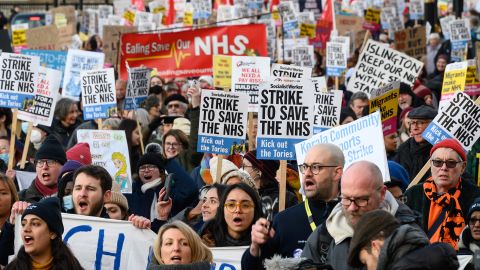
Nursing staff and supporters march from University College Hospital to Downing Street on January 18, 2023 in London, England.

The Freeths, who are self-employed, said minimizing time off work with ill health was a major factor in their decision making, particularly given long wait times for appointments on the NHS.

According to the Office for National Statistics, record numbers of Brits are leaving the workforce due to long-term sickness, a problem it partly ascribes to long wait times for NHS treatment.

This is an issue of growing concern to employers. Recent polling by Savanta of more than 1,000 businesses on behalf of the Independent Healthcare Providers Network found that over half are worried that rising NHS waiting times may result in employees taking long absences or permanently leaving work due to sickness.

And one in five said they were considering offering private medical insurance to their employees in the coming year.

With the NHS estimating that it will take years for wait times to fall, the demand for private health care in Britain is set to keep growing.

Longer-term, there are questions about whether the NHS is sustainable in its current form, offering comprehensive free health care to all funded purely by taxes, particularly against the backdrop of an aging population and strained government finances.

The NHS is already the largest single item of public expenditure in Britain, according to the Office for Budget Responsibility, with ONS figures showing that healthcare spending amounts to around 12{08cd930984ace14b54ef017cfb82c397b10f0f7d5e03e6413ad93bb8e636217f} of GDP.

Some experts worry that moving away from a universal NHS would lead to a two-tier health system where people with means pay for private care, enabling them to go back to work and resume normal life more quickly than those who are less well-off and forced to rely on constrained public services.

“The risk is less a sudden privatization and more an emergence of something resembling the English education system — where the very best education is so often conditional on ability to pay,” researchers at the Institute for Public Policy Research, a think tank, wrote in a report last year.

“If this were to become the new normal… it would worsen overall health and widen inequality,” they added.

But Ash of Spire Healthcare has a less dystopian view of the future. “We’ve clearly moved into a world in which we’re all NHS patients but have episodes of private care,” he said.

That’s “a million miles from a US system,” he added. There is no universal health care in America and most people have private health insurance because health care is very expensive.

“There is huge commitment to the NHS. You cannot underestimate that,” Ash said.

Worker shortages in education, healthcare and rail jobs are fueling labor crises

Worker shortages in education, healthcare and rail jobs are fueling labor crises

Fatigued staff in education and learning, health care and the railroad market are pushing again right after months of staffing shortfalls

Striking nurses demonstrate for better working conditions on the public sidewalks outside Riverside Hospital on Sept. 13 in Minneapolis.
Hanging nurses display for far better performing ailments on the general public sidewalks exterior Riverside Healthcare facility on Sept. 13 in Minneapolis. (Annabelle Marcovici for The Washington Article)

The U.S. overall economy came in just several hours of shutting down due to the fact of a standoff in between unions and railroad carriers about sick spend and scheduling, highlighting just how drastically staffing shortages have reshaped American workplaces and driven fatigued workers to push back again.

With a lot more than 11 million job openings and only 6 million unemployed personnel, businesses have struggled for far more than a calendar year to hire sufficient people today to fill their ranks. That mismatch has left workforce pissed off and burnt out, and is fueling a new spherical of electric power struggles on the task.

Though the railway dispute, which the White Dwelling served solve early Thursday, has garnered the most interest, a number of other strikes are spreading throughout the United States. Some 15,000 nurses walked out of the work in Minnesota this 7 days, and wellness-treatment staff in Michigan and Oregon have not too long ago licensed strikes. Seattle instructors known as off a 7 days-lengthy strike, delaying the start of the university yr.

At the centre of each and every of these difficulties are common labor shortages that have brought on deteriorating doing the job problems. Staffing shortfalls in important industries, such as wellness care, hospitality and education, have set unprecedented stress on tens of millions of personnel, igniting a wave of labor disputes as properly as new attempts to arrange nationwide.

Every little thing you need to have to know about the averted rail strike

As well numerous industries are even now struggling to locate workers. The share of doing work-age Us citizens who have a job or are wanting for a person is at 62.4 percent, a complete share level lessen than it was in February 2020, according to Labor Department information.

The motives are intricate and broad. Early retirements, a massive slowdown in immigration that commenced all through the Trump administration, as nicely as ongoing baby treatment and elder treatment challenges merged with covid-similar ailments and fatalities have all slash into the number of obtainable workers.

“We have approximately 2.5 million much less persons in the labor power than we were being on observe to have with pre-pandemic trends,” mentioned Wendy Edelberg, director of the Hamilton Task at the Brookings Institution. “That’s a large variety, and it means that people who are continue to there, who are still operating these jobs, are possessing to do even more.”

The worry of working at a work that is understaffed is playing a massive function in workers’ requires, which frequently revolve around staffing — or deficiency of it. Seattle lecturers wanted greater exclusive education and learning teacher-to-student ratios. Railroad conductors and engineers were inquiring for ill go away. And the nurses who stopped do the job in Minnesota explained they are wanting for extra adaptable schedules and protections in opposition to retaliation for reporting situations of understaffing.

“If you glimpse at sectors like nursing properties, area educational institutions, railroads — employment has fallen like a stone,” mentioned Lisa Lynch, an economics professor at Brandeis College and previous Labor Division main economist. “And with that, you see a marked enhance in labor action and strike action. People are drained and overworked.”

Biden scores offer on rail strike, but worker discontent emerges

While the U.S. financial system has formally recouped the 20 million jobs it missing at the beginning of the pandemic, the gains have been uneven. Significant shortfalls remain, specially in lower-wage industries that have dropped staff to higher-having to pay opportunities in warehousing, design, and qualified and organization solutions. The hospitality and leisure industry is still down 1.2 million careers from February 2020. Public colleges are lacking approximately 360,000 workers and health treatment has still to get better 37,000 positions. Rail transportation, in the meantime, is down 12,500 work opportunities.

Just after months of juggling excess responsibilities, Sabrina Montijo give up her $19-an-hour teacher’s aide task in the Bay Location in August. She now cares for her two youthful youngsters whole-time and says she isn’t certain when she’ll return to the workforce.

“Ever since the pandemic begun, we were very quick-staffed,” Montijo, 33, explained. “I had to do the job off-the-clock for the reason that there was no person there. We could not discover staff and if we did, we were being constantly getting to teach anyone, normally having to get started more than.”

Amongst the added stress at operate and difficulties locating very affordable boy or girl treatment, she says it just created perception to depart. Controlling on just a single revenue from her husband’s occupation as a butcher at Safeway has not been quick, but Montijo claims it’s greater than the alternative.

“It acquired to the issue exactly where I didn’t come to feel like I experienced a choice,” she claimed. “I was possessing to established up arts and crafts, do science jobs, make phone calls and discuss to mothers and fathers — all at the very same time. There is only so substantially a person man or woman can do.”

The us faces catastrophic trainer lack

Worker burnout has grow to be a persistent dilemma across the economy, nevertheless labor economists say it is particularly pronounced in industries with acute labor shortages. Lots of entrance-line employees in retail, dining establishments, schooling and well being care who labored through the pandemic — often putting their health and nicely-being at possibility — say their employment are becoming even harder as vacancies pile up.

Whilst employers across the economic climate say they are battling to uncover and preserve staff, labor shortages are most pronounced in retail (in which around 70 per cent of job openings continue to be unfilled), manufacturing (about 55 percent) and leisure and hospitality (45 p.c), in accordance to a U.S. Chamber of Commerce assessment of Labor Office knowledge.

“When you glance at the positions that are possessing hassle selecting, it is the kinds with truly extended hrs, inflexible schedules, not terrific fork out and restricted positive aspects,” said Paige Ouimet, a professor at the College of North Carolina’s Kenan-Flagler Business School who focuses on finance and labor economics. “Running your staff like this — asking them to do 20, 30 percent additional simply because you’re small staffed — it’s pretty a great deal a short-term tactic. You’re going to hold shedding persons.”

In lots of situations, companies have started raising wages in hopes of attracting new personnel. The optimum wages gains have been in the least expensive-paying industries, like hospitality, where common hourly earnings are up 8.6 per cent from a 12 months in the past. (Which is in comparison to an maximize of 5.2 p.c for all personnel.)

But although these spend boosts could not be heading far more than enough in attracting or retaining workers, economists say they are contributing to inflation. Dining establishments, airlines, health-care companies and transportation providers are all charging a lot more, in element, they say, for the reason that of growing labor charges.

Aveanna Healthcare, which delivers property overall health care and hospice services, is collaborating with the Medicaid systems it performs with to enhance reimbursement costs to offset bigger spend for nurses.

“Inflation has driven our workforce to seek out work that can and will spend greater wages,” Tony Unusual, the company’s main government, explained in an earnings phone very last month. “We have to have to increase caregiver wages on common 15 per cent to 25 percent in particular marketplaces that we serve. We will systematically go by way of state by condition and deal by deal and regulate reimbursement costs.”

As covid persists, nurses are leaving personnel positions — and tripling their salaries as tourists

New inflation information produced this week confirmed that prices remained stubbornly superior, in huge element mainly because of growing expenses for providers including wellness treatment and transportation. In contrast to rates for TVs and home furniture, which are largely dependent on the expense of elements and shipping and delivery, economists say support inflation tends to be carefully linked to workers’ wages.

“It is very clear that the limited labor marketplace is primary to wage advancement, which is top to value growth,” reported Jason Furman, an economics professor at Harvard College. “Inflation in providers tends to be a great deal much more persistent and it is a great deal more durable to provide down. Gasoline rates are extremely unstable. Goods costs are fairly unstable. But in solutions, if prices are significant a single month, they are almost certainly heading to continue being high up coming month.”

It is unclear no matter whether — or when — numerous of the persons who remaining the workforce through the pandemic will return. Which is notably true for workers 55 and more mature, who have stopped operating at bigger charges. The task market is still small much more than 500,000 personnel from that age team.

“There’s been a quite significant and persistent decrease in labor force participation amid workers over 55,” mentioned Edelberg of the Brookings Institution. “The pandemic has been a second of introspection and reevaluation, and it has led a ton of persons to action out of the labor pressure.”

Joseph White, who lives in Nashville, missing his work at Guitar Middle 6 months into the pandemic. But he claims he’d had more than enough: The keep was continuously small-staffed and consumers ended up intractable. In 1 occasion, a shopper pulled a gun on him for striving to enforce the company’s mask mandate.

“I’m weary, I’m damaged down, worn out and old,” the 62-12 months-aged mentioned. “I was worked to dying for so extended that lastly, I said, there is no way I’m going again.”

He’s started drawing on Social Stability payments to make ends meet, and aids his wife run her little store, Black Canine Beads. But White says he has no intention of joining the labor drive yet again.

“Our quality of lifetime is considerably far better even while we have less income,” he said. “I received drained of becoming a commodity.”

Lauren Kaori Gurley and Jeff Stein contributed to this report.