
Reliable Pet Health Information: How to Read, Write, and Share It

Reliable Pet Health Information: How to Read, Write, and Share It

Pet owners often turn to the internet when a dog refuses food, a cat starts scratching, or a new puppy needs a routine. Online resources can help people prepare questions and understand basic care, but advice varies in quality. Learning how to assess pet health information—and how responsible publishers can present it—makes it easier to act thoughtfully without mistaking a web article for veterinary care.

Why Accuracy Matters

Animals cannot describe symptoms in words, so owners may rely on changes in appetite, behavior, movement, or appearance to decide what to do next. An inaccurate article can lead someone to delay a veterinary visit, try an unsuitable remedy, or misread a potentially serious change. Clear, careful information helps readers recognize limits and seek professional help when needed.

Good guidance should distinguish general education from diagnosis. A checklist of common reasons a pet might vomit, for instance, should not imply that an owner can identify the cause at home. It should explain that repeated vomiting, blood, severe weakness, or other concerning signs warrant prompt veterinary advice.

How Readers Can Assess Online Advice

Check the author and sources

Look for the writer’s relevant qualifications or for review by a veterinarian with experience in the subject. Reliable articles identify where their information comes from, especially when discussing medications, nutrition, disease, or treatment. A confident tone alone is not evidence of expertise.

Look for context, not quick cures

Pet care depends on factors such as species, age, size, health history, and the severity of symptoms. Be cautious of advice that presents one remedy as suitable for every animal or promises an immediate result. Human medicines and home treatments can be unsafe for pets, so readers should check with a veterinarian before giving anything not specifically recommended for their animal.

Notice when the article was updated

Some basic care principles remain useful for years, while recommendations about products, disease prevention, and clinical practice can change. A publication date or update note helps readers judge whether information may need a fresh check. If a claim conflicts with guidance from a pet’s veterinarian, ask the veterinarian to explain the difference.

What Responsible Pet Health Writing Includes

Useful details and clear limits

Strong articles answer the practical question a reader brought to the page. They define unfamiliar terms, separate routine care from warning signs, and give concrete next steps. When relevant, they explain what information to record—such as when a symptom began, how often it occurs, or whether the animal’s eating and drinking have changed—before contacting a clinic.

Writers should also avoid implying that every pet follows the same schedule or responds identically to care. A recommendation may be affected by local disease risks, an animal’s medical history, or the advice of its own veterinary team. Stating these limits does not make an article less useful; it helps readers apply it appropriately.

Readable, calm language

Plain language makes health information easier to use under stress. Explain technical terms the first time they appear, use headings that reflect readers’ questions, and avoid dramatic wording that creates needless alarm. At the same time, do not soften urgent advice so much that readers miss it. Direct wording is especially important when a symptom calls for immediate veterinary attention.

Sharing Expertise Beyond One Website

Veterinarians, animal behavior professionals, shelter teams, and experienced pet-care educators can help improve the quality of public information by contributing to trusted publications. A well-chosen guest posting opportunity can introduce practical guidance to a new audience, provided the writer and publisher agree on appropriate sourcing, review, and editorial standards.

Before preparing a contribution, identify the publication’s readers and the question the article should answer. A piece for first-time cat owners may need to explain routine preventive care, while an article for experienced dog owners could focus on recognizing a change in behavior. Keep the scope manageable, use sources that readers can evaluate, and make clear when a veterinary appointment is the right next step.

Planning Content With the Right Support

Independent websites may need help with research, editing, illustration, or page design, especially when publishing regularly. A freelance marketplace such as Osdire brings buyers and freelancers together across categories that include writing, graphics, and marketing. If commissioning work, agree on the audience, deliverables, deadline, and review process in advance. For pet health content, also decide who will check clinical claims and how corrections will be handled.

Outsourcing a task does not transfer editorial responsibility. The publisher should verify factual claims, protect readers’ privacy when using case examples, and avoid presenting paid product promotion as impartial medical advice. A transparent review process can preserve accuracy while still allowing specialists to contribute their knowledge.

Conclusion

Reliable pet health information gives owners a better starting point for caring for an animal, not a substitute for individualized veterinary guidance. Readers can check expertise, sources, context, and warning signs; publishers can make their articles clear, current, and carefully reviewed. When accurate information is shared responsibly, it helps pet owners make more informed decisions and have more productive conversations with their veterinary teams.

Rescue Dog Confused by Open Door Until Another Pet Helps Delights Viewers

Rescue Dog Confused by Open Door Until Another Pet Helps Delights Viewers

A rescue puppy battling to navigate his way as a result of a doorway has remaining the internet in stitches.

Henry, the Labrador combine, seemingly doesn’t “fully grasp how doorways function” as he has been caught on camera standing driving a single that is marginally ajar.

Through the TikTok online video, Henry’s owner can be listened to telling the story in very first man or woman utilizing a voice-shifting filter. They can be listened to declaring: “I never know if I can fit by” and “I are unable to touch the door, it truly is not likely to move.”

dog door
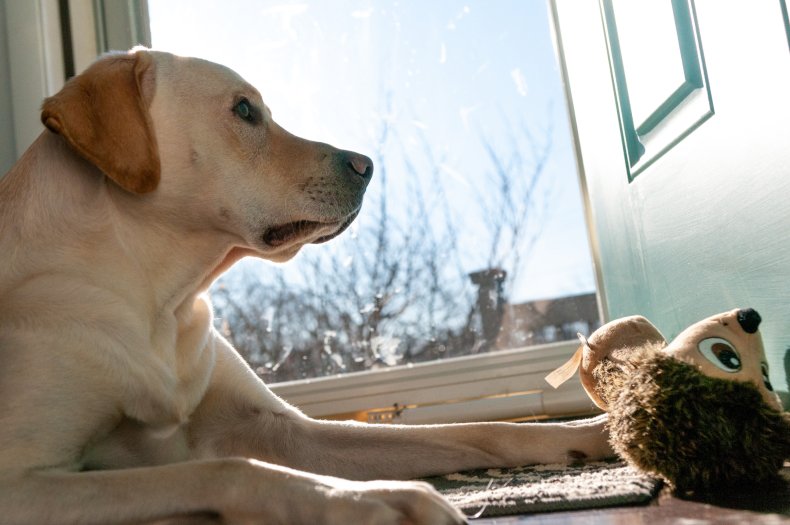
A stock impression of a Labrador doggy by the door with a toy. A movie of a rescue pet who demanded assistance opening a door has long gone viral on TikTok.
Jason Whitman/iStock/Getty Photographs Additionally

When bewildered Henry can be seen having difficulties to get again into his property in Newark, Delaware, from the yard, luckily for us a further canine, called Duke, is readily available to assistance.

The well-known clip shared to a web page dedicated to the canine has 896,300 views considering the fact that it was posted on March 27.

In a review posted in the journal Character Scientific Stories earlier shared by Newsweek, Saara Junttila, and colleagues set 1,002 canines as a result of a sequence of intelligence assessments to evaluate the overall performance of 13 different pet dog breeds.

It turns out Labrador retrievers scored near the bottom in the tests involving challenge-resolving and inhibitory command. On the other hand, this does not imply the Labrador is not intelligent.

In actuality, Henry’s TikTok biography states he is a mixture of two more intelligent canines— husky and shepherd.

The examine observed German shephards had been the third smartest of 13 breeds, which could not shock quite a few as they are good performing puppies who are normally observed with law enforcement forces.

The greatest-performing breed across the check series was the border collie. This is consistent with preceding analysis by Stanley Coren, author of The Intelligence of Canines and professor emeritus at the College of British Columbia’s Division of Psychology.

Even so, Henry’s lack of typical perception isn’t regarded as a undesirable factor as he has supplied his proprietor and the world wide web with a large amount of enjoyment.

The video has racked up 91,000 likes and about 230 reviews.

One consumer claimed: “My 80lb retriever does the very same, in the meantime, my mini poodle would choose a lap close to the property to achieve enough air to SLAM open a entirely shut door.”

Another particular person mentioned: “The way Duke threw his head again like “Oh brother not THIS all over again.”

“Thank god for Duke,” praised 1 viewer, when yet another explained: “Me any time I am mildly inconvenienced in existence.”

It just isn’t just this duo that has delighted the internet—recently Newsweek shared the heartwarming instant two Malamutes were caught on camera waiting for their “very best pal.”

Newsweek attained out to @henry_the_rescue_pup for remark by way of TikTok. We could not confirm the information of the circumstance.

Do you have humorous and lovable video clips or pictures of your pet you want to share? Send them to lifestyle@newsweek.com with some facts about your finest pal and they could show up in our Pet of the Week lineup.

Canadian Animal Health Institute details increases in pet ownership, medicalization

Canadian Animal Health Institute details increases in pet ownership, medicalization

TORONTO, ONTARIO — The Canadian Animal Health and fitness Institute (CAHI) unveiled the effects of its 2022 Pet Population Survey on Sept. 22, detailing rising pet possession all through the region. 4 thousand pet proudly owning homes participated in the nationwide survey, which was done by Kynetec.

In accordance to the details, additional than 50 {08cd930984ace14b54ef017cfb82c397b10f0f7d5e03e6413ad93bb8e636217f} of Canadian homes (60{08cd930984ace14b54ef017cfb82c397b10f0f7d5e03e6413ad93bb8e636217f}) very own at minimum a single puppy or cat. The facts also in depth the expanding pet populace. For 2022, the puppy inhabitants elevated to 7.9 million from 7.7 million in 2020, and the cat populace improved to 8.5 million from 8.1 million in 2020.

“We know that puppies, cats, and other animals can give numerous added benefits for mental health including companionship and coping with nerve-racking conditions,” stated Emily Bond, Ph.D., systems director for CAHI.  “It will come as no shock that the developments demonstrate an increase in both equally the Canadian pet dog and cat populations, with the premier raises going on from 2020 to 2022. It will be intriguing to see if this trend continues, now that lifestyle is returning to the new regular.”

The facts also revealed that the gap between the medicalization of dogs and cats is gradually reducing. In accordance to CAHI, the rate of puppies that frequented a veterinarian remained stable at 86{08cd930984ace14b54ef017cfb82c397b10f0f7d5e03e6413ad93bb8e636217f}, but price for cats enhanced from 58{08cd930984ace14b54ef017cfb82c397b10f0f7d5e03e6413ad93bb8e636217f} in 2020 to 61{08cd930984ace14b54ef017cfb82c397b10f0f7d5e03e6413ad93bb8e636217f} in 2022.

“The development price of the Canadian pet dog and cat populations and the charge of Canadian pets going to the veterinarian carries on to surpass pre-COVID crisis stages,” stated Colin Siren, senior vice president of Kynetec Canada.

In accordance to CAHI, the data demonstrates the purpose COVID-19 performed in growing operator fascination in pet wellness and wellness. However recognition of pet well being is increasing, Canada is battling with labor shortages inside the animal health and fitness market. In accordance to CAHI, the nation at this time has a lack of veterinarians and animal health and fitness professionals, which has hindered some pets from getting healthcare.

“Nearly a single in five pet proprietors desired or needed preventative care in the past 12 months but had been not able to entry it owing to affordability or the inability to get an appointment, among the other factors,” Siren stated. “Despite these worries, veterinary expert services continue to be highly valued.”

As the medicalization rate gap proceeds to near with a lot more cat moms and dads browsing the vet and getting extra informed of their cat’s wellness, Canadian people may possibly obtain an increased desire in pet overall health goods, particularly those people showcasing veterinarian claims and attributes.

Stay up to day on the hottest pet foodstuff processing market headlines on our News page.

Pet insurance: How it works and what it costs

Pet insurance: How it works and what it costs
Older Caucasian veterinarian staring at bulldog
Pet insurance plan can support offset expenses or even include them fully.

LWA/Larry Williams/Mix Images/Getty Visuals


If you have at any time experienced a pet get injured or sick, then you know that vet expenses can increase up quickly. 

Thankfully, pet insurance policy — a style of wellness insurance policies that is just for cats and canine — can assistance offset people expenditures or even deal with them solely.

You can very easily get a quote to see if this is suitable for you.

Do you have a furry mate and never want vet charges draining you dry? Here is what pet insurance coverage does and how it may possibly be ready to enable. 

How does pet insurance policies perform?

Pet insurance coverage is a sort of wellness insurance plan plan you can get for a domestic cat or dog. Like human wellbeing insurance, you pay a regular top quality and, in trade, get protection for a range of medical therapies, prescriptions and at times preventative actions, far too. 

These procedures commonly function on a reimbursement foundation. So, you can expect to pay your vet right and then file a declare with your insurance provider afterward. They’ll then system that claim and reimburse you for the proper sum. Based on your coverage and the therapy, it may well be the entire amount or a proportion of what you were being initially charged. 

In some instances, pet insurance policies policies have a deductible. This suggests you have to pay out a sure amount out of pocket ahead of your insurance provider will contribute.

If this seems like a little something that could benefit you look at delivering some standard details to get a totally free price quote.

How considerably does pet insurance coverage charge?

Pet insurance coverage expenditures change commonly, but with most corporations, you will pay out among $30 to $70 for each month for a pet dog and $15 to $40 for each month for a cat.

The precise selling price you pay out will count on a variety of factors, together with:

  • The form of animal you have
  • Your pet’s breed and gender
  • The age of your pet
  • The place you reside

The insurance policies firm you choose matters, far too, which is why it’s significant to shop all over when finding pet insurance coverage. Generally compare at the very least a handful of quotations to make certain you happen to be having the best offer and protection.

You may well also be able to get pet insurance via an current insurance coverage company you function with (the 1 that gives your motor vehicle insurance, for example). Quite a few providers offer discounts for individuals with numerous protection traces.

What does pet insurance policies deal with?

Coverage differs by insurance company and system but, commonly, pet coverage addresses sudden injuries and emergencies, as nicely as more substantial goods, like operation, for case in point.

This is a glimpse at what most insurance policy firms go over:

  • Mishaps and injuries, like damaged bones, cuts or swallowed objects
  • Health problems, including allergies, infections and diabetic issues
  • Surgical procedure
  • Treatment for heredity and congenital problems, like hip dysplasia, cherry eye or glaucoma
  • Procedure for behavioral challenges, which includes pacing, chewing or licking
  • Different therapy, like acupuncture or chiropractic care
  • Tests and diagnostics, like blood tests, MRIs and X-rays
  • Crisis test costs
  • Most cancers treatment 
  • Sure drugs and prescription meals

Retain in intellect that all pet coverage plans will have protection boundaries — a most volume the insurance provider will lead annually. You can expect to want to keep these in intellect when picking your policy.

What pet insurance coverage won’t protect

Pet insurance plan normally isn’t going to contain plan care, like vaccinations, heartworm/flea preventatives or annual examine-ups — at minimum immediately. Even so, numerous insurers do allow you to incorporate coverage for these items at an further charge. 

Pet insurance plan normally is not going to cover pre-present circumstances either. So if your pet has a documented issue just before you choose out the plan, any remedies connected to it will not be suitable for reimbursement. 

Types of pet insurance coverage

There are a lot of types of pet insurance policy programs. Some insurers present incident-only designs, which only cover remedy for accidents and accidents, like a snake bite or ingesting a poisonous material, for case in point. These tend to be the most budget-helpful choices, as the protection is limited.

Providers commonly supply a extra thorough prepare, much too, which incorporates mishaps and accidents, as well as tests, diagnostics, prescription drugs and a variety of other health-related remedies your vet deems required.

Finally, a lot of insurers also have a program treatment or wellness bundle you can increase as a nutritional supplement to your main coverage. This will go over issues like yearly check-ups, vaccinations, microchipping and additional.

Have a lot more concerns? Look at achieving out to a pet insurance skilled to find out additional.